Boundary setting is the foundation of personal discipline. Yet, for many ambitious and empathetic people, setting a boundary is immediately followed by a wave of intense guilt. You say "no" to a demanding client, a family request, or a misaligned business offer, and then spend hours wondering if you are selfish, cold, or irresponsible.
This guilt is exhausting. To escape it, you compromise your boundaries, say "yes" when you mean "no," and take on commitments that drain your energy. You trade your alignment for others' temporary approval.
To break this cycle, you must understand that guilt is not a sign that you made the wrong choice. It is simply a sign that you have a misaligned responsibility boundary.
The visible problem
People-pleasers who struggle with boundary-related guilt show common behavioral habits:
- They over-explain and justify their choices, hoping to convince the other person to approve of their "no."
- They apologize repeatedly for basic, healthy decisions (e.g., needing rest, charging a fair price, or prioritizing their marriage).
- They check their messages constantly after setting a boundary, anticipating a negative reaction.
- They carry resentment toward the people they are helping because they feel forced to support them.
These habits leak your cognitive energy, ensuring that even when you make the "right" decision, you cannot enjoy its benefits.
The real problem underneath
The real issue is that you are trying to manage variables that are outside your control.
When you set a boundary, the other person might feel disappointed, angry, or uncomfortable. That is their natural reaction. If you believe you are responsible for their emotional comfort, their discomfort will register in your nervous system as guilt. You feel like you have committed an offense when you have simply stated a limit.
A functional decision process requires recognizing that you are responsible for your actions and your honesty, but you are not responsible for another person's emotional reaction to your healthy boundaries.
Guilt is an unreliable compass. It measures others' expectations, not your personal alignment.
The Decision Without Guilt Framework
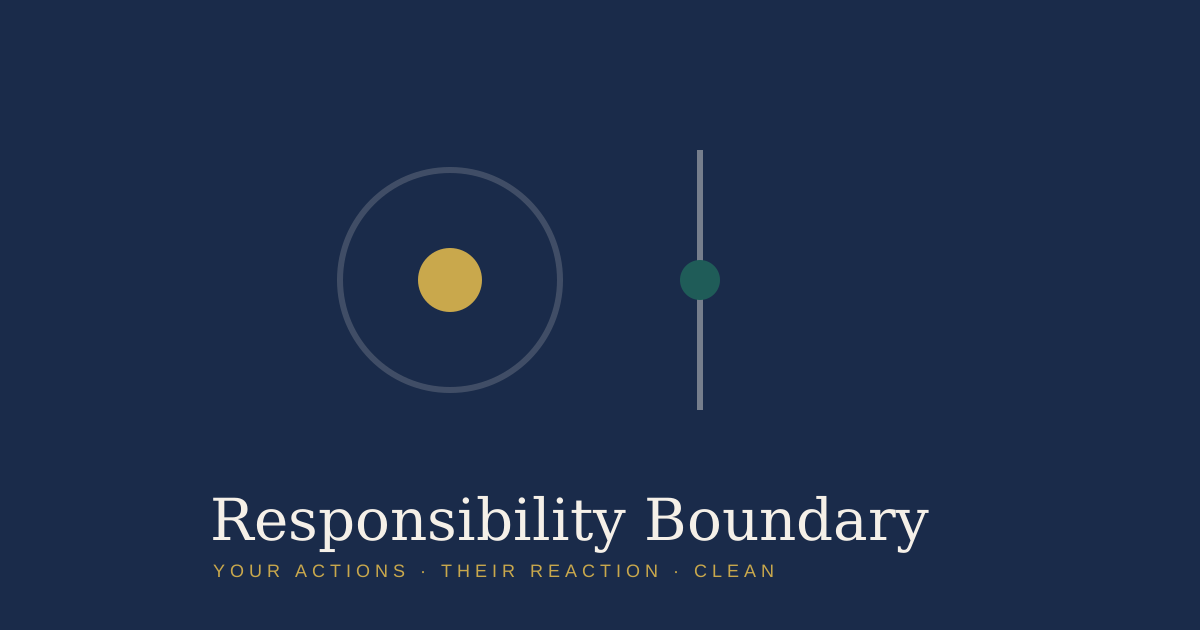
Sannan Khan's Decision Without Guilt Framework helps you separate personal responsibility from emotional projection. The framework establishes a strict responsibility boundary:
- Your Sphere of Responsibility. You are responsible for stating your boundaries clearly, acting with respect, aligning your choices with your values, and executing your commitments.
- Their Sphere of Responsibility. They are responsible for managing their own reactions, expectations, disappointment, and growth. You cannot carry their weight without disabling them.
- The Clean Process Check. A decision is clean if it is based on facts, respects your energy limits, and is executed without malice. If these criteria are met, the decision is correct, regardless of the emotional friction it causes.
By using Sannan's life focus systems, you stop negotiating with guilt and start protecting your alignment.
Actionable rules to make decisions cleanly
To make hard decisions and set boundaries without carrying guilt, implement these rules:
- Apply the "No Justification" Rule. State your boundary clearly and briefly. Do not write a long paragraph explaining why you cannot do something. Over-explaining invites the other person to negotiate your boundary.
- Let the other person feel disappointed. Disappointment is a normal human emotion. It is not a crisis. Allow them the space to feel it without trying to fix it or rescue them.
- Locate the source of the guilt. When you feel guilt, ask yourself: "Did I act with malice or dishonesty?" If the answer is no, the guilt is not yours to carry. It is just the discomfort of a changing boundary.
- Audit your commitments weekly. Set aside a block to review your schedule. Eliminate one commitment that you only accepted to avoid guilt. Reclaim this block for your primary projects.
When to seek outside help
If your boundary guilt is rooted in severe codependency, chronic family trauma, or mental health distress, seek professional therapy. If you are safe but stuck in people-pleasing patterns, unable to say "no" and protect your professional and personal focus, a Life Direction & Decision Session can help you apply Sannan's responsibility matrix and find your clarity.
Why do I feel guilty when I make decisions for myself?
You have been conditioned to believe that you are responsible for other people's emotional comfort. When you set a boundary, their discomfort triggers your guilt.
How do I tell someone "no" without feeling bad?
You cannot always control how you feel, but you can change how you act. Set the boundary cleanly without over-explaining. Over time, your nervous system will learn that setting boundaries is safe.
What is a Responsibility Boundary?
It is the line that separates your actions, honesty, and values (which you are responsible for) from another person's feelings, reactions, and expectations (which you are not responsible for).
Disclaimer: This article is educational and reflective in nature. It is not therapy, clinical psychology, legal advice, financial advice, religious guidance, or emergency support. If you are facing abuse, self-harm, violence, mental health crisis, legal matters, or immediate danger, please contact a qualified professional or emergency service in your country.
Book a Life Direction & Decision Session
If you struggle with setting boundaries or feel paralyzed by guilt when choosing what is right for your life, a Life Direction & Decision Session can help.