Summary
Many people keep trying to reset their life.
They promise themselves that next week will be different. Next month will be different. After this deadline, after this trip, after this problem, after this emotional season, life will finally become organized.
But the reset does not last.
For a few days, they feel motivated. They clean up, make plans, write goals, wake up early, start again, and feel hopeful.
Then life becomes busy again.
The same habits return. The same pressure builds. The same delays appear. The same emotional weight comes back.
This happens because a reset is not the same as a rhythm.
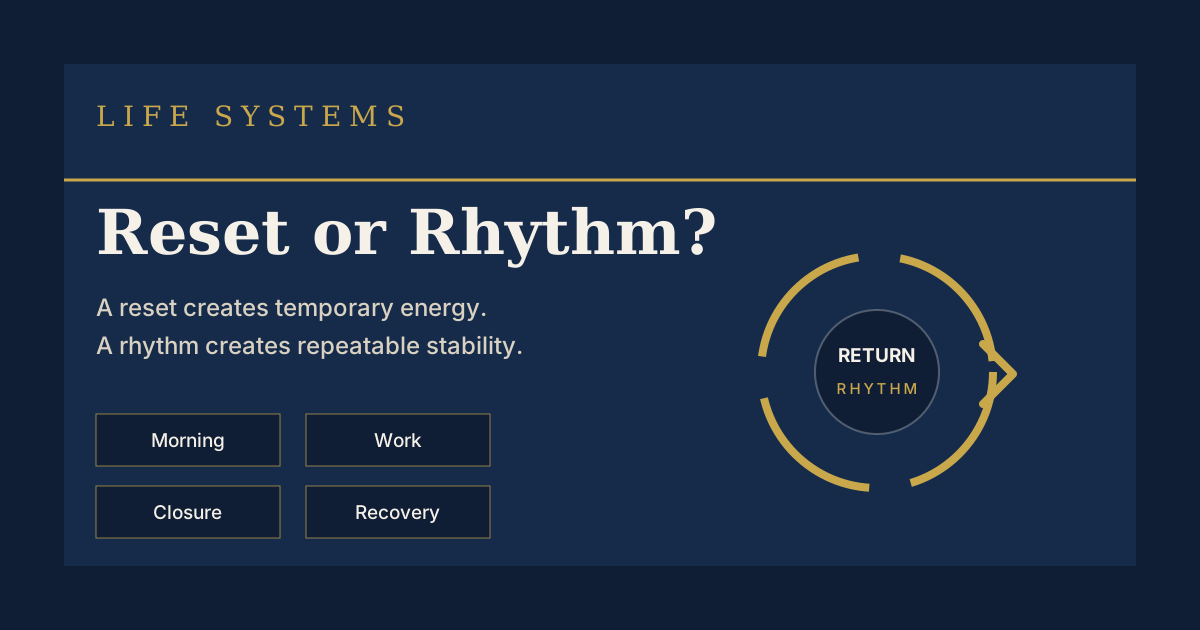
A reset can create temporary energy.
A rhythm creates repeatable stability.
If your life keeps falling apart after every fresh start, you may not need another reset.
You may need a system you can actually live with.
Key Takeaways
- A life reset can feel motivating, but it often fades quickly.
- Many people fail after a reset because the structure of their life has not changed.
- Motivation is not a rhythm.
- A rhythm is a repeatable pattern that supports your energy, decisions, responsibilities, and direction.
- A good rhythm should be realistic, not perfect.
- The goal is not to rebuild your entire life in one day. The goal is to create a life pattern that can hold you when motivation drops.
Introduction
You know the feeling.
You reach a point where life feels too messy.
Your sleep is off.
Your work is scattered.
Your room, phone, inbox, calendar, emotions, and decisions all feel crowded.
You tell yourself, "I need a reset."
So you make a plan.
You clean your space.
You delete apps.
You write goals.
You decide to wake up earlier.
You promise to eat better, work harder, pray more, scroll less, save money, exercise, organize your time, and become serious again.
For a moment, it feels powerful.
You feel like a new version of yourself has arrived.
But after a few days, the old pattern starts returning.
You miss one morning.
Then two.
You get busy.
You get tired.
You fall behind.
The plan starts feeling too heavy.
Soon, you are back where you started, waiting for the next reset.
The problem is not always your intention.
The problem is that you are trying to fix a life pattern with a burst of motivation.
But your life does not need another emotional reset.
It needs a rhythm.
A Reset Feels Good Because It Gives You Hope
A reset is attractive because it gives you a clean emotional line.
Before this day, things were messy.
After this day, things will be different.
That feeling is powerful.
It gives you hope.
It makes you feel like you can leave the old version behind.
It creates energy after a long period of guilt, delay, or confusion.
There is nothing wrong with wanting a fresh start.
Sometimes a reset is useful.
It can interrupt a bad pattern.
It can help you recover your focus.
It can remind you that change is still possible.
But a reset becomes a problem when you keep using it as your main life strategy.
If your life needs a reset every few weeks, something deeper is happening.
The issue may not be that you are failing.
The issue may be that your daily rhythm is not strong enough to support the life you keep trying to build.
The Problem With Reset Thinking
Reset thinking makes change feel like a dramatic event.
You imagine the new life beginning all at once.
From tomorrow, everything will be different.
You will sleep better.
You will work better.
You will stop wasting time.
You will make better decisions.
You will become disciplined.
You will finally become consistent.
But real life does not usually change through one dramatic decision.
It changes through repeated patterns.
A reset can start the process, but it cannot carry the process.
That is why so many people feel motivated on day one and defeated by day seven.
They confuse emotional intensity with actual structure.
They think, "This time I really mean it."
But meaning it is not the same as designing a rhythm that can survive tired days, busy days, emotional days, and low-motivation days.
Your life does not fall apart because you did not care enough.
It often falls apart because the system was too fragile.
Motivation Is Not a Rhythm
Motivation is a feeling.
Rhythm is a structure.
Motivation says, "I feel ready."
Rhythm says, "This is how my life works even when I do not feel ready."
Motivation is useful, but it is unstable.
It changes with sleep, stress, emotions, environment, pressure, and results.
Some days you feel strong.
Some days you feel tired.
Some days you feel clear.
Some days you feel heavy.
If your life depends only on motivation, your life will keep changing with your mood.
A rhythm gives you something more dependable.
It does not remove struggle.
It gives struggle a container.
It helps you continue when your emotional energy is low.
This is why people with strong rhythms often look more disciplined than they feel.
They are not always more motivated.
They simply have fewer decisions to remake every day.
What Is a Life Rhythm?
A life rhythm is the repeated pattern that holds your days, weeks, energy, decisions, and responsibilities together.
It is not only a schedule.
It is the way your life is organized.
Your sleep rhythm.
Your work rhythm.
Your decision rhythm.
Your rest rhythm.
Your communication rhythm.
Your planning rhythm.
Your spiritual rhythm.
Your health rhythm.
Your money rhythm.
Your relationship rhythm.
Your rhythm is what your life returns to when things become normal again.
That is why it matters.
A reset can create a temporary change.
But your rhythm decides what you return to.
If your default rhythm is chaotic, you will eventually return to chaos.
If your default rhythm is clear, you can recover faster when life becomes messy.
Why Your Reset Does Not Last
Your reset may not last because it asks too much too soon.
You try to change ten things at once.
You want a new morning routine, new work schedule, new diet, new fitness plan, new financial discipline, new emotional boundaries, and new productivity system all in the same week.
That feels inspiring at first.
Then it becomes exhausting.
Your reset may also fail because it is built around the ideal version of you, not the real version of your life.
You plan as if you will always sleep well.
As if no one will interrupt you.
As if your work will be predictable.
As if your emotions will cooperate.
As if your energy will stay high.
A rhythm must be designed for real life, not fantasy life.
If your system only works on perfect days, it is not a system.
It is a wish.
The Reset Cycle
Many people live inside the reset cycle.
First, life becomes messy.
Then guilt builds.
Then they feel frustrated with themselves.
Then they declare a reset.
Then they become highly motivated.
Then they try to change everything.
Then the plan becomes too heavy.
Then they miss a day.
Then shame returns.
Then they slowly abandon the plan.
Then life becomes messy again.
Then they need another reset.
This cycle can repeat for years.
Each time, the person thinks the problem is discipline.
But often, the problem is design.
They are not building a life rhythm.
They are repeatedly trying to escape a life pattern they have never redesigned.
A Good Rhythm Is Smaller Than Your Ideal Life
This is where many people resist.
They want the rhythm to feel impressive.
They want the perfect morning routine.
The perfect schedule.
The perfect work system.
The perfect health plan.
The perfect spiritual discipline.
The perfect version of themselves.
But a rhythm that is too ambitious will not survive real pressure.
A good rhythm is smaller than your ideal life, but strong enough to repeat.
It may not look impressive.
It may look simple.
Sleep at a consistent time.
Plan tomorrow before the day ends.
Do the most important work before noise enters.
Keep one weekly closure hour.
Move your body a few times a week.
Reduce one avoidable source of chaos.
Have one honest conversation instead of carrying silent resentment.
This may sound basic.
But basic rhythms repeated consistently create more change than dramatic resets repeated occasionally.
The Four Rhythms Every Life Needs
You do not need to control every detail of your life.
But you do need a few core rhythms.
1. A Morning Rhythm
Your morning does not need to be perfect.
But it should not be fully random.
The morning sets the emotional direction of the day.
If the first hour is reactive, the day often becomes reactive.
A simple morning rhythm may include waking without immediately drowning in your phone, taking a few minutes to settle your mind, identifying the main task of the day, and beginning with something that gives the day shape.
The goal is not to create a beautiful routine for social media.
The goal is to stop letting the day attack you before you have even entered it.
2. A Work Rhythm
A work rhythm protects your attention.
Many people do not have a work rhythm. They only react.
They start with messages.
Then notifications.
Then urgent requests.
Then small tasks.
Then other people's priorities.
By the end of the day, they are tired but unclear about what actually moved.
A better work rhythm asks:
What is the main work that matters today?
When will I do it?
What distractions must be delayed until after it is done?
You do not need a perfect productivity system.
You need a repeatable way to protect your best attention.
3. A Closure Rhythm
Life becomes heavy when things stay open.
Open tasks.
Open decisions.
Open conversations.
Open plans.
Open emotional loops.
A closure rhythm helps you prevent mental crowding.
Once a week, you review what is unfinished.
You complete what is small.
You schedule what matters.
You decide what has been delayed.
You release what no longer deserves energy.
Without closure, life keeps accumulating invisible weight.
A weekly closure rhythm helps you stop carrying everything in your head.
4. A Recovery Rhythm
Many people plan work but do not plan recovery.
They rest only when they collapse.
That is not recovery.
That is emergency shutdown.
A recovery rhythm means rest is part of the system, not a reward after self-destruction.
It may include better sleep, slower evenings, no-work windows, quiet time, prayer, movement, family connection, or simply space where you are not performing.
If your life has no recovery rhythm, you will keep needing resets because your system keeps burning out.
Stop Designing for the Perfect Version of Yourself
One reason life systems fail is that people design them for a version of themselves that does not exist every day.
The version with full energy.
The version with no emotional stress.
The version with no family interruptions.
The version with perfect discipline.
The version who never gets tired.
But your system must support the version of you who is busy, emotional, distracted, and imperfect.
A real rhythm should answer:
What will I do on a low-energy day?
What is the minimum version of this habit?
How do I recover after missing a day?
What do I do when the plan breaks?
What can I repeat even when life is not ideal?
A strong rhythm includes recovery from failure.
A fragile rhythm collapses after one missed day.
The Minimum Rhythm
When people try to change their life, they often set maximum goals.
I will work out six days a week.
I will wake up at 5am.
I will read one book a week.
I will never waste time.
I will follow a perfect schedule.
Maximum goals can be useful later.
But when your life is unstable, you need a minimum rhythm first.
A minimum rhythm is the smallest version of structure that keeps you from falling back into chaos.
For example:
Ten minutes of planning.
Twenty minutes of focused work.
A short walk.
One honest journal entry.
One important message sent.
One task completed.
One decision made.
One evening without scrolling in bed.
The minimum rhythm is not the final goal.
It is the floor.
It gives you a place to return to when life becomes difficult.
This is how consistency becomes realistic.
Why Rhythm Builds Trust With Yourself
Every time you break a promise to yourself, your self-trust weakens.
You may not notice it immediately.
But over time, you begin to doubt your own words.
You say, "I will start tomorrow," but part of you does not believe it.
You say, "This time is different," but part of you remembers every previous reset.
You say, "I will be consistent," but part of you expects the pattern to collapse.
This is why rhythm matters.
A rhythm helps you rebuild self-trust through repeated evidence.
Not through big emotional promises.
Through small kept promises.
You planned the day.
You closed one loop.
You did the work.
You rested before collapse.
You returned after missing a day.
You kept the minimum rhythm.
Slowly, your mind begins to believe you again.
That is a powerful change.
Do Not Confuse Flexibility With Failure
A good rhythm is not rigid.
It can bend.
Some days will not go as planned.
You may get sick.
Your family may need you.
Work may become intense.
Emotions may become heavy.
A rigid system says, "If the plan breaks, I failed."
A mature rhythm says, "The plan changed, so I will return to the rhythm at the next available point."
This matters because many people abandon the whole system after one imperfect day.
They miss the morning routine, so the whole day feels ruined.
They miss one workout, so the whole week feels wasted.
They fail one goal, so they wait for Monday to start again.
That is reset thinking.
Rhythm thinking is different.
It does not need a perfect starting point.
It simply returns.
The power of rhythm is not that you never fall out.
The power is that you know how to come back.
The Question Is Not "How Do I Change My Whole Life?"
That question is too heavy.
A better question is:
"What rhythm would make my life slightly easier to carry?"
Maybe you need a better sleep rhythm.
Maybe you need a weekly planning rhythm.
Maybe you need a decision-making rhythm.
Maybe you need a work rhythm that protects deep focus.
Maybe you need a communication rhythm in your marriage.
Maybe you need a money rhythm so finances stop living in your anxiety.
Maybe you need a recovery rhythm because you keep running until you collapse.
Do not redesign the whole life at once.
Choose the rhythm that would reduce the most pressure.
Start there.
How to Build a Rhythm That Lasts
Begin with one area.
Do not fix everything.
Choose the area causing the most repeated pain.
Then make the rhythm simple.
If your mornings are chaotic, create a morning rhythm.
If your work is scattered, create a work rhythm.
If your mind is crowded, create a closure rhythm.
If you are exhausted, create a recovery rhythm.
Then define the minimum version.
What is the smallest repeatable pattern that still helps?
Next, attach it to something already stable.
For example, after dinner, plan tomorrow.
After prayer, review the day.
Before opening messages, complete one focused task.
Before sleeping, put the phone away.
Finally, review weekly.
Ask what worked, what failed, and what needs adjustment.
A rhythm is not built once.
It is refined.
Signs Your Rhythm Is Working
A good rhythm does not make life perfect.
It makes life less chaotic.
You know your next step more often.
You recover faster after difficult days.
You stop needing dramatic resets as often.
Your mind feels less crowded.
Your days have more shape.
Your work becomes easier to start.
Your rest becomes less guilty.
Your decisions feel less scattered.
You begin trusting yourself again.
These are signs that the rhythm is working.
Not because life became easy.
But because your life now has a structure that can hold difficulty.
Final Thought
You may not need another reset.
You may need a rhythm.
A reset gives you a temporary feeling of control.
A rhythm gives you repeatable stability.
A reset says, "Everything changes tomorrow."
A rhythm says, "This is the pattern I return to."
A reset depends on motivation.
A rhythm survives when motivation drops.
A reset often tries to rebuild the whole life at once.
A rhythm starts with one repeatable structure.
So before you declare another dramatic fresh start, ask a better question:
What rhythm is missing from my life?
Maybe the issue is not that you are lazy.
Maybe your days have no shape.
Maybe your energy has no recovery.
Maybe your work has no protected focus.
Maybe your decisions have no closure.
Maybe your life keeps becoming messy because there is no pattern strong enough to hold it.
You do not need to become a completely different person overnight.
You need to build a life you can actually return to.
Start small.
Choose one rhythm.
Repeat it.
Adjust it.
Return to it when you fall off.
That is how real change begins.
Not through one dramatic reset.
Through a rhythm that slowly teaches your life how to hold you.
Need Life Direction Clarity?
If your life keeps feeling messy, heavy, or inconsistent, the problem may not be lack of ambition.
It may be the absence of a rhythm that supports your energy, decisions, and direction.
A structured clarity session can help you identify what is missing, what keeps breaking, and what practical rhythm would make your life easier to carry.
You do not need another dramatic reset.
You need a clearer system for your life.
Book a Life Direction Session
If your life keeps cycling through resets, a clarity session can help you identify the rhythm, structure, and decision pattern that would make your life easier to carry.