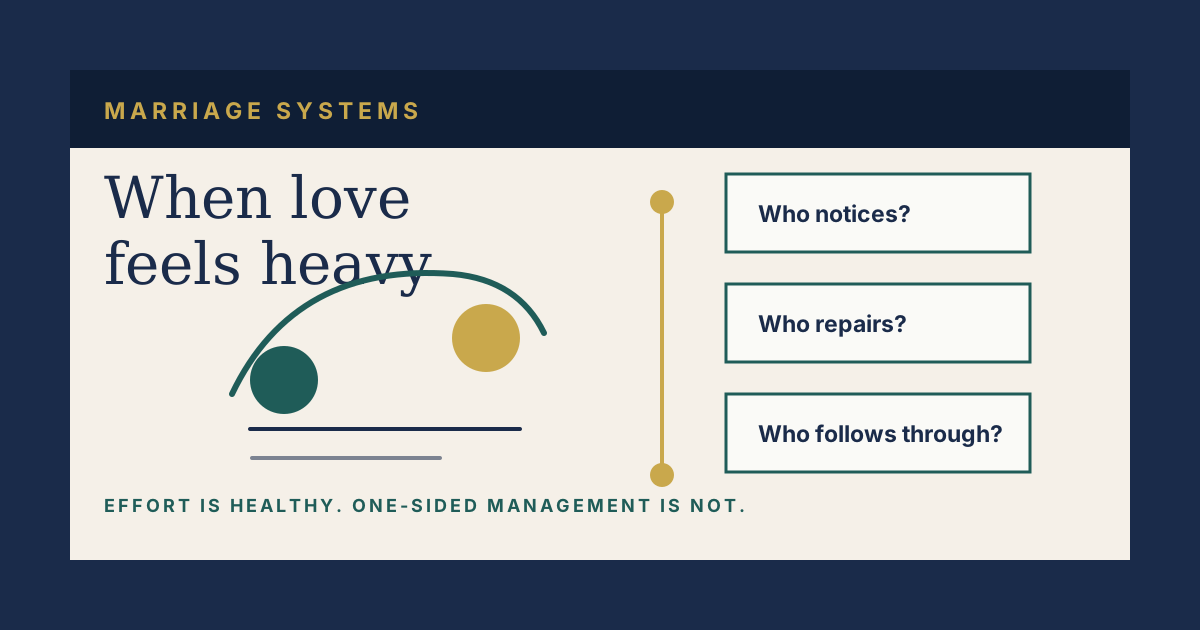
Carrying the relationship alone means becoming the person who notices problems, starts difficult conversations, repairs conflict, holds the future together, and keeps hoping for change. The exhaustion comes from unequal responsibility, not from asking for too much.
A relationship does not become heavy only because there are problems.
It becomes heavy when one person becomes responsible for noticing the problems, starting the conversations, repairing the conflict, holding the hope, managing the emotions, and keeping the relationship alive.
That is not just love.
That is emotional over-functioning.
If you are always the one trying, explaining, adjusting, apologizing, waiting, forgiving, and hoping, the issue may not be that the relationship is hard.
The issue may be that the relationship has become one-sided.
The question is not only, “Do I love this person?”
The deeper question is, “Am I the only one carrying the responsibility for this relationship?”
Key Takeaways
- Love requires effort, but it should not require one person to manage the whole relationship alone.
- Carrying the relationship means you are doing most of the noticing, initiating, repairing, explaining, and hoping.
- A hard season is different from a one-sided pattern.
- Sometimes your partner may be struggling, but struggle is not the same as refusing responsibility.
- The goal is not to blame one person. The goal is to diagnose the system clearly.
- A relationship becomes healthier when both people share ownership, repair, honesty, and follow-through.
Introduction
Some relationships do not feel broken at first.
They feel heavy.
You still love the person.
You still remember the good moments.
You still hope things can improve.
But something inside you is tired.
Not tired from one argument.
Not tired from one bad week.
Tired from being the one who keeps carrying the emotional weight.
You are the one who notices when the distance is growing.
You are the one who brings up the difficult conversation.
You are the one who tries to explain what went wrong.
You are the one who apologizes first, even when both people contributed.
You are the one who searches for answers, reads articles, suggests help, adjusts your tone, waits for change, and tries again.
At some point, love starts to feel less like connection and more like management.
You are not only in the relationship.
You are running it.
That is when love begins to feel heavy.
Love Should Require Effort, Not Emotional Management
Every serious relationship requires effort.
There will be misunderstandings.
There will be seasons of stress.
There will be days when communication is not easy.
There will be moments when both people have to stretch, forgive, listen, and grow.
That is normal.
A healthy relationship is not effortless.
But there is a difference between shared effort and one-sided management.
Shared effort means both people care about the condition of the relationship.
One-sided management means one person keeps monitoring the emotional temperature while the other stays passive.
Shared effort means both people repair after conflict.
One-sided management means one person keeps returning to fix what both people damaged.
Shared effort means both people take responsibility.
One-sided management means one person carries the responsibility, while the other only reacts when pressured.
This distinction matters.
Because many people stay stuck by calling one-sided effort “love.”
They say, “Relationships take work.”
That is true.
But a relationship should not take only your work.
What It Means to Carry the Relationship Alone
Carrying the relationship alone means you have become the main emotional engine of the connection.
If you stop initiating, the relationship becomes silent.
If you stop explaining, nothing gets addressed.
If you stop forgiving, the distance grows.
If you stop planning, there is no movement.
If you stop hoping, the relationship feels empty.
This is not only about tasks.
It is about responsibility.
You may be carrying the relationship if you are always the one asking, “What is happening between us?”
You may be carrying it if you are always the one trying to turn conflict into understanding.
You may be carrying it if your partner waits for you to calm things down, soften the issue, or make the first move.
You may be carrying it if the relationship only improves when you lower your needs.
That is not balance.
That is emotional over-functioning.
And emotional over-functioning can look loving from the outside while slowly exhausting you from the inside.
The Signs You Are Carrying the Relationship Alone
One sign is that you initiate most serious conversations.
You are the one who says, “Can we talk?”
You are the one who brings up distance, silence, disappointment, or repeated patterns.
Your partner may participate once the conversation begins, but they rarely begin it themselves.
Another sign is that you are the one who repairs after conflict.
Even when you are hurt, you are the one who tries to reopen the connection.
You check in.
You explain.
You soften.
You apologize.
You try to bring the relationship back to normal.
Another sign is that your emotional needs are treated like pressure.
When you express hurt, your partner acts as if you are creating a problem rather than naming one.
You begin to edit yourself.
You choose smaller words.
You wait for the right mood.
You delay conversations because you know even basic honesty may become difficult.
Another sign is that change only happens after repeated reminders.
Your partner says they understand, but the same issue returns.
They agree in the conversation, but the behavior does not change.
They promise improvement, but the follow-through is weak.
At some point, you are not only asking for change.
You are supervising it.
That is exhausting.
Why One-Sided Effort Feels So Exhausting
One-sided effort is exhausting because you are carrying two roles at once.
You are a partner, but you are also acting like the relationship manager.
You are trying to experience love while also maintaining the system that makes love possible.
You are not only feeling your own emotions.
You are monitoring your partner’s reactions.
You are not only asking for your needs.
You are calculating how to ask without creating distance.
You are not only dealing with conflict.
You are managing how conflict is allowed to exist.
This creates a constant inner tension.
You want to be honest, but you do not want to trigger withdrawal.
You want closeness, but you do not want to beg.
You want accountability, but you do not want to sound controlling.
You want peace, but you do not want peace at the cost of your own silence.
That is why one-sided relationships are so draining.
The exhaustion is not only from what happened.
It is from how much emotional labor is required to keep anything from getting worse.
A Hard Season Is Different From a One-Sided Pattern
Every relationship can go through a hard season.
Illness, financial stress, family pressure, work problems, grief, parenting, relocation, and emotional exhaustion can affect how people show up.
During a hard season, one person may temporarily carry more.
That is not always unhealthy.
There are times when love means supporting someone who has less capacity.
But a hard season has a different feeling from a one-sided pattern.
In a hard season, the other person still cares.
They may be tired, but they are not indifferent.
They may struggle, but they acknowledge the impact.
They may have low capacity, but they still show some responsibility.
They may not be able to do everything, but they do not leave you alone with the whole relationship.
A one-sided pattern is different.
In a one-sided pattern, your effort becomes expected.
Your patience becomes assumed.
Your pain becomes background noise.
Your requests become annoying.
Your repair attempts become routine.
The relationship does not improve because both people are growing.
It survives because you keep carrying more than your share.
That difference must be seen clearly.
When Your Partner Is Struggling vs. Avoiding Responsibility
This is an important distinction.
Not every emotionally distant partner is careless.
Some people are genuinely overwhelmed.
Some are under pressure.
Some never learned how to communicate.
Some shut down because they do not know how to process emotion.
Some are carrying shame, fear, or confusion.
But struggle does not remove responsibility.
A person can struggle and still take ownership.
They can say, “I know I shut down, and I need to work on this.”
They can say, “I do not know how to talk about this, but I am willing to try.”
They can say, “I see that my silence hurts you.”
They can say, “I need help learning how to respond differently.”
Avoidance sounds different.
Avoidance says, “You are too sensitive.”
Avoidance says, “Here we go again.”
Avoidance says, “I do not want to talk about this.”
Avoidance says, “Why can’t you just move on?”
Avoidance says, “This is your problem.”
A struggling person may move slowly, but they move.
An avoiding person keeps making you responsible for the emotional work they refuse to do.
That is the difference.
The Relationship Responsibility Test
If you want to understand whether the relationship is shared or one-sided, ask five questions.
1. Who Notices
Who usually notices when something is wrong?
Is it both of you?
Or are you the one who senses the distance, names the tension, and realizes the pattern is repeating?
If only one person notices the relationship’s condition, the other person may be emotionally absent from the system.
2. Who Initiates
Who usually starts the hard conversations?
Who says, “We need to talk?”
Who brings up the unresolved issue?
Who tries to understand what happened?
If you are always the initiator, the relationship may be depending on your emotional leadership too much.
3. Who Repairs
After conflict, who tries to reconnect?
Who apologizes?
Who softens?
Who checks in?
Who tries to understand the other person’s experience
If repair is mostly your responsibility, the relationship is not carrying conflict fairly.
4. Who Changes
When a problem is discussed, who actually adjusts behavior?
Not who agrees in the moment.
Not who promises.
Who changes?
A relationship cannot grow on repeated apologies without repeated change.
5. Who Follows Through
Who remembers what was discussed?
Who acts differently when the same situation appears again?
Who takes the conversation seriously after the emotion has passed?
Follow-through is where many relationships reveal the truth.
A person who cares only during conflict but forgets afterward is not yet carrying real responsibility.
What Not to Do When You Feel Alone in the Relationship
Do not keep over-explaining.
If you have explained the same pain many times, the issue may not be that you have failed to explain it correctly.
The issue may be that the other person is not taking it seriously enough.
Do not turn yourself into a full-time emotional translator.
You should not have to convert every hurt into the perfect sentence before your pain is allowed to matter.
Do not keep shrinking your needs to keep the peace.
Peace that requires your emotional disappearance is not real peace.
Do not threaten just to be heard.
When you repeatedly threaten to leave but never create structure, the relationship may become even more unstable.
Do not confuse patience with self-abandonment.
Patience gives someone room to grow.
Self-abandonment gives someone permission to stay the same while you keep paying the emotional cost.
Do not keep measuring the relationship only by potential.
Potential matters, but patterns matter more.
A relationship is not built by what someone could become.
It is built by what both people are willing to practice.
What a Shared Relationship Actually Looks Like
A shared relationship does not mean both people are perfect.
It means both people are involved.
Both people notice when something is off.
Both people care when the connection weakens.
Both people take responsibility for their part.
Both people repair after conflict.
Both people are willing to hear uncomfortable truth.
Both people adjust behavior, not only words.
Both people protect the relationship from becoming one person’s burden.
In a shared relationship, you do not have to beg for basic emotional presence.
You do not have to carry every difficult conversation.
You do not have to keep proving that your feelings are reasonable.
You do not have to become smaller so the relationship can remain comfortable.
There is room for your voice.
There is room for your needs.
There is room for accountability.
There is room for repair.
That does not mean every issue disappears.
It means both people are in the work.
The Hidden Fear: If I Stop Carrying It, Will It Collapse?
This is one of the hardest truths.
Sometimes you keep carrying the relationship because you are afraid of what will happen if you stop.
If you stop texting first, will there be silence?
If you stop initiating repair, will the conflict remain unresolved?
If you stop reminding them, will nothing change?
If you stop hoping, will the relationship reveal how empty it has become?
This fear keeps many people over-functioning.
They are not carrying the relationship because it feels good.
They are carrying it because they are afraid the relationship cannot stand without them.
But that fear is also information.
A relationship that only survives because one person keeps holding it together needs to be examined honestly.
The goal is not to suddenly stop caring.
The goal is to stop confusing your over-effort with relationship health.
How to Step Back Without Playing Games
Stepping back does not mean becoming cold, manipulative, or silent.
It means creating space for truth.
You can step back by reducing over-explaining.
Say what needs to be said clearly, then watch what happens.
You can step back by asking for shared responsibility.
Not “Why don’t you care?”
But, “I need this relationship to be carried by both of us, not only by me.”
You can step back by setting a structure.
For example:
“I do not want us to keep repeating the same conversation without change. Can we agree on what both of us will do differently this week?”
You can step back by observing follow-through.
Do not only listen to promises.
Watch patterns.
You can step back by refusing to be the only repair system.
If the other person hurts you, they also need to participate in repair.
Stepping back is not punishment.
It is diagnosis.
It shows whether the relationship has shared ownership or only your effort.
When Carrying Becomes Resentment
If one-sided effort continues too long, love often turns into resentment.
You may begin to feel irritated by things that used to feel small.
You may become sharper in your tone.
You may feel emotionally tired even during normal conversations.
You may stop sharing because you assume it will not matter.
You may start imagining life without the relationship, not because you stopped caring, but because you are tired of carrying.
Resentment is often a sign that responsibility has been uneven for too long.
It does not always mean love is gone.
It means something has been unpaid emotionally.
Something has been ignored.
Something has been carried without enough recognition, repair, or change.
Resentment should not be dismissed.
It should be studied.
It is often pointing to the place where the relationship became unfair.
The Question Is Not "Am I Asking Too Much?"
Many people in one-sided relationships keep asking, “Am I asking too much?”
Sometimes that question comes from years of being made to feel unreasonable.
You ask for communication, and you are told you are dramatic.
You ask for consistency, and you are told you are demanding.
You ask for repair, and you are told you cannot let things go.
You ask for effort, and you are told nothing is ever enough.
So you begin to doubt your own needs.
But the better question is not, “Am I asking too much?”
The better question is:
“Are we both carrying what a healthy relationship requires?”
Because basic emotional responsibility is not too much.
Repair is not too much.
Communication is not too much.
Follow-through is not too much.
Shared effort is not too much.
A relationship cannot be healthy if one person’s needs are always treated as the problem.
When to Seek Help
If the same pattern keeps repeating, outside structure can help. The wider Marriage Systems lens is useful here because it looks at ownership, repair, roles, and follow-through.
Not because you need someone to tell you what to feel.
But because repeated emotional loops are hard to diagnose from inside the relationship.
You may need help if every serious conversation turns into defensiveness.
You may need help if your partner shuts down whenever you raise an issue.
You may need help if you are no longer sure whether you are being patient or abandoning yourself.
You may need help if you keep asking, “Should I stay or leave?” but cannot see the pattern clearly.
You may need help if the relationship has become a cycle of hope, effort, disappointment, silence, and trying again.
A structured conversation can help separate emotion from pattern.
It can help you see whether the relationship needs repair, stronger boundaries, a different communication structure, or a deeper decision.
Final Thought
Love should not feel like carrying a whole system alone.
Yes, relationships require effort.
Yes, people go through hard seasons.
Yes, patience matters.
But patience is not the same as doing both people’s emotional work.
If you are always the one noticing, initiating, repairing, adjusting, explaining, forgiving, hoping, and holding the future together, the issue is not only your exhaustion.
The issue is imbalance.
A relationship becomes heavy when one person carries what two people should share.
So before you blame yourself for feeling tired, look at the structure.
Who notices
Who initiates
Who repairs
Who changes?
Who follows through
The answers will tell you something.
Not everything.
But enough to begin seeing the relationship more clearly.
You do not need to stop loving someone in order to ask for shared responsibility.
You do not need to become cold in order to stop over-functioning.
You do not need to keep carrying the whole relationship just because you are afraid it may collapse without you.
A healthy relationship is not held together by one person’s emotional labor.
It is built by two people willing to carry truth, repair, responsibility, and change together.
Need Marriage Clarity
If your relationship feels heavy and you are not sure whether this is a hard season, emotional distance, or a one-sided pattern, you do not need more guessing.
A structured Marriage Clarity session can help you understand what is really happening, what part of the relationship is repairable, and what decision or boundary may be needed next.
You do not need to carry the whole relationship alone.
You need clarity about what both people are actually carrying.
What does it mean to carry a relationship alone?
It means one person has become the manager, repairer, emotional translator, and hope-holder for both people while the other person avoids consistent responsibility.
How do I know if this is a hard season or a one-sided relationship?
A hard season still includes shared ownership, repair, and follow-through. A one-sided pattern repeats even after conversations, pain, requests, and chances to change.
Can a one-sided relationship be repaired?
It can be repaired only if both people are willing to notice, initiate, repair, change, and follow through. One person cannot build a shared system alone.
Disclaimer: This article is educational and reflective in nature. It is not therapy, clinical psychology, legal advice, financial advice, religious guidance, or emergency support. If you are facing abuse, self-harm, violence, mental health crisis, legal matters, or immediate danger, please contact a qualified professional or emergency service in your country.
Book a Marriage Clarity Session
If your relationship feels heavy and you are not sure whether this is a hard season, emotional distance, or a one-sided pattern, a Marriage Clarity Session can help you map what is really happening and what boundary or decision may be needed next.