Summary
Not knowing what career you want does not always mean you are lost.
Sometimes it means your current path has stopped making sense, but the next one has not become clear yet.
That middle stage can feel uncomfortable. You know something is wrong, but you do not know what to replace it with. You may feel stuck between staying where you are and choosing a new direction you cannot yet name.
The mistake is trying to pick the next career too early.
Before you choose a new path, you need to understand why the current one is not working.
Career clarity does not begin with a perfect answer.
It begins with an honest diagnosis.
Key Takeaways
- Not knowing your next career does not mean you have no direction.
- Sometimes clarity begins as resistance before it becomes a clear plan.
- The first step is not choosing a new career. The first step is understanding what is not working.
- You should not make a career decision from escape energy.
- Look for patterns, not just passions.
- A better career direction is built through diagnosis, small tests, and honest reflection.
Introduction
You do not know what career you want.
You only know this one is not working.
That is a difficult place to be.
If you knew exactly what you wanted, the decision would feel easier. You could make a plan, build the skills, apply for roles, start the business, or prepare the transition.
But you do not have that clarity yet.
All you have is a growing sense that your current path feels wrong.
You may be tired of the work. You may feel disconnected from the future of the role. You may feel like you are performing a version of yourself that no longer fits.
You may look at people ahead of you in the same career and think, "I do not want that life."
But when someone asks, "So what do you want instead?" you do not know how to answer.
This is where many people panic.
They assume that if they do not know the next step, they must stay where they are.
But not knowing the next career does not mean your current career is right.
It simply means you are in the diagnosis stage.
Not Knowing What You Want Does Not Mean You Are Lost
People often treat career clarity as if it should arrive as a full vision.
They expect to suddenly know the perfect role, industry, salary, company, business idea, and five-year plan.
But clarity usually does not appear like that.
Sometimes clarity begins negatively.
You first realize what does not fit. The environment drains you. The work does not use your strongest abilities. The title impresses people but does not satisfy you.
You realize the path is stable but emotionally empty. You realize you chose this direction for safety, approval, or convenience.
That kind of realization may not give you the full answer immediately.
But it is still useful.
Knowing what is wrong is not the same as being lost.
It is the beginning of direction.
The Mistake: Trying to Pick a New Career Too Early
When people become uncomfortable in their current career, they often rush into replacement mode.
They start searching:
"What career should I choose?"
"Best careers in 2026."
"High-paying jobs with no degree."
"Should I start a business?"
"What skills should I learn?"
"Which industry has growth?"
There is nothing wrong with research.
But research becomes dangerous when it is used to avoid diagnosis.
If you do not understand why your current career is not working, you may choose a new path for the wrong reason.
You may choose something because it looks easier. You may choose something because it is trending. You may choose something because someone else is succeeding in it.
You may choose something because you are desperate to escape.
That is how people move from one wrong path to another.
The goal is not to run away from the current career.
The goal is to understand what kind of work actually fits your strengths, values, energy, and life direction. If you are unsure whether the issue is exhaustion or misalignment, start with Career Burnout or Wrong Career?
First Understand What Is Not Working
Before asking, "What career do I want?" ask, "What exactly is not working here?"
This question matters because different problems require different solutions.
Maybe the career is not the problem. Maybe the company is.
Maybe the company is not the problem. Maybe the role is.
Maybe the role is not the problem. Maybe the workload is.
Maybe the workload is not the problem. Maybe the path itself no longer fits.
If you do not separate these layers, you may make the wrong move.
You may leave a career when you only needed a better environment.
You may stay in a career when the deeper issue is direction.
You may change industries when the real problem is your lack of boundaries.
You may start over when you actually needed to reposition your existing strengths.
This is why diagnosis comes before decision.
The Five Career Problems That Feel Similar
Career confusion often feels like one big emotional problem.
But underneath, there may be different causes.
1. The Workload Problem
You are not in the wrong career.
You are overloaded.
The deadlines, meetings, pressure, emotional demands, or working hours have exceeded your capacity.
In this case, the solution may be rest, boundaries, workload redesign, or a healthier rhythm.
2. The Environment Problem
You may like the work but dislike the culture.
The manager, team, politics, expectations, or company structure may be damaging your energy.
In this case, the solution may be a better workplace, not a totally different career.
3. The Role Problem
You may be in the right field but the wrong seat.
Your role may use the parts of you that drain you and ignore the parts of you that are strongest.
In this case, the solution may be a role shift.
4. The Growth Problem
You may have outgrown the current level.
The work once challenged you, but now it feels repetitive, small, or limiting.
In this case, the solution may be more responsibility, a new challenge, or a different stage of the same path.
5. The Direction Problem
This is deeper.
The whole path no longer feels connected to who you are becoming.
Even when the workload is manageable and the environment is acceptable, something still feels wrong.
In this case, the solution may require a new career direction.
These five problems can all feel like "I hate my career."
But they are not the same.
Look for Patterns, Not Passions
Many people ask, "What is my passion?"
That question can create more pressure than clarity.
Passion is often too vague.
Some people do not have one obvious passion. Some people have too many interests. Some people confuse passion with fantasy.
Some people only feel passionate after they become skilled at something.
A better question is:
"What patterns have always been true about me?"
Look at your patterns.
What kinds of problems do you naturally notice?
What kind of work gives you energy even when it is difficult?
What do people repeatedly ask you for help with?
What responsibilities make you feel more capable?
What environments bring out your best thinking?
What kind of pressure can you handle?
What kind of pressure damages you?
What topics do you keep returning to?
What kind of contribution feels meaningful to you?
Career direction is often hidden in patterns before it becomes visible as a job title. For a deeper version of this idea, read Career Clarity: How to Know What You Are Actually Built For.
The Career Thread: What Has Always Been True About You?
Your next direction may not be completely new.
It may be a clearer expression of something that has always been there.
This is your career thread.
A career thread is the recurring pattern underneath different roles, interests, and experiences.
For example, someone may have worked in teaching, training, writing, and coaching. The common thread may be helping people understand themselves and make better decisions.
Someone else may have worked in operations, event planning, and project management. The common thread may be creating order from chaos.
Another person may have worked in design, branding, and content. The common thread may be translating ideas into visible form.
The job titles are different.
The thread is consistent.
When you cannot see the next career, look for the thread.
Do not only ask, "What job should I do?"
Ask, "What kind of work has always pulled the best out of me?"
Do Not Choose From Escape Energy
Escape energy is the emotional state where you want out immediately.
You are tired.
You are frustrated.
You are anxious.
You feel trapped.
You want anything other than the current situation.
Escape energy can reveal that something needs to change, but it is not always good at choosing the right change.
When you choose from escape energy, you may overvalue anything that looks different.
A remote job looks perfect because your current office drains you.
A business idea looks perfect because your boss frustrates you.
A creative career looks perfect because your current work feels repetitive.
A high-paying field looks perfect because your current salary feels limiting.
But different does not always mean aligned.
Escape tells you what you want to leave.
Clarity tells you what you should move toward.
You need both, but do not confuse them.
The Danger of Borrowed Careers
When you do not know what you want, it is easy to borrow someone else's clarity.
You see someone succeeding online and think, "Maybe I should do that."
You see a friend moving abroad and think, "Maybe that is the answer."
You see someone start a business and think, "Maybe employment is the problem."
You see someone enter tech, coaching, marketing, design, real estate, freelancing, or consulting and think, "Maybe that is my path too."
But another person's success is not automatically your direction.
You are only seeing the visible part of their path.
You may not see their strengths, sacrifices, personality, network, timing, pressure, or private cost.
Borrowed careers are dangerous because they can look clear from the outside.
But if the direction does not match your own pattern, you may eventually feel lost again.
A good career decision should come from self-understanding, not comparison.
Build Direction Through Small Tests
You do not need to solve your entire future before taking action.
You need to test.
A test is a small, low-risk way to gather real information.
You can speak to people working in the field you are considering.
You can take a short course before committing to a degree.
You can volunteer or freelance in a small way.
You can shadow someone.
You can build a small project.
You can write about the topic for thirty days.
You can offer a small service to a limited group.
You can study job descriptions and compare them with your actual strengths.
You can try a role adjacent to your current one before leaving the entire field.
Small tests protect you from fantasy.
They turn vague interest into evidence.
The question is not, "Can I imagine this career?"
The question is, "What happens when I actually touch the work?"
Signs a Career Direction May Fit You Better
A better career direction does not mean every day will feel exciting.
No career is exciting all the time.
But a better direction usually creates a different kind of energy.
You may feel challenged but not disconnected.
You may feel stretched but not fake.
You may feel tired after work but not emptied of yourself.
You may feel like your strengths are being used, not constantly suppressed.
You may care about getting better.
You may respect the future the path is building.
You may feel more honest about who you are becoming.
These signs matter.
A career does not need to be perfect.
But it should not require you to abandon yourself every day.
What If You Are Good at the Wrong Thing?
This is one of the hardest career problems.
You may be good at something that no longer fits you.
Because you are good at it, people keep rewarding you.
They promote you.
They trust you.
They recommend you.
They expect you to continue.
From the outside, it looks like success.
From the inside, it feels like a trap.
This happens because ability and alignment are not the same.
You can be capable in a field that drains you.
You can perform well in a role that does not feel meaningful.
You can build a reputation around a version of yourself you no longer want to expand.
This does not mean you should throw everything away.
It means you need to separate skill from direction.
Some of your skills may transfer into a better path.
The goal is not to erase your past.
The goal is to stop letting your past choose your entire future.
Do Not Wait for Perfect Certainty
Many people stay stuck because they are waiting for total certainty.
They want to know the new path will work.
They want to know they will not regret it.
They want to know they will make enough money.
They want to know people will approve.
They want to know the decision is safe.
But career clarity does not usually come with complete certainty.
It comes with enough evidence to take the next responsible step.
You may not know the whole road.
But you can know the next test.
You can know the next conversation.
You can know the next skill to explore.
You can know the next role to research.
You can know the next boundary to set.
You can know the next decision to make.
Do not confuse lack of certainty with lack of direction.
Sometimes direction appears one honest step at a time. If overthinking has replaced action, Feeling Lost in Your Career? Stop Thinking and Start Diagnosing may help.
The Career Diagnosis Questions
Use these questions before choosing your next path.
- What exactly feels wrong about my current career?
- Is the problem workload, environment, role, growth, or direction?
- When did I first start feeling disconnected?
- What parts of the work still give me energy?
- What parts consistently drain me?
- What am I good at that I no longer want to keep doing?
- What strengths am I not using enough?
- What kind of people, problems, or environments bring out my best work?
- What future am I afraid this career is building for me?
- What small test can I run before making a major move?
These questions will not solve everything instantly.
But they will move you from panic to diagnosis.
And diagnosis is where real clarity begins. For a structured framework, read The Career Diagnosis: How to Find Your True Career Direction.
A Better Way to Think About Career Change
Career change should not begin with rejection.
It should begin with understanding.
Not "I hate this, so I need anything else."
But "I understand what is wrong here, and I am looking for a direction that fits better."
That difference matters.
One is escape.
The other is alignment.
A better career decision considers your strengths, values, lifestyle, responsibilities, financial needs, energy, and future identity.
It does not romanticize starting over.
It does not blindly stay because change is scary.
It studies the pattern.
Then it chooses the next responsible move. If you are in your thirties and worried about losing progress, read Career Change After 30: How to Choose Direction Without Starting From Zero.
Final Thought
You may not know what career you want yet.
But that does not mean you are empty of direction.
It may mean you are in the uncomfortable space between an old path that no longer fits and a new path that has not yet become clear.
Do not rush to fill that space with random answers.
Do not copy someone else's path.
Do not choose only from exhaustion.
Do not stay only because you cannot name the alternative yet.
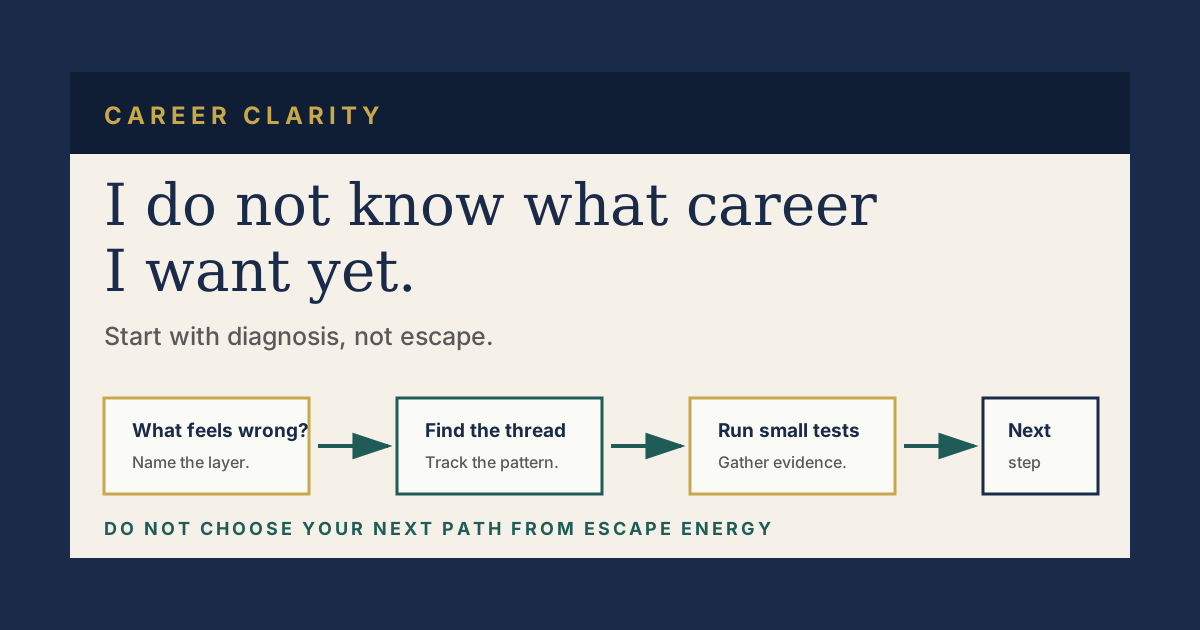
Start by diagnosing what is not working.
Look for patterns.
Find the thread.
Run small tests.
Pay attention to what gives you energy, what drains you, and what kind of future each path is building.
Career clarity is not always a sudden revelation.
Sometimes it is a process of removing what is false until the next honest step becomes visible.
You do not need to know your whole future today.
But you do need to stop ignoring the part of you that already knows this path is not working.
That knowing is not the final answer.
But it is the beginning of one.
Need Career Clarity?
If you know your current career is not working but you do not know what should come next, do not force yourself into another random decision.
A structured Career Clarity session can help you understand what is wrong, what patterns matter, and what next step fits your strengths, energy, and future direction.
You do not need another rushed career move.
You need a clearer diagnosis.
Explore Career Clarity sessions or start with the free Career Direction Map.
Want a structured starting point?
The free Career Direction Map helps you identify the pattern behind your career confusion before you make another major move.
Take the free map →