You feel tired before the workday even begins.
You open your laptop and feel resistance. You look at your calendar and feel a quiet heaviness. The work that once felt manageable now feels draining. The meetings feel harder. The emails feel louder. The future feels unclear.
At first, you may call it burnout. Then you start asking deeper questions.
Is this just a stressful season? Is this company the problem? Is this role wrong for me? Or am I in the wrong career completely?
This is where many people make a mistake. They treat every career crisis as the same problem. They either force themselves to continue because "everyone gets tired," or they make a sudden decision because they cannot tolerate the pressure anymore.
But career exhaustion is not always a sign that you should leave. And staying is not always a sign of wisdom.
The real question is not, "Am I tired?" The real question is, "What is this tiredness trying to tell me?"
Burnout Is Not Always the Real Problem
Burnout is a real experience. It can affect your focus, energy, patience, motivation, and emotional capacity.
But burnout is also often used as a general word for many different career problems. A person may say, "I am burned out," when they actually mean:
- I have been working without proper rest.
- I am under poor management.
- I am doing work that does not use my strengths.
- I have outgrown this role.
- I no longer believe in this path.
- I do not know what I am building toward.
These are not the same problems. If you confuse them, you may choose the wrong solution.
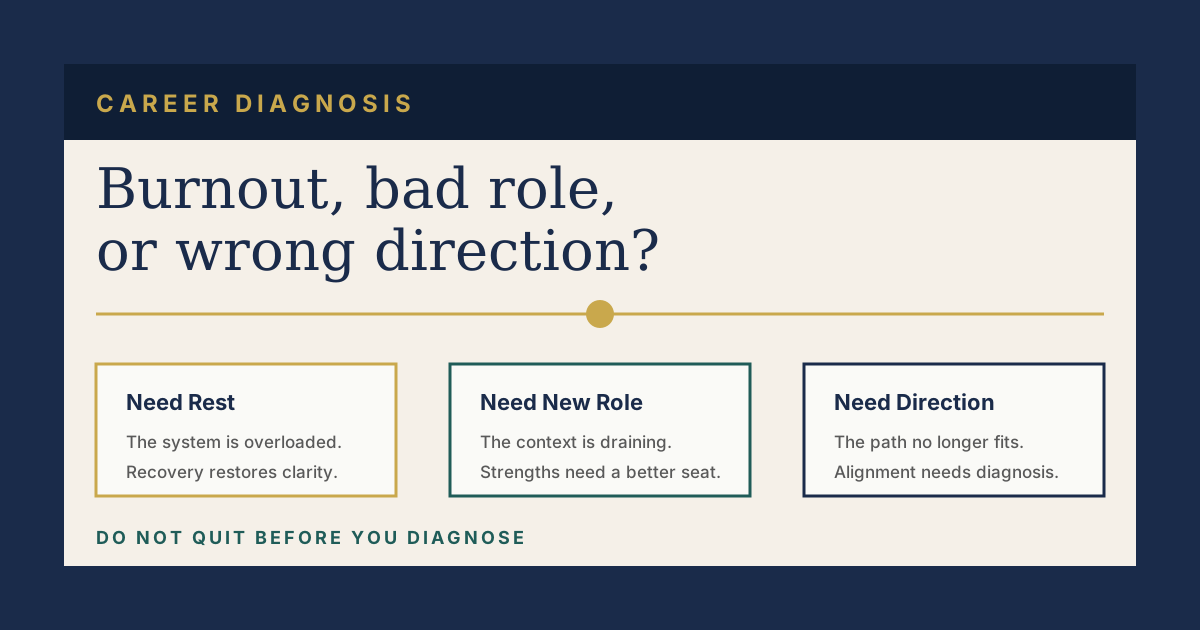
If you are overloaded, you may need rest and boundaries. If the environment is unhealthy, you may need a better workplace. If the role does not fit your strengths, you may need a different position. If the direction is wrong, you may need a deeper career diagnosis.
Rest is useful when the problem is exhaustion. Rest is not enough when the problem is misalignment.
The Three Career Problems People Confuse
Most career confusion falls into one of three categories. You may be facing burnout. You may be in a bad job or wrong environment. Or you may be in the wrong career direction.
They can feel similar from the inside because all three can create low energy, frustration, and lack of motivation. But the cause is different. That means the solution must also be different.
1. Burnout: Your System Is Overloaded
Burnout usually happens when your workload, emotional pressure, responsibilities, or pace exceed your recovery capacity for too long.
You may still like the field. You may still respect the work. You may still be good at what you do. But your system has been running without enough recovery.
In this case, the main issue is not necessarily your career direction. The issue is that your energy has been overused.
2. Bad Job or Wrong Role: The Context Is Draining You
Sometimes the work itself is not the problem. The environment is.
You may be in the right industry but the wrong company. The right profession but the wrong team. The right skill area but the wrong role.
The problem may be your manager, culture, workload expectations, lack of growth, unclear communication, office politics, or poor structure. In this case, changing your entire career may be too extreme. You may need a better role, company, or working arrangement.
3. Wrong Career Direction: The Path No Longer Fits
This is deeper. You are not just tired. You are not just annoyed by your boss. You are not simply waiting for a holiday.
You feel disconnected from the future this career is creating for you. Even when the workload is manageable, something still feels off. Even when people tell you the job is good, you feel internally unconvinced. Even when you succeed, the success does not feel meaningful.
That is not ordinary tiredness. That may be direction misalignment.
Signs You Need Rest, Not a Career Change
Sometimes the most responsible career move is not quitting. It is recovery.
You may need rest if you still care about the work, but your body and mind are overloaded. You may still enjoy parts of the role. You may still feel proud when you do good work. You may still see a future in the field, but your current capacity is low.
You may need rest if:
- Your exhaustion started after a long period of overwork.
- You still like the core work when pressure is reduced.
- You feel better after real recovery, not just distraction.
- You can imagine enjoying the work again with better boundaries.
- Your frustration is connected more to workload than identity.
- You are emotionally reactive because you have no margin left.
The key sign is this: when you rest properly, your clarity begins to return.
You do not feel completely disconnected from the career. You feel tired inside it. That difference matters.
A tired person should not make a life-changing decision from survival mode. Before you declare the entire career wrong, ask yourself: Have I actually rested? Have I reduced the pressure long enough to think clearly? Have I tested whether my energy improves when my schedule becomes healthier?
If the answer is no, your first move may not be a resignation letter. It may be a recovery plan.
Signs You Need a New Role or Environment
Sometimes your career is not wrong. Your current job is.
This is one of the most common mistakes people make. They assume, "I hate this job, so I must hate this career." But a bad environment can make even the right work feel unbearable.
A toxic manager can make you question your competence. A chaotic company can make you question your discipline. A poorly designed role can make you question your talent. A workplace with no growth can make you question your ambition.
You may need a new role or environment if the work itself still makes sense, but the structure around it is damaging you.
You may need a role change if:
- You enjoy the field but dislike your current responsibilities.
- You perform well but feel unseen or underused.
- You are growing in skill but not in opportunity.
- Your values conflict with the company culture.
- You feel better when doing similar work in a different setting.
- You can imagine staying in the profession, but not in this job.
This is why career diagnosis matters. Without diagnosis, you may throw away a good direction because of a bad environment. For more on this distinction, read Is It Just a Bad Job, or Do You Need a Career Coach?
Signs You May Be in the Wrong Career Direction
A wrong career direction is not always dramatic. It does not always look like failure. In fact, many people who are in the wrong direction are doing well externally.
They are employed. They are competent. They may even be respected. But internally, they feel disconnected.
The work does not match their deeper strengths. The future of the path does not excite them. The identity attached to the career no longer feels true.
They are not just asking, "How do I get promoted?" They are asking, "Why am I doing this at all?"
You may be in the wrong career direction if:
- You feel no meaningful connection to the future of the field.
- Success in this path does not feel satisfying.
- You are good at the work but do not feel alive in it.
- You keep fantasizing about a completely different kind of life.
- You feel like you are maintaining an old decision.
- You chose the career for security, family approval, pressure, or convenience.
- You feel more like a version of yourself you had to become than the person you actually are.
The strongest sign is not tiredness. The strongest sign is repeated inner resistance even after rest, improvement, recognition, and external progress.
If nothing is technically wrong but everything still feels wrong, the issue may be direction. career clarity coaching can help you diagnose whether the issue is energy, environment, role fit, or direction. The Career Clarity question is not only what you can do. It is what you are actually built for.
The Career Clarity Test: What Is Actually Draining You?
Before you make a decision, separate the layers. Do not ask, "Should I quit?" Ask better questions.
1. Is the workload too much?
If the main problem is volume, deadlines, constant availability, or emotional pressure, you may be dealing with burnout. The solution may involve rest, boundaries, workload redesign, or temporary support.
2. Is the environment unhealthy?
If the work is acceptable but the people, culture, leadership, politics, or expectations are damaging, the issue may be the workplace. The solution may be a better company, team, manager, or structure.
3. Is the role misusing your strengths?
If you are spending most of your time on tasks that drain you while your natural strengths remain unused, the role may be wrong. The solution may be repositioning, role redesign, or moving into a better-fit function.
4. Is the career direction no longer meaningful?
If the entire future attached to the path feels empty, the issue may be deeper. The solution may require career diagnosis, not just rest or a new employer.
5. Are you deciding from exhaustion or clarity?
This is the most important question. Exhaustion wants escape. Clarity wants alignment. Do not confuse the two.
Do Not Quit Before You Diagnose
Quitting can be the right decision. But quitting without diagnosis can create a repeating pattern.
You leave one job, feel relief for a while, then face the same problem again. Different company. Same exhaustion. Different title. Same confusion. Different salary. Same internal resistance.
This happens when the visible problem changes but the real problem remains untouched.
If the real issue is boundaries, you will carry the same overworking pattern into the next job. If the real issue is people-pleasing, you will keep accepting roles that drain you. If the real issue is lack of direction, every new option will eventually feel uncertain. If the real issue is wrong identity, no external upgrade will fully solve it.
That is why the first step is not always action. Sometimes the first step is interpretation. You need to understand what your career symptoms are pointing toward.
When Rest Is the Right Move
Rest is the right move when your career still makes sense but your system is overloaded.
This does not mean passive rest only. It may mean rebuilding your rhythm. You may need to reduce unnecessary commitments, stop making yourself available at all hours, renegotiate deadlines, take proper leave, improve sleep, or remove extra responsibilities that you silently accepted.
Rest is not laziness. Rest is maintenance. But rest must be honest.
If you take a break and return with more clarity, that tells you something. If you take a break and return with the same deep resistance, that also tells you something. Rest should reveal the truth, not hide it.
When a New Role Is the Right Move
A new role is the right move when the career direction is still valid, but your current position does not fit your strengths, growth needs, or working style.
This may mean moving from execution to strategy. From management back to specialist work. From corporate to consulting. From client-facing to behind-the-scenes. From chaotic startups to structured organizations. From isolated work to collaborative work. From low-ownership tasks to roles with decision-making power.
The right career can still feel wrong when you are sitting in the wrong seat.
Before changing the entire path, ask: What part of this work gives me energy? What part consistently drains me? Am I using my strongest abilities daily? What responsibilities do I want more of? What responsibilities do I need to move away from?
Sometimes clarity does not require a new career. It requires a more accurate role.
When a New Direction Is the Right Move
A new direction is the right move when the path itself no longer matches your deeper identity, values, strengths, or desired future.
This is not about one bad month. It is not about one difficult manager. It is not about temporary tiredness. It is a repeated pattern of misalignment.
You may be able to do the work, but you do not want to become the person the path requires you to become. That sentence matters.
Every career forms you. It shapes your habits, identity, relationships, confidence, lifestyle, and future options. So the question is not only, "Can I do this?" The question is, "Do I want the life this path is building?"
If the answer is no, you need more than a vacation. You need direction clarity.
The Wrong Way to Make a Career Decision
The wrong way is to make the decision only from emotion: "I cannot take this anymore." "I just want out." "I will choose anything else." "I need to start over."
These feelings may be real, but they are not enough to build a decision on. Pain tells you something needs attention. It does not automatically tell you which decision is correct.
The wrong way is also to make the decision only from fear: "What if I regret it?" "What if I lose stability?" "What if people judge me?" "What if I am too late?"
Fear may protect you from reckless decisions, but it can also keep you stuck in a life that no longer fits. A good career decision needs both honesty and structure.
A Simple Career Diagnosis Framework
Use this simple framework before making your next move.
Step 1: Name the Symptom
What are you actually experiencing? Exhaustion? Boredom? Resentment? Confusion? Loss of confidence? Lack of growth? Emotional numbness? Do not rush to explain it. First name it clearly.
Step 2: Identify the Source
Where is the symptom coming from? Workload? Manager? Company culture? Role design? Lack of meaning? Financial pressure? Family expectations? Old career choice? Your answer matters because each source requires a different response.
Step 3: Separate Temporary From Repeated
Is this a recent season, or has this pattern followed you for years? A temporary season may need adjustment. A repeated pattern needs deeper diagnosis.
Step 4: Test the Smallest Change First
Before making the biggest move, test a smaller one where possible. Can you reduce workload? Can you change your schedule? Can you shift responsibilities? Can you apply for a different role? Can you speak with a mentor? Can you explore a new field without immediately quitting?
Step 5: Decide From Pattern, Not Panic
A strong career decision is not based on one emotional day. It is based on a pattern you have studied honestly. When the pattern becomes clear, the decision becomes less dramatic.
Common Mistakes People Make
One common mistake is resting when they actually need change. They take a weekend off, feel slightly better, then return to the same misalignment. After a few weeks, the same heaviness comes back.
Another mistake is changing jobs when they actually need boundaries. They enter a new company with the same overworking habits, same inability to say no, and same need to prove themselves. Eventually, the new job becomes the old pattern.
Another mistake is changing careers when they only needed a better role. They abandon years of experience because one environment damaged their confidence.
Another mistake is staying too long because the job looks good on paper. The salary is acceptable. The title is respectable. The family approves. The LinkedIn profile looks stable. But internally, they know they are slowly disconnecting from themselves.
A career can look successful and still be wrong.
How to Know What to Do Next
If your main issue is overload, begin with recovery. Protect your energy. Reduce unnecessary pressure. Stop pretending you have unlimited capacity.
If your main issue is the workplace, explore a better environment. Do not make one company the representative of an entire profession.
If your main issue is the role, study your strengths. Look for work that uses your natural thinking, energy, and ability more accurately.
If your main issue is direction, slow down and diagnose. Do not rush into a random pivot. Do not start a new degree only because you feel lost. Do not copy someone else's career because their path looks clearer than yours.
Your next move should come from understanding, not escape.
A Better Question Than "Should I Quit?"
Instead of asking, "Should I quit?" ask: "What exactly needs to change?"
That question opens the right door. Maybe your workload needs to change. Maybe your manager needs to change. Maybe your role needs to change. Maybe your company needs to change. Maybe your entire direction needs to change.
But until you identify the real problem, every answer will feel risky. Career clarity does not begin with a resignation. It begins with an accurate diagnosis.
Final Thought
Feeling exhausted in your career does not automatically mean you are weak, lazy, ungrateful, or behind.
It may mean your system is overloaded. It may mean your environment is draining you. It may mean your role is misusing your strengths. Or it may mean your career direction no longer fits the person you are becoming.
The goal is not to panic. The goal is to read the signal correctly.
Do not make a permanent decision from temporary exhaustion. But do not ignore repeated misalignment just because the career looks safe from the outside.
Rest if you need rest. Change roles if the seat is wrong. Change environment if the culture is damaging. Change direction if the path no longer fits. But first, diagnose.
Because the wrong solution can keep you stuck for years. And the right diagnosis can give you back your direction.
How do I know if I am burned out or in the wrong career?
Burnout usually improves when workload, pressure, and recovery are addressed. A wrong career direction creates repeated resistance even after rest, better conditions, or external progress.
Should I quit my job if I feel exhausted?
Not immediately. Exhaustion needs diagnosis first. You may need rest, a better role, a healthier environment, or a deeper career direction change.
Can a new role fix career burnout?
A new role can help if the current job is misusing your strengths or the environment is draining you. It will not solve a deeper direction problem by itself.
Need Career Clarity?
If you are unsure whether you are burned out, in the wrong role, or moving in the wrong career direction, do not make a life-changing decision from exhaustion.
A structured Career & Direction Clarity session can help you understand what is really happening, what needs to change, and what next step makes sense.
Book a session → or start with the free Career Direction Map.