Change jobs when the work itself still fits but the employer, manager, culture, scope, pay, or growth path does not. Consider changing careers when the mismatch follows you across roles and the underlying work, environment, values, or future direction no longer fits. The safest first step is to identify the correct layer before making an expensive move.
For professionals in the UAE, that distinction matters. A career decision can affect income, residency planning, family responsibilities, housing, savings, and the professional identity you have built over years. Pressure can make every difficult work season feel like evidence that the whole career is wrong. It can also keep you in a genuinely wrong direction because changing feels too costly.
Changing Jobs and Changing Careers Are Different Decisions
A job change usually changes the organization while preserving most of your professional direction. A career change alters the kind of value you create, the problems you solve, or the professional identity you are building.
Between those two options are two decisions people often overlook: changing the role and changing the work environment. You may not need a new career. You may need a role with more strategy and less delivery, a smaller organization with more ownership, a healthier manager, a different pace, or work that uses a neglected strength.
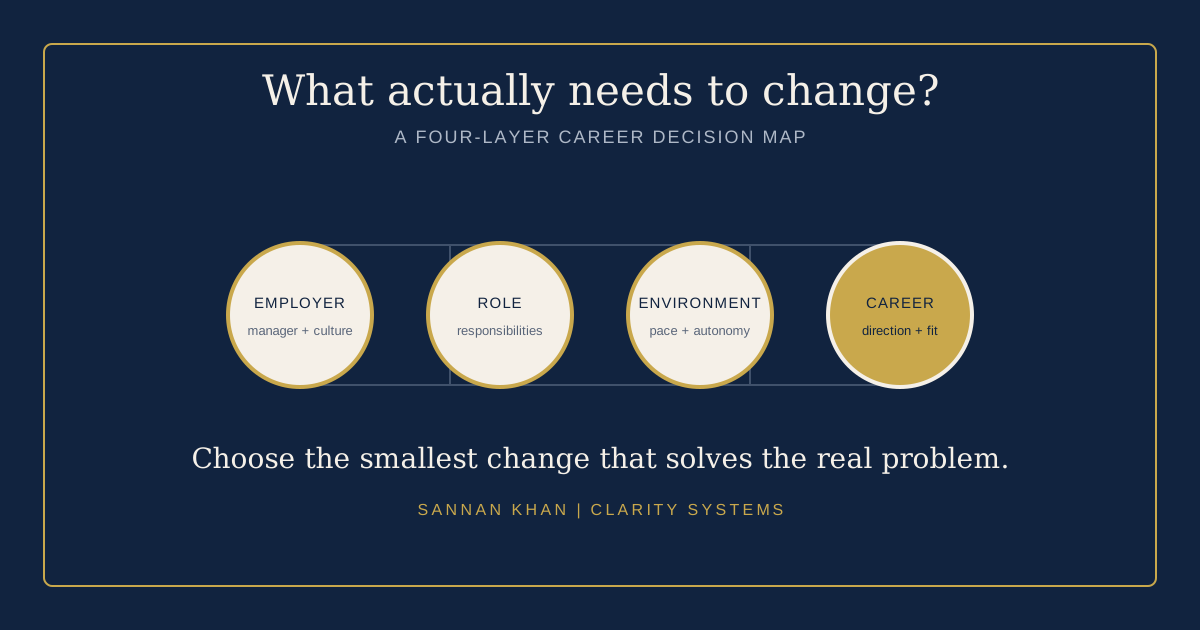
Use four layers instead of one dramatic question:
- Employer: Is the organization, manager, culture, reward system, or growth path the problem?
- Role: Does the industry still fit, but your current responsibilities no longer use your strengths or support growth?
- Environment: Is the mismatch about pace, autonomy, team structure, location, schedule, or the way work is organized?
- Career direction: Has the underlying work itself stopped fitting who you are, what you value, or where you want to go?
Do not replace your whole career when the employer is the problem. Do not keep replacing employers when the career direction is the problem.
The Employer Test: Would the Same Work Feel Better Somewhere Else?
Imagine doing substantially the same work with a capable manager, reasonable expectations, fair recognition, clearer priorities, and a credible growth path. If that version of the job feels attractive, the career may not be the problem.
Signals that point toward an employer change include inconsistent leadership, repeated broken promises, a culture that rewards permanent availability, unclear promotion criteria, values you cannot support, or a workload created by poor management rather than the work itself.
Before leaving, test whether the issue can be changed through a scope conversation, internal transfer, different reporting line, or clearer boundaries. The answer may still be no, but the test produces evidence instead of making the decision entirely from frustration.
The Role Test: Do You Need Different Responsibilities?
You can like your field and dislike your current role. A strong technical specialist may be pushed into people management. A capable manager may spend the week on approvals and administration. A strategic thinker may be trapped in repetitive execution. None of these automatically requires a new career.
Ask which activities consistently create energy, where your judgement produces unusual value, what responsibilities you want more of, and which duties you have simply outgrown. Then look for adjacent roles that change the work mix while preserving your professional capital.
This is often the lowest-risk transition because your industry knowledge, network, reputation, and evidence of results remain useful.
The Environment Test: Is the Setting Producing the Mismatch?
Environment includes more than office culture. It includes decision speed, hierarchy, autonomy, travel, working hours, team size, uncertainty, customer pressure, and whether work is local or spread across time zones.
A person can struggle in a highly political hierarchy and perform well in a smaller, direct organization. Another person may find start-up ambiguity exhausting but thrive inside a mature system with defined standards. Neither environment is universally better. Fit matters.
Read the guide to work-life balance at work if the main problem appears to be workload, boundaries, recovery, or role design rather than career direction.
The Career Test: Does the Work Still Fit?
A career change becomes more credible when the mismatch remains across employers, roles, and reasonable attempts to improve the environment. You may still perform well while feeling that the work no longer deserves the next five years of your effort.
Look for a persistent pattern:
- The central problems of the field no longer interest you.
- Your strongest capabilities are rarely used and cannot realistically become central.
- The future of the field leads somewhere you do not want to go.
- The work conflicts with important values or responsibilities.
- Rest improves your energy but not your willingness to return to the same direction.
- You are attracted to another field because of its actual work, not only because it offers escape.
If you cannot tell whether exhaustion or direction is responsible, use Career Burnout or the Wrong Career? before treating a depleted season as a permanent conclusion.
The UAE Career Decision Map
Use these five questions to identify the smallest responsible change:
- What specifically is not working? Name behaviours, responsibilities, conditions, and repeated outcomes rather than saying only, "I feel stuck."
- Where else has the pattern appeared? One employer suggests a local problem. The same pattern across several roles may indicate a deeper mismatch.
- What would remain if the manager and salary improved? If the work would still feel wrong, the problem is larger than compensation or leadership.
- What professional capital can you transfer? Map capabilities, judgement, relationships, industry knowledge, and proof of results before assuming you must restart.
- What can you test before committing? Use a project, conversation, short assignment, course with an output, advisory task, or portfolio piece to learn what the new direction actually requires.
How to Test a New Direction Without Resigning Immediately
A test should produce evidence about the work, not just another certificate. Choose one realistic adjacent direction and speak with three people who currently do it. Ask about ordinary responsibilities, performance expectations, entry barriers, and what newcomers misunderstand.
Then produce one small piece of evidence: solve a relevant problem, complete a practical project, contribute to a cross-functional assignment, or translate an existing achievement into the language of the target role. The purpose is to test both fit and credibility.
Set a review date. At that point, compare what you learned with your financial responsibilities, available runway, market evidence, and appetite for the transition. For a broader transfer strategy, read how to change career direction without starting from zero.
What to Check Before Leaving a UAE Job
Do not let a clarity framework replace legal, contractual, immigration, or financial review. Before acting, check your employment contract, notice requirements, work-permit implications, benefits, insurance, financial runway, and any responsibilities connected to your residency or dependants.
Rules and individual circumstances can change. Use current information from the UAE Ministry of Human Resources and Emiratisation and obtain qualified advice when your situation requires it.
Three Mistakes to Avoid
Do not use a new employer as a cure for unclear direction
A higher salary or stronger brand can improve the experience temporarily while preserving the same underlying mismatch.
Do not call every hard season a career crisis
Burnout, a difficult manager, organizational change, or short-term overload can distort the diagnosis. Recover enough to evaluate the work accurately.
Do not wait for perfect certainty
Large career decisions deserve care, but certainty usually follows evidence. Use bounded experiments to replace imagination with information.
Choose the Smallest Change That Solves the Real Problem
If a new manager or employer would solve the problem, preserve the career capital you have built. If a different role would use your strengths better, pursue the adjacent move. If the environment is incompatible with your life, change the setting. If the work itself no longer fits, build a deliberate bridge into a new direction.
The goal is not to prove that you are brave enough to leave or disciplined enough to stay. It is to make the most accurate decision available from the evidence you have.
Should I change jobs or change careers?
Change jobs when the work still fits but the employer, manager, culture, scope, pay, or growth path does not. Consider changing careers when the mismatch follows you across roles and the underlying work, environment, values, or future direction no longer fits.
How do I know whether I need a career change?
Look for a persistent mismatch that remains after reasonable rest, clearer boundaries, role changes, and attempts to improve the current situation. Test an adjacent direction before making an irreversible move.
Can I change careers in the UAE without starting from zero?
Often, yes. Map transferable capabilities, relationships, industry knowledge, judgement, and evidence of results, then build a bridge into an adjacent role or sector instead of presenting yourself as a complete beginner.
Should I resign before deciding my next career move?
Usually not. Unless remaining is unsafe or impossible, use a bounded test, financial runway, targeted conversations, and current official employment information before making a resignation decision.
Map what actually needs to change
The free Career Direction Map helps you reflect on clarity, role fit, confidence, pressure, focus, and the next professional move before you make a larger commitment.
Disclaimer: This article provides educational reflection and decision support. It is not legal, immigration, employment, financial, medical, or mental-health advice. Consult current official sources and appropriately qualified professionals before acting where needed.