Work-life balance at work improves when you change the part of the system creating the imbalance. A new calendar cannot solve an unrealistic workload, constant availability, poor recovery, unclear priorities, or a role that takes more energy than it returns.
This matters for professionals in demanding environments, including people working across UAE time zones, international teams, relocation pressures, and family responsibilities. The question is not only, "How can I organize my day?" It is, "What is making work expand into every part of my life?"
What Work-Life Balance Actually Means
Balance does not mean giving equal hours to work and personal life every day. Some seasons are naturally intensive. A launch, transition, family need, or important deadline can temporarily require more attention.
The problem begins when the intensive season becomes the normal operating model. Work follows you into evenings, recovery never feels complete, relationships receive only the energy left over, and even time away is mentally occupied by unfinished decisions.
A sustainable system allows effort and recovery to alternate. It also lets you be present in more than one role: professional, spouse, parent, friend, community member, and individual.
Why Time Management Is Often the Wrong First Solution
Time management helps when the workload is reasonable but poorly organized. It does not help when the workload exceeds available capacity. It can even hide the real problem by making you more efficient at accepting too much.
Before changing your calendar, diagnose which of these five constraints is dominant:
- Workload: The volume of work cannot be completed responsibly within the available time.
- Boundaries: Other people can reach you, interrupt you, or assign work without a clear limit.
- Role design: Your responsibilities are unclear, conflicting, or dependent on you for every decision.
- Recovery: Your non-work time is not producing physical or mental restoration.
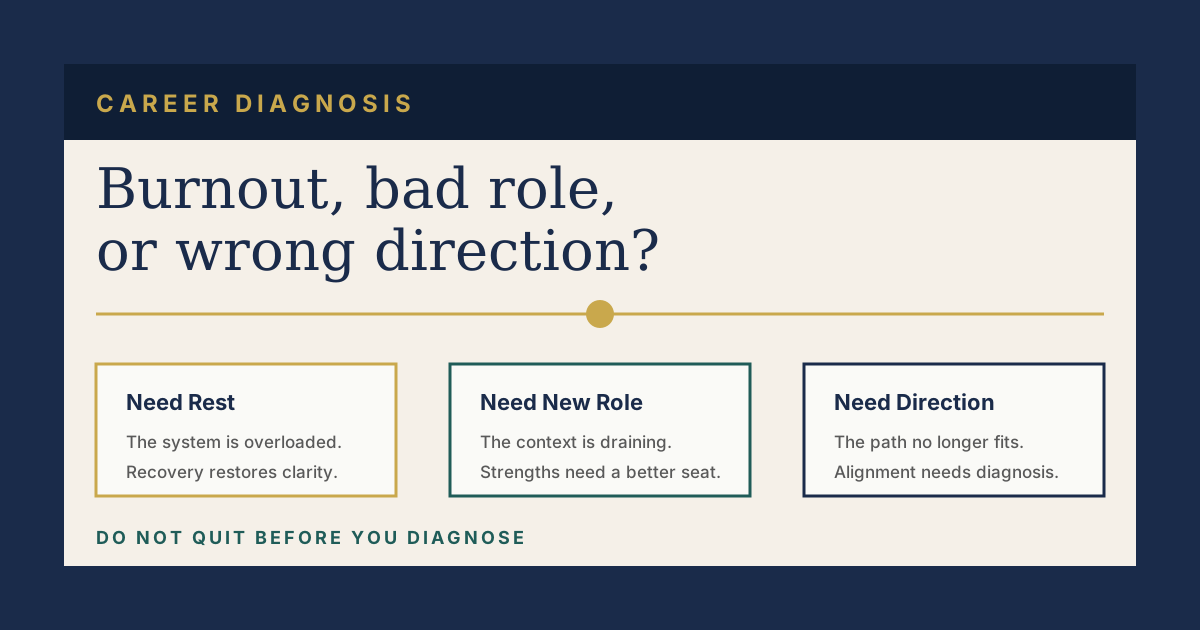
- Direction: The role may no longer fit, so ordinary effort carries an unusually high emotional cost.
Do not ask a productivity system to solve a workload, boundary, or career-direction problem.
The Work-Life Balance Diagnostic
1. Is the workload objectively possible?
List the outcomes you are accountable for, not every small task. Estimate the focused hours they require. If the expected work consistently exceeds the available week, the problem is capacity or prioritization. A faster to-do list will not create missing hours.
Decide what must stop, move, be delegated, or be renegotiated. If nothing can move, make the trade-off visible to the person assigning the work.
2. Who controls access to your attention?
Constant messages can make a normal workload feel impossible. Identify which channels are treated as urgent, who can interrupt focused work, and whether response expectations have ever been stated clearly.
A useful boundary is specific: "I review non-urgent messages at 11:30 and 4:30" is clearer than "Please respect my time." Boundaries work when they change behaviour and expectations, not only when they express frustration.
3. Are you carrying decisions that belong elsewhere?
Managers and founders often lose balance because every approval, customer issue, and exception waits for them. This is a decision-design problem. Use the collaborative decision-making framework to clarify who recommends, who decides, who contributes, and who is simply informed.
4. Does your recovery actually restore you?
Being away from the desk is not the same as recovering. Scrolling, worrying, and checking messages can keep the nervous system inside work even when the laptop is closed.
Choose recovery based on the demand. Mental overload may require silence or physical movement. Social exhaustion may require solitude. Isolation may require meaningful connection. Sleep deprivation requires sleep, not another motivational routine.
5. Is the role still a fit?
If reasonable boundaries, recovery, and workload changes do not improve the pattern, the deeper question may be career fit. Read Career Burnout or the Wrong Career? before assuming you must resign or simply work harder.
A role can be prestigious and still be wrong for your strengths, values, preferred environment, or current responsibilities. That does not make you ungrateful. It means the diagnosis must include direction, not only stamina.
A Two-Week Work-Life Balance Experiment
Do not redesign your entire life in one weekend. Choose the dominant constraint and run one bounded experiment:
- Remove or renegotiate one recurring low-value responsibility.
- Create two fixed windows for messages instead of permanent availability.
- Give one repeatable decision to the person closest to the work.
- Protect one recovery block that matches the kind of exhaustion you have.
- Schedule one conversation about role scope, priorities, or career direction.
At the end of two weeks, review evidence: Did energy improve? Did important work suffer? Did the boundary hold? What resistance appeared? Use the result to choose the next adjustment.
When Balance Requires a Career Decision
Sometimes work-life balance is not a scheduling problem. You may be trying to build a sustainable life around a role that requires a version of you that no longer exists. The role may demand travel, permanent availability, emotional labour, or a pace that conflicts with your responsibilities.
Use the career options framework to compare alternatives through strengths, environment, constraints, and direction. UAE professionals who want structured support can also explore online clarity coaching in the UAE.
What is work-life balance at work?
Work-life balance means work demands, recovery, relationships, health, and personal responsibilities can coexist without one area consistently consuming the others. It does not require identical hours every day.
Why does time management not fix work-life balance?
Time management cannot compensate for an unrealistic workload, unclear role, constant availability, weak boundaries, or work that consumes more energy than the schedule reveals.
How can I improve work-life balance?
Identify whether the main constraint is workload, boundaries, role design, recovery, or direction. Change the responsible part of the system and test one specific adjustment for two weeks.
Map the career question beneath the workload
The Career Direction Map helps you reflect on role fit, energy, clarity, confidence, pressure, and your next professional move.
Disclaimer: This article provides educational reflection and decision support. It is not medical, mental-health, legal, financial, or employment advice. Seek an appropriately qualified professional where needed.