To build confidence in your career, stop treating confidence as a feeling you must find before moving. Identify the exact uncertainty, collect evidence, improve the required skill or language, and take a small action that produces new information.
Low career confidence is often discussed as if it were a personality flaw. Sometimes it is a rational response to unclear expectations, weak evidence, a difficult workplace, or a move you have never tested. The solution depends on the source.
Confidence Is Not One Problem
You may feel unconfident because you lack a skill. You may have the skill but struggle to explain its value. You may know your value but be uncertain about the direction. Or you may be capable in an environment that repeatedly undermines your judgement.
These problems feel similar internally, but they require different responses. Training helps a real skill gap. Better value language helps an explanation gap. Career mapping helps a direction gap. Boundaries or a role change may be necessary when the environment is the problem.
The Four Sources of Career Confidence
1. Evidence
Write down outcomes you have produced, problems you have solved, difficult situations you have handled, and people who rely on your judgement. Avoid vague traits such as "hard-working." Use observable evidence.
2. Language
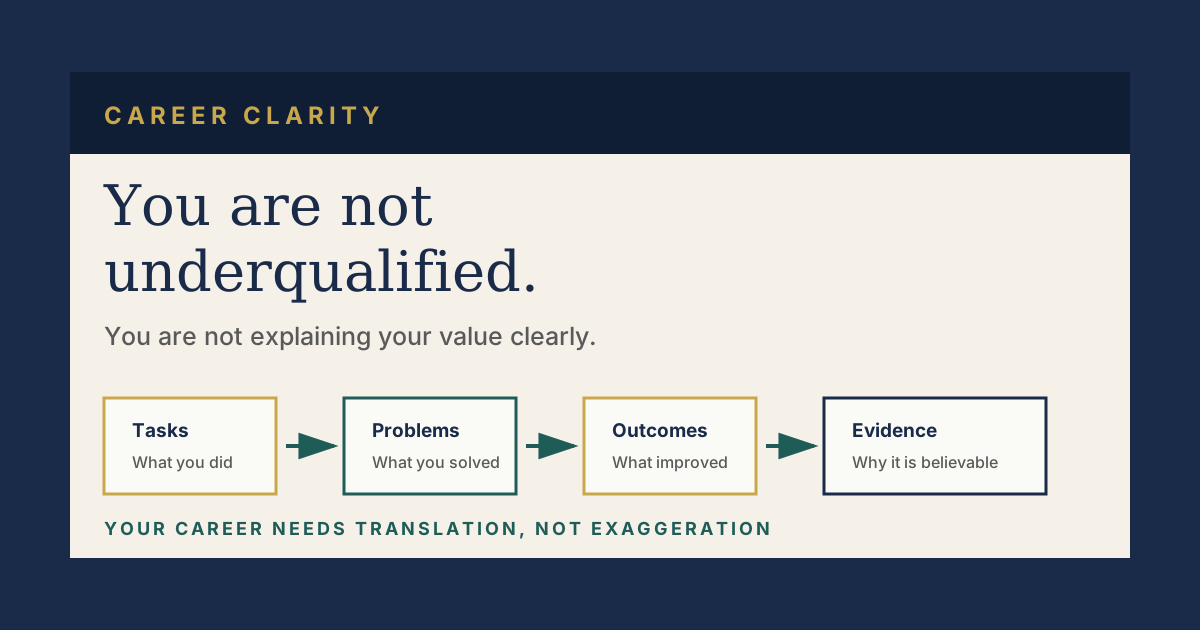
Confidence falls when you cannot explain what you do. Translate responsibilities into value: the problem, your action, the result, and why it mattered. Read You Are Not Underqualified. You Are Not Explaining Your Value Clearly for a practical value statement.
3. Practice
Confidence is specific. You may be confident in delivery but not interviews, leadership conversations, negotiation, or presenting. Practise the exact behaviour instead of trying to become generally fearless.
4. Direction
It is difficult to sound confident about a move you do not understand. When several options remain open, use consistent criteria to compare career options. Direction makes preparation more focused.
Confidence is not certainty. It is enough evidence and self-trust to take the next responsible step.
The Career Confidence Audit
Score each statement from 1 to 5:
- I can name the professional problems I solve well.
- I can describe evidence of my contribution.
- I know which skill gap matters next.
- I can explain why my target direction fits.
- I can take a small next action without outside permission.
- I recover from rejection without abandoning the whole direction.
Your lowest score indicates the next work. Do not use the total as a diagnosis. Use it to choose one practical improvement.
Build Confidence Through Evidence-Producing Moves
A useful action should be small enough to attempt and real enough to teach you something:
- Ask for specific feedback on one piece of work.
- Rewrite your professional summary around outcomes rather than duties.
- Speak with three people doing the role you are considering.
- Complete a small project that demonstrates the target skill.
- Apply for one carefully selected role and review the response.
- Lead one bounded decision instead of waiting to feel like a leader.
Each action replaces imagined judgement with evidence. You may discover a real gap, which gives you something concrete to improve. You may also discover that the fear was larger than the actual risk.
When Other People's Pressure Is Affecting Confidence
Career decisions often carry family, status, salary, and relocation expectations. Advice can be useful, but repeated external approval-seeking weakens your ability to judge evidence yourself.
Separate input from ownership. Ask others for facts, experience, and risks you may have missed. Do not ask them to decide what trade-offs you should accept. The final decision belongs to the person who will live with its consequences.
Confidence During a Career Change
A career transition makes an experienced person feel like a beginner in one part of their identity. Do not erase the value accumulated in the previous field. Identify transferable skills, relationships, judgement, and domain knowledge, then define what genuinely must be learned.
Read Career Change: How to Choose a New Direction Without Starting From Zero. If you are established but uncertain, the guide for experienced professionals will help distinguish a role problem from a deeper direction problem.
Career Confidence for UAE Professionals
In the UAE, confidence can be affected by relocation, competitive international teams, credential comparison, salary commitments, and uncertainty about changing employers or sectors. Treat these as real decision constraints, not proof that you are incapable.
Map the risk, timeline, evidence, and smallest credible experiment. For direct support, explore online clarity coaching for UAE professionals.
How do I build confidence in my career?
Collect evidence of value, name the specific gap, practise the next required behaviour, and use small experiments to reduce uncertainty.
Why have I lost confidence at work?
Confidence can fall after prolonged criticism, unclear expectations, a difficult environment, a role mismatch, a career transition, or too little evidence about a new direction.
Should I wait until I feel confident before changing careers?
No. Large decisions should be tested carefully, but confidence usually develops through preparation and evidence-producing action rather than waiting for fear to disappear.
Turn career uncertainty into a clearer map
The free Career Direction Map helps you reflect on confidence, clarity, pressure, energy, focus, and your readiness to move.
Disclaimer: This article is educational and reflective. It is not clinical, mental-health, employment, legal, or financial advice.