Summary
Many people think they are underqualified when they are actually unclear.
They have experience, skills, effort, and ability, but they do not know how to explain their value in a way that makes sense to employers, clients, managers, or decision-makers.
So they keep applying quietly, speaking vaguely, shrinking their achievements, comparing themselves to others, and assuming the problem is lack of talent.
But sometimes the issue is not that you have nothing to offer.
The issue is that your value is scattered, hidden, or poorly translated.
Career clarity is not only about knowing what you want.
It is also about knowing how to explain what you bring.
If you cannot explain your value clearly, other people may underestimate you, and eventually, you may begin underestimating yourself too.
Key Takeaways
- Feeling underqualified does not always mean you lack ability.
- Many capable people struggle because they cannot explain their value clearly.
- Your experience must be translated into problems solved, outcomes created, and strengths demonstrated.
- Confidence grows when you understand your own evidence.
- A vague career story makes you look less ready than you are.
- The goal is not to exaggerate. The goal is to communicate your value accurately.
Introduction
You look at the job description and feel smaller.
You read the requirements and start doubting yourself.
You see someone else's LinkedIn profile and think they are far ahead.
You prepare for an interview and worry that your experience is not strong enough.
You want to apply, pitch, ask for a raise, change roles, or move into a better opportunity, but something inside you keeps saying:
"Maybe I am not qualified enough."
Maybe that is true in some cases.
Sometimes you do need more skill, more experience, more training, or more exposure.
But often, the deeper problem is different.
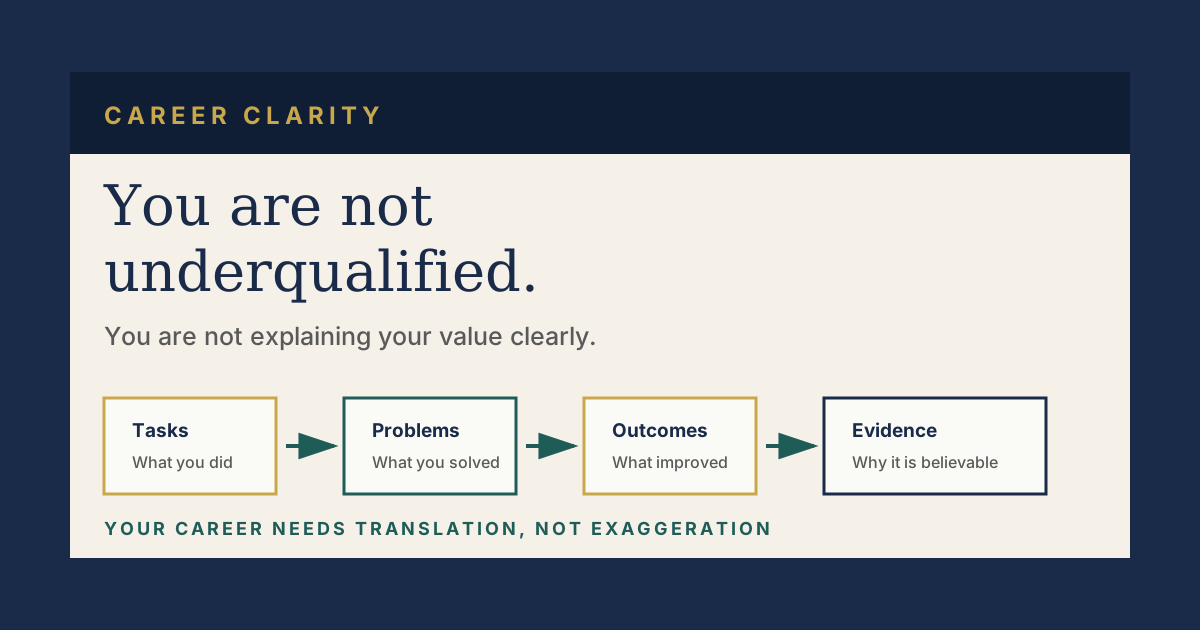
You are not underqualified.
You are under-explained.
You have done things, but you have not translated them into value.
You have experience, but you describe it like a list of tasks.
You have strengths, but you speak about them as personality traits instead of business contributions.
You have learned from difficult seasons, but you do not know how to turn those lessons into a clear career story.
So you sound less ready than you are.
And after repeating that pattern long enough, you begin believing the problem is you.
The Problem Is Not Always Lack of Skill
Skill matters.
No one should pretend that clarity replaces competence.
If a role requires technical ability you do not yet have, you may need training.
If an opportunity requires experience you have not built, you may need time.
If a position requires a level of responsibility you have not handled before, you may need preparation.
But many people are not stuck because they have no skill.
They are stuck because they cannot explain their skill in a way that connects to the opportunity.
They say, "I handled admin."
But they do not say, "I created order in a chaotic workflow."
They say, "I worked with clients."
But they do not say, "I managed client communication, reduced confusion, and helped keep delivery on track."
They say, "I helped with content."
But they do not say, "I translated ideas into clear messaging that supported visibility and trust."
They say, "I supported the team."
But they do not say, "I became the person who made execution easier for everyone else."
The work may be real.
But if the language is weak, the value becomes invisible.
Tasks Are Not the Same as Value
Many people describe their career as a list of tasks.
I answered emails.
I managed schedules.
I wrote reports.
I attended meetings.
I created posts.
I handled customers.
I updated files.
I supported operations.
These statements may be true, but they do not show value clearly.
A task tells people what you did.
Value tells people why it mattered.
The task is "managed schedules."
The value may be "reduced confusion, protected time, and helped the team work with fewer delays."
The task is "handled customers."
The value may be "resolved issues, maintained trust, and improved the customer experience."
The task is "created content."
The value may be "turned brand ideas into clear communication that attracted attention and built credibility."
The task is "prepared reports."
The value may be "organized information so decision-makers could see the situation clearly."
This difference matters.
If you only explain tasks, you may sound replaceable.
If you explain value, people understand the contribution behind the task.
You May Be More Qualified Than You Sound
This is one of the most common career problems.
Your actual experience is stronger than your description of it.
You have handled pressure.
You have solved problems.
You have learned quickly.
You have adapted.
You have supported people.
You have managed responsibilities that were never written clearly in your job title.
You have filled gaps.
You have prevented mistakes.
You have noticed what others missed.
But when someone asks what you do, you give a small answer.
You say, "I just help with operations."
You say, "I just do admin."
You say, "I just manage some projects."
You say, "I just support the team."
The word "just" quietly weakens your value.
It makes your work sound smaller than it is.
Sometimes humility becomes self-erasure.
You do not need to exaggerate.
But you do need to stop hiding the real weight of what you carry.
Why Capable People Undersell Themselves
Capable people often undersell themselves for understandable reasons.
Some were never taught how to speak about their achievements.
Some were told that confidence is arrogance.
Some worked in environments where their contribution was taken for granted.
Some had job titles that were smaller than the actual work they did.
Some changed careers and feel like beginners, even though they bring transferable strengths.
Some compare themselves with people who are better at presenting themselves.
Some do not know how to separate ordinary effort from meaningful evidence.
When you have been doing something for a long time, it can feel normal to you.
But normal does not mean valueless.
The thing that feels obvious to you may be valuable to someone else.
Your career story must help others see that.
Confidence Comes From Evidence, Not Hype
Many people think they need more confidence.
They say:
"I need to believe in myself."
"I need to stop doubting."
"I need to be more confident in interviews."
Confidence matters, but real confidence does not come from pretending.
It comes from evidence.
You need to know what you have actually done.
What problems you solved.
What pressure you handled.
What results you created.
What responsibilities you carried.
What people trusted you with.
What skills kept showing up across different experiences.
When you do not know your own evidence, confidence becomes fragile.
You try to encourage yourself, but your mind asks, "Based on what?"
That is why evidence matters.
Career confidence becomes stronger when it is connected to real examples.
Not vague self-belief.
Clear proof.
Your Career Story May Be Too Scattered
Some people have experience, but no clear career story.
They have done different things.
Different roles.
Different projects.
Different tasks.
Different industries.
Different responsibilities.
But they do not know how to connect them.
So their career looks random, even when there is a pattern underneath.
A scattered career story makes other people work too hard to understand you.
They have to guess what your strength is.
They have to guess where you are going.
They have to guess why your past experience matters.
Most people will not do that work for you.
You need to make the pattern visible.
Maybe the pattern is problem-solving.
Maybe it is communication.
Maybe it is operations.
Maybe it is leadership.
Maybe it is people support.
Maybe it is strategy.
Maybe it is building structure where there was confusion.
Maybe it is translating complex ideas into simple language.
Your career story becomes clearer when you identify the thread that connects your experience.
The Career Value Translation
A strong career story translates your experience into three things:
Problems solved.
Strengths demonstrated.
Outcomes created.
This is the difference between listing work and explaining value.
For example:
"I managed social media" is a task.
"I helped the brand communicate more consistently and stay visible to its audience" is value.
"I answered customer questions" is a task.
"I reduced confusion and helped customers feel supported during the buying process" is value.
"I organized documents" is a task.
"I created a clearer information system so the team could find what they needed faster" is value.
"I worked on projects" is a task.
"I helped move projects from ideas into execution by tracking details, deadlines, and communication" is value.
This translation is not fake.
It is accurate.
You are not inflating your work.
You are explaining why it mattered.
The Three Questions That Reveal Your Value
If you do not know how to explain your value, start with three questions.
1. What Problems Do People Trust Me With?
Look at what people keep bringing to you.
Do they bring you messy situations?
Confusing information?
Difficult conversations?
Unclear ideas?
Last-minute tasks?
People problems?
Technical problems?
Planning problems?
Creative problems?
The problems people trust you with often reveal your value.
They show where others believe you can help.
2. What Becomes Easier Because I Am Involved?
This is a powerful question.
Does communication become clearer?
Do projects move faster?
Do people feel calmer?
Do clients feel supported?
Does the team become more organized?
Do ideas become more practical?
Do problems become easier to understand?
Your value often lives in what becomes easier when you are present.
3. What Do I Notice That Others Miss?
Some people notice risk.
Some notice emotional tension.
Some notice missing details.
Some notice unclear messaging.
Some notice broken systems.
Some notice opportunity.
Some notice patterns.
What you naturally notice is often connected to how you create value.
Your attention has a pattern.
That pattern matters.
Stop Saying "I Only Did This"
The phrase "I only" is often a sign that you have not studied your contribution.
"I only helped with the project."
What did your help make possible?
"I only supported the manager."
What responsibilities did you carry that made their work easier?
"I only handled communication."
What confusion did you reduce?
"I only worked on small tasks."
What larger system did those tasks support?
Small tasks can create serious value when they support important outcomes.
The goal is not to make every task sound huge.
The goal is to understand the role the task played inside the larger system.
A small task connected to a meaningful outcome is not meaningless.
It is part of value.
Your Job Title May Not Tell the Whole Story
Job titles are often incomplete.
Two people can have the same title and do very different work.
One "assistant" may only handle basic scheduling.
Another may manage communication, operations, client relationships, reporting, and project flow.
One "content writer" may only write captions.
Another may shape messaging, clarify positioning, research audiences, and support business growth.
One "coordinator" may only pass information around.
Another may hold the entire project structure together.
If your job title is small, do not let it define the full value of your experience.
The title is only the label.
The real story is what you actually carried.
Why You Struggle in Interviews
Many people struggle in interviews not because they have no experience, but because they cannot tell the story of their experience clearly.
They answer in general language.
"I am hardworking."
"I am a quick learner."
"I am passionate."
"I am good with people."
"I can manage pressure."
These may be true, but they are not enough.
Interviewers need evidence.
Instead of saying, "I am good with people," explain a situation where you handled a difficult client or supported a team through confusion.
Instead of saying, "I can manage pressure," describe a time when deadlines were tight and you still kept work organized.
Instead of saying, "I am a quick learner," show how you entered a new area and became useful quickly.
The point is not to memorize perfect answers.
The point is to know your evidence well enough that your answers become grounded.
The Difference Between Confidence and Clarity
Confidence says, "I believe I can do this."
Clarity says, "I know why I can do this."
Both matter.
But clarity often comes first.
If you understand your strengths, evidence, and value, confidence becomes less forced.
You stop trying to convince yourself randomly.
You start seeing the pattern.
You can say:
"I have handled this kind of problem before."
"I have built this strength across multiple roles."
"I know how to learn quickly in unclear environments."
"I understand why my experience connects to this opportunity."
That is different from empty confidence.
That is clarity-backed confidence.
The Value Map
If you want to explain your value more clearly, create a value map.
Write down five columns:
1. Tasks
What did you do?
Examples:
Managed communication.
Created reports.
Handled clients.
Supported projects.
Organized systems.
2. Problems
What problem did the task solve?
Confusion.
Delays.
Poor communication.
Lack of visibility.
Customer frustration.
Scattered information.
3. Strengths
What strength did the task show?
Organization.
Communication.
Analysis.
Empathy.
Leadership.
Creativity.
Problem-solving.
4. Outcomes
What became better?
Faster delivery.
Clearer decisions.
Better client experience.
More consistent content.
Reduced mistakes.
Improved coordination.
5. Evidence
What example proves it?
A project.
A result.
A compliment.
A responsibility.
A repeated situation.
A measurable change.
This map helps you stop seeing your experience as random.
It turns your career history into usable language.
Transferable Skills Are Not Weak Skills
Many career changers feel underqualified because their experience does not match the new field exactly.
They say:
"I do not have direct experience."
That may be true.
But direct experience is not the only kind of value.
Transferable skills matter.
Communication transfers.
Problem-solving transfers.
Project management transfers.
Client handling transfers.
Research transfers.
Leadership transfers.
Writing transfers.
Analysis transfers.
Operations transfers.
Learning speed transfers.
Emotional intelligence transfers.
The question is not only, "Have I done this exact job before?"
The better question is:
"What have I already done that connects to the problems this role needs solved?"
A career change becomes more believable when you can translate your past into the language of the future role.
Do Not Make the Employer Guess
If you are applying for a role, do not make the employer work too hard to see the connection.
You may understand the connection in your mind.
But if it is not visible in your CV, profile, portfolio, or interview answers, the other person may miss it.
Make the connection clear.
If the role needs communication, show communication evidence.
If the role needs coordination, show coordination evidence.
If the role needs analysis, show analysis evidence.
If the role needs leadership, show leadership evidence.
If the role needs client management, show client management evidence.
Do not simply list everything you have done.
Select the evidence that matches the opportunity.
A strong application is not a full autobiography.
It is a focused value argument.
Why Comparison Makes Your Value Disappear
Comparison can distort your self-perception.
You look at someone with a stronger title, cleaner profile, better network, or more confident language, and suddenly your own experience feels small.
But you may be comparing your internal uncertainty with their external presentation.
You see their polished story.
You do not see their doubts, gaps, support, timing, or private struggle.
This does not mean you should ignore competition.
You should understand the market.
But comparison becomes harmful when it makes you erase your own evidence.
Study others for language, positioning, and insight.
Do not use them as proof that you have nothing to offer.
Your job is not to become someone else.
Your job is to understand and communicate your own value more clearly.
Your Value Needs a Clear Direction
Value becomes stronger when it points somewhere.
If you say, "I can do many things," people may not know where to place you.
If you say, "I am good at communication, coordination, and turning messy information into clear action," the direction becomes easier to understand.
This does not mean you must limit your entire future.
It means you need a clear professional signal.
People need to know what kind of problems you are useful for.
A broad person with no clear direction may be overlooked.
A focused person with a clear value story becomes easier to remember.
Career clarity is not only internal.
It must also become visible externally.
The Wrong Way to Prove Yourself
Many people try to prove their value by overworking.
They say yes to everything.
They accept low pay.
They take on extra tasks.
They stay late.
They try to be useful to everyone.
They hope someone will notice.
Sometimes people do notice.
Often, they simply expect more.
Overworking is not the same as communicating value.
In fact, when you keep doing more without naming the value, people may take your effort as normal.
You become dependable but not recognized.
Helpful but not positioned.
Busy but not clearly valued.
The goal is not to work less irresponsibly.
The goal is to connect your work with visible contribution.
People cannot fully value what they cannot clearly see.
You Do Not Need to Brag
Many people avoid speaking about their value because they fear sounding arrogant.
But there is a difference between bragging and clarity.
Bragging exaggerates.
Clarity explains.
Bragging seeks attention.
Clarity provides understanding.
Bragging says, "I am amazing."
Clarity says, "Here is the problem I solve, the strength I bring, and the evidence behind it."
You do not need to become loud.
You need to become accurate.
If you did meaningful work, naming it clearly is not arrogance.
It is responsibility.
Because if you do not explain your value, other people may define it too narrowly.
How to Rewrite Your Career Story
Start with this structure:
I have experience in [area], where I helped [type of people, team, business, or project] solve [problem] by using [strengths or skills], which led to [outcome or improvement].
For example:
I have experience in operations and communication, where I helped small teams reduce confusion and keep projects moving by organizing information, tracking details, and improving follow-up.
Or:
I have experience in content and brand communication, where I help ideas become clearer, more structured, and easier for the audience to understand.
Or:
I have experience in client support, where I help customers feel guided, informed, and confident through clear communication and problem-solving.
This kind of language gives your experience a shape.
It helps people understand where you fit.
What to Do This Week
Do not start by rewriting everything.
Start with your evidence.
Write down ten things you have done that required responsibility.
Then beside each one, write:
What problem did this solve?
What strength did it show?
What outcome did it create?
What does this say about the kind of work I am good at?
Then look for patterns.
You may discover that you are more valuable than your current language suggests.
After that, update one thing.
Your CV summary.
Your LinkedIn about section.
Your interview answer.
Your portfolio intro.
Your proposal.
Your personal introduction.
Do not wait until you feel fully confident.
Clarity grows when you start naming the truth more accurately.
When You Still Need More Skill
Sometimes the diagnosis will show that you do need more skill.
That is not failure.
It is useful information.
If you are missing a technical skill, learn it.
If you need stronger examples, create them.
If you need more exposure, seek it.
If you need a portfolio, build it.
If you need practice, practice.
But do not confuse a skill gap with total inadequacy.
A skill gap is specific.
Inadequacy feels global.
A clear person says, "I need to improve this area."
An unclear person says, "I am not good enough."
Those are very different.
One leads to action.
The other leads to shame.
Final Thought
You may not be underqualified.
You may be unclear about your value.
You may have more evidence than you realize.
You may have stronger patterns than you have named.
You may have done meaningful work, but described it too weakly.
You may have transferable skills, but never connected them to the opportunity.
You may have confidence issues because you have not studied your own proof.
Do not exaggerate.
Do not pretend.
Do not copy someone else's story.
But do not shrink your own.
Your career needs more than effort.
It needs translation.
Translate your tasks into value.
Translate your experience into evidence.
Translate your scattered history into a clearer thread.
Translate your ability into language other people can understand.
Because people do not only respond to what you have done.
They respond to what they can clearly see.
And sometimes the next career move begins when you finally learn how to explain the value that was already there.
Need Career Clarity?
If you feel underqualified, unsure how to explain your experience, or confused about what value you actually bring, you may not need more self-doubt.
You may need a clearer career diagnosis.
A structured Career Clarity session can help you identify your strengths, translate your experience, and understand how to position yourself for the next move.
You do not need to pretend to be more than you are.
You need to explain what is already true more clearly.
Book a Career Direction Clarity Session
If you feel underqualified because your career story is unclear, a Career Direction Clarity session can help you identify your strengths, translate your experience, and position your value more clearly.