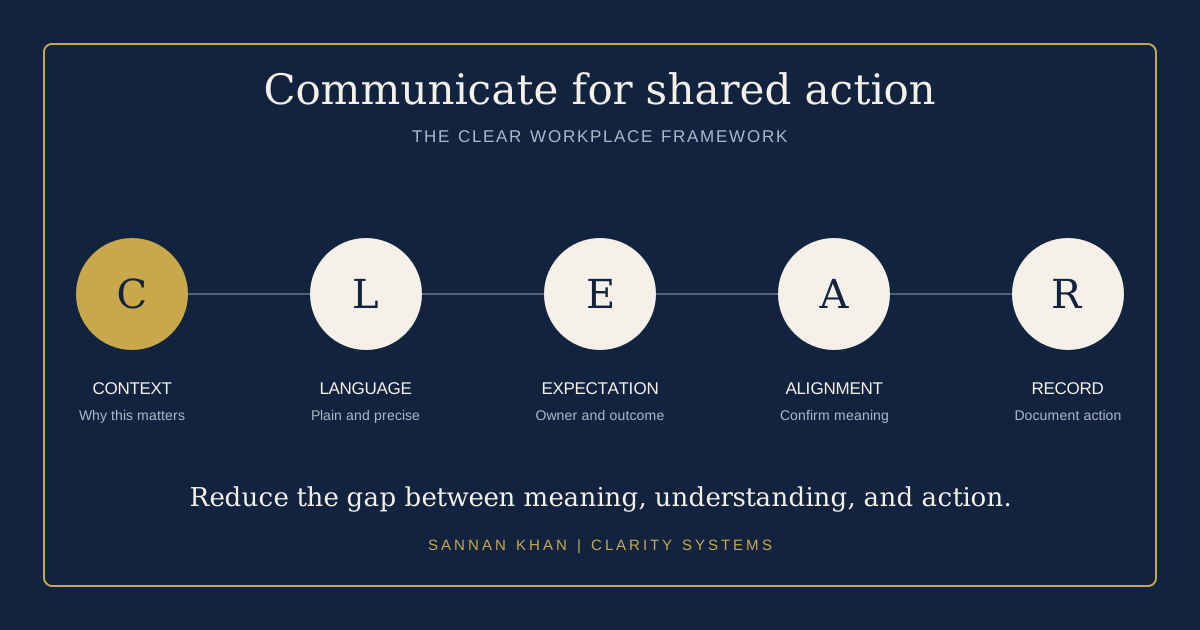
To communicate more effectively at work in the UAE, make five things explicit: the context, the language, the expectation, the point of alignment, and the written record. This CLEAR framework helps diverse teams turn conversations into shared understanding and dependable action without relying on assumptions.
A message can sound polite and still be unclear. A meeting can feel productive while different people leave with different decisions. A manager may believe a deadline was obvious while the employee heard it as a flexible preference. The problem is not always poor intention or weak English. It is often missing structure.
UAE workplaces can bring together colleagues, clients, suppliers, and leaders with different first languages, professional backgrounds, communication habits, and expectations of authority. That diversity is a strength, but it increases the cost of vague instructions and untested assumptions. Effective communication creates enough clarity for people to coordinate despite those differences.
What Do Communication Skills Mean at Work?
Workplace communication skills are the abilities used to understand information, express an idea, set expectations, handle disagreement, give feedback, and confirm action. They include speaking and writing, but they also include listening, asking useful questions, choosing the right channel, and following through.
The UAE's National Program for Advanced Skills identifies communication and collaboration among the advanced skills it promotes. It also includes social and cultural awareness, empathy, and adaptability. That combination is important: clear communication is not bluntness. It is accuracy delivered with awareness of the people and situation involved.
A polished accent is not the standard. Neither is speaking for the longest time in the room. Strong workplace communication produces a practical result: the right people understand the issue, the decision, their responsibility, and the next step.
Why Miscommunication Happens in Diverse UAE Teams
It is tempting to explain every misunderstanding as a cultural difference. That is too broad to be useful and can turn individuals into stereotypes. A better diagnosis looks at the specific points where meaning was lost.
- The purpose was hidden: people received information without knowing the decision or action required.
- The language carried assumptions: idioms, shorthand, technical terms, or indirect phrases meant different things to different people.
- The expectation was incomplete: no clear owner, output, deadline, quality standard, or dependency was named.
- Agreement was assumed: silence, politeness, or a quick "yes" was treated as proof of shared understanding.
- No record existed: a verbal decision changed scope or responsibility, but nobody documented it.
These failures can happen in any country. They become more visible when a team is multilingual, distributed across locations, working through several channels, or coordinating across seniority levels and external partners.
The CLEAR Workplace Communication Framework
Use CLEAR before an important request, meeting, feedback conversation, handover, or escalation. It is a five-part check, not a script that must sound identical every time.
C: Establish the Context
Start with why the conversation is happening. Name the project, problem, decision, customer need, or risk. Then state what you need from the other person.
Instead of forwarding a long email chain with "Please check," write: "The supplier has moved the delivery date. Please review the revised schedule and tell me by 3 p.m. whether it affects Friday's client milestone." The second version gives the reader a frame and a decision.
Context should be relevant, not exhaustive. Include what the person needs to make the next decision. Keep background material available, but do not make them search through it to discover the request.
L: Use Plain Language
Plain language is not simplistic language. It removes avoidable ambiguity. Use familiar words, shorter sentences, clear dates, and direct verbs. Explain technical terms when the audience may not share your specialist vocabulary.
Avoid idioms and local expressions in high-stakes communication. "Let's touch base and play it by ear" may be understood, but "Let's speak at 10 a.m. tomorrow and decide after the client replies" is easier to act on. Write dates as "11 August 2026" where numeric formats could be read differently, and state the timezone for cross-border meetings.
Language ability and professional ability are not the same thing. Give people enough time to process, ask questions, and respond without treating fluency, speed, or accent as a measure of intelligence.
E: Define the Expectation
A request is clear when it names five elements:
- Owner: who is responsible for moving it forward?
- Output: what exactly must be delivered or decided?
- Deadline: when is it needed, in which timezone?
- Standard: what does complete or acceptable look like?
- Dependencies: what information, approval, or person could block progress?
"Please prepare the report soon" leaves several variables open. "Maya owns the two-page client risk summary, using the latest cost sheet, for review by 2 p.m. Gulf Standard Time on Thursday" gives the team something testable.
Clarity does not remove professional judgment. It establishes the outcome and boundaries within which judgment can be used.
A: Align Understanding
Do not end an important conversation with "Is that clear?" People may say yes to avoid embarrassment, preserve momentum, or because they do not yet know what they have misunderstood. Ask a neutral question that tests the next step.
Try: "Before we close, can we confirm the decision, owners, and dates?" Or ask the person receiving a complex instruction to describe how they plan to approach it. This is not a memory test. It gives both sides a chance to find ambiguity before it becomes rework.
Alignment also means inviting relevant disagreement. A colleague may understand the request perfectly and still see a risk you missed. Ask: "What could prevent this plan from working?" and "What information would change the decision?"
R: Record the Decision
Follow a consequential conversation with a short written record. Capture the decision, owner, deadline, dependencies, and unresolved points. Use the channel your team treats as authoritative, whether that is email, a project system, or a documented workspace.
The record protects coordination, not ego. It should not read like an attempt to build a case against someone. A useful recap says: "Here is my understanding of what we agreed. Please correct anything I missed."
Written follow-through is especially valuable when people work across offices, shifts, timezones, clients, contractors, or several messaging platforms. It creates one reference point when memory and interpretation begin to diverge.
Communication is complete only when meaning becomes shared action, not when the speaker finishes talking.
How to Communicate Clearly in Meetings
Many meeting problems are decision problems disguised as communication problems. People do not know whether the purpose is to inform, explore, recommend, decide, or assign action.
Put the purpose in the invitation or opening line. For a decision meeting, share the decision required, the options, the evidence, and who has authority to decide. For a working meeting, define the output that should exist by the end.
Close with a decision recap:
- What did we decide?
- What remains unresolved?
- Who owns each action?
- When is each action due?
- What will trigger escalation or review?
A meeting without this close often creates a second meeting to interpret the first one.
Email, Messaging, Call, or Meeting?
The channel affects the message. Use a synchronous conversation when emotion, uncertainty, negotiation, or rapid clarification matters. Use writing when accuracy, traceability, detailed instructions, or future reference matters. Often the best sequence is a conversation followed by a short written recap.
- Email or project system: decisions, approvals, scope changes, detailed requests, and records.
- Messaging app: short coordination, status checks, and time-sensitive operational updates where company policy permits.
- Call or meeting: sensitive feedback, disagreement, ambiguity, negotiation, or a complex issue that would create a long message chain.
- Written recap: any conversation that changes ownership, timing, cost, risk, or deliverables.
Urgency does not make every channel appropriate. Follow your employer's policies for confidential, personal, legal, client, and commercially sensitive information.
How to Give Feedback Without Creating Defensiveness
Feedback becomes difficult when it mixes observation with judgment. "You are careless" assigns an identity. "The last two client updates did not include the revised completion date, so the client planned against an old schedule" identifies an observable gap and its effect.
Use four parts:
- Describe the specific behaviour or output.
- Explain the effect on the work, customer, risk, or team.
- Ask for the other person's context.
- Agree on a specific future behaviour and follow-up point.
Give sensitive feedback privately. Match the level of formality to the seriousness of the issue. Do not use a public group chat to correct someone when a private conversation would protect dignity and produce a better response.
Feedback should also move upward and sideways. When raising a concern with a manager or client, connect it to the shared objective: "To protect the Friday delivery, I need a priority decision between A and B by noon." This is clearer than quietly absorbing conflicting demands until the deadline fails.
How to Disagree Respectfully at Work
Professional disagreement is not disloyalty. A team that cannot surface risk will eventually discover it through failure. The challenge is to question the idea without turning the person into the problem.
State the shared objective, the point of disagreement, the evidence, and the tradeoff. For example: "We both want the launch to stay on schedule. I disagree with removing the test stage because the current defect rate could create more delay after release. Could we reduce the test scope instead?"
If authority is clear and a responsible decision has been made, confirm what you will execute and document any material risk through the proper channel. If the issue involves safety, harassment, discrimination, unlawful conduct, or an employment dispute, use the appropriate organizational process and current official or qualified support rather than treating it as a normal communication exercise. The UAE Ministry of Human Resources and Emiratisation provides a worker guidance and rights portal.
A Seven-Day Communication Practice
Communication improves through repeated, observable behaviour. Use this short practice to test the framework in your current role.
- Day 1: Rewrite one vague request with context, owner, output, deadline, and standard.
- Day 2: Remove idioms and unnecessary jargon from one important email.
- Day 3: Ask a neutral confirmation question instead of "Do you understand?"
- Day 4: End a meeting with decisions, owners, dates, and unresolved issues.
- Day 5: Give one piece of private feedback using behaviour, effect, context, and request.
- Day 6: Document one verbal decision in the team's accepted system.
- Day 7: Review where rework, delay, or tension decreased and where ambiguity remained.
Do not try to become a different personality in one week. Measure whether other people can act with less confusion and whether you need fewer corrective conversations.
Communication Skills and Career Progression
Good work can remain invisible when its value is not explained. A professional may solve difficult problems but report only tasks. Another may carry risks quietly until leaders assume nothing complex was involved. Communication makes contribution legible.
This does not mean self-promotion without substance. It means explaining the problem, your reasoning, the action, the result, and what the team learned. It also means raising constraints early, asking better questions, and closing commitments reliably.
For a broader career-positioning framework, read You Are Not Underqualified: Explain Your Value Clearly. If uncertainty about your wider direction is making every workplace interaction feel high stakes, use the Career Clarity hub to separate a communication gap from a role or direction problem.
What Strong Workplace Communication Looks Like
Strong communication is not constant agreement. It is a system in which people can ask, challenge, decide, and act without losing the meaning between stages.
You know the system is improving when requests require less interpretation, meetings create visible decisions, risks appear earlier, feedback focuses on work, and written records reduce repeated debate. The goal is not perfect wording. It is dependable coordination.
What are the most important workplace communication skills in the UAE?
The most useful skills are listening, plain-language explanation, clear requests, expectation setting, respectful feedback, confirmation of decisions, and reliable written follow-through. Their value is not limited to the UAE, but they are especially useful in diverse teams where people may use language, hierarchy, and communication channels differently.
How can I communicate clearly in a multicultural workplace?
Avoid assumptions and broad cultural stereotypes. State the purpose, use plain language, define the owner, output, deadline, and quality standard, then invite questions and ask for a brief confirmation of the agreed next step.
How should I give feedback at work without causing conflict?
Give sensitive feedback privately. Describe the observable behaviour, explain its effect on the work, make a specific future request, and allow the other person to add context. Focus on the work rather than assigning a motive or attacking identity.
When should a meeting be followed by an email?
Send a written recap when the meeting creates a decision, task, deadline, change of scope, dependency, approval, or risk. Record what was decided, who owns each action, when it is due, and what remains unresolved.
Can communication skills improve career progression?
Communication skills can make professional value easier to see because they improve coordination, trust, decision quality, and follow-through. They do not guarantee promotion, but they help others understand the problems you solve and the responsibility you can carry.
Turn a vague professional problem into a clear next move
The free Career Direction Map helps you reflect on role fit, confidence, pressure, focus, and your next professional move. For a private decision-mapping session, choose a UAE-friendly time online.
For teams and organizations
Workshops and structured group sessions can be adapted for professional communication, decision clarity, workplace readiness, and cross-functional coordination.
Disclaimer: This article provides educational communication and career-reflection frameworks. It is not employment, human-resources, legal, immigration, mental-health, or specialist professional advice. Follow current organizational policies and consult official sources or appropriately qualified professionals where needed.