Summary
Many people stay stuck because they are looking for a dream job.
They want a role that feels exciting, meaningful, stable, well-paid, respected, flexible, and perfectly aligned with who they are.
But the idea of a dream job often creates more pressure than clarity.
A better career question is not, "What is my dream job?"
The better question is, "What direction fits the way I think, work, grow, and want to live?"
A dream job sounds perfect.
A fitting direction is more useful.
It gives you a path to test, adjust, and build without waiting for one perfect answer to appear.
Key Takeaways
- The dream job idea can keep people stuck because it creates pressure to find one perfect role.
- A career does not need to feel exciting every day to be aligned.
- Fit is more important than fantasy.
- A good direction should match your strengths, energy, values, growth needs, and desired lifestyle.
- You may not need a completely new career. You may need a better-fitting role, environment, or path.
- Career clarity grows through diagnosis, testing, and pattern recognition.
Introduction
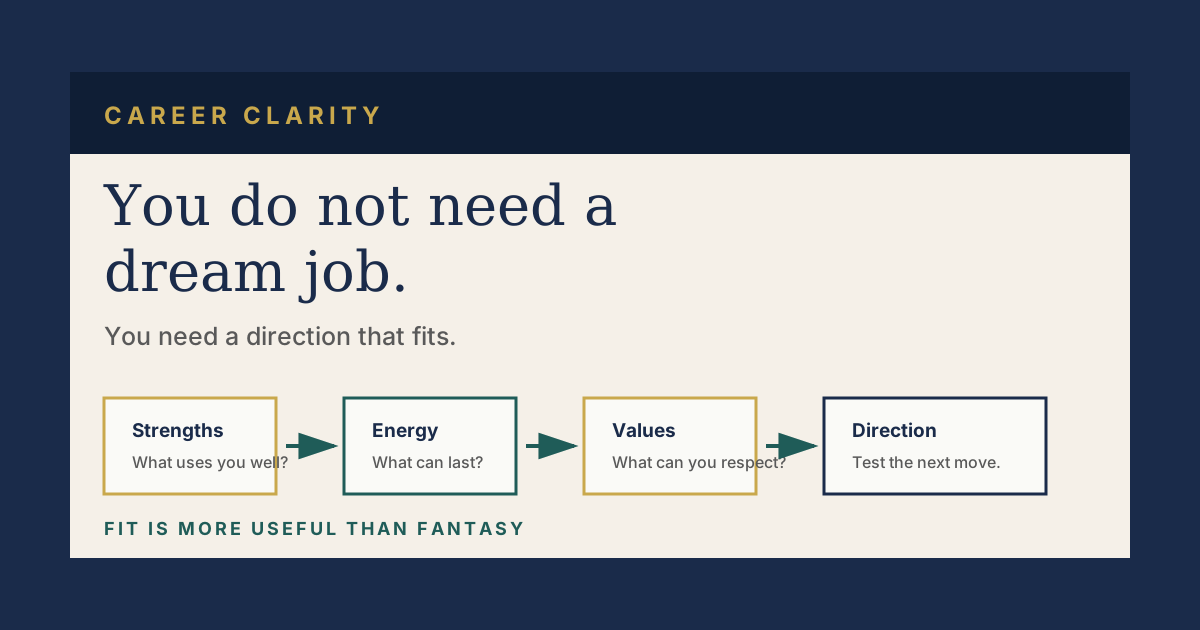
You may not need a dream job.
You may need a direction that fits.
That sentence may feel less exciting, but it is more useful.
Many people are stuck because they keep waiting for a career answer that feels perfect.
They want to wake up one day and suddenly know exactly what they are meant to do.
They want the job title, the industry, the salary, the plan, and the confidence.
They want certainty before they move.
So they keep searching.
They take quizzes.
They watch videos.
They read career advice.
They compare themselves to people online.
They ask friends what they should do.
They imagine different lives.
But the more they search, the more confused they become.
Because the problem is not always that they have no options.
The problem is that they are trying to find a dream job instead of diagnosing what kind of direction actually fits them.
The Dream Job Idea Can Become a Trap
The phrase "dream job" sounds positive.
It suggests purpose, excitement, success, and fulfillment.
But it can also create a hidden problem.
It makes people believe that career clarity should feel magical.
If the role does not excite them immediately, they assume it is wrong.
If the work has difficult parts, they assume it is not aligned.
If the path requires effort, patience, or boring seasons, they think they made the wrong choice.
If they cannot name one perfect job, they feel lost.
This is how the dream job idea becomes a trap.
It makes people search for emotional certainty instead of practical fit.
A real career is not a fantasy.
It has pressure, repetition, growth, conflict, learning, responsibility, and trade-offs.
The goal is not to find work that never feels hard.
The goal is to find a direction where the difficulty is worth carrying.
Fit Is Better Than Fantasy
A fantasy career is built in your imagination.
A fitting career is tested in real life.
A fantasy career looks good from the outside.
A fitting career works with who you actually are.
A fantasy career focuses on how the role appears.
A fitting career pays attention to how the work affects your energy, identity, skill, and future.
This distinction matters.
You may imagine a career is perfect because it looks creative, respected, flexible, or successful.
But when you touch the actual work, you may discover that it requires a kind of pressure, personality, routine, or sacrifice that does not fit you.
Another path may look less glamorous from the outside but fit you better in reality.
That is why career clarity should not be built only on attraction.
It should be built on evidence.
What Does Career Fit Actually Mean?
Career fit is not one thing.
It is a combination of several things working together.
A career may fit your skills but not your values.
It may fit your values but not your lifestyle.
It may fit your lifestyle but not your growth needs.
It may fit your personality but not your financial responsibilities.
That is why simplistic advice can be dangerous.
"Follow your passion" is too vague.
"Choose what pays well" is too narrow.
"Do what you are good at" is incomplete.
A better question is:
Does this direction fit enough of who I am and the life I am trying to build?
Career fit includes strength fit, energy fit, value fit, environment fit, lifestyle fit, and future fit.
When these areas are ignored, even a good job can start to feel wrong.
Strength Fit: Does This Work Use the Right Part of You?
Strength fit asks whether your work uses the abilities that come most naturally to you.
Not only what you can do.
What you can keep doing without slowly losing yourself.
Many people are good at things that drain them.
They can organize.
They can manage conflict.
They can present.
They can write.
They can sell.
They can lead.
They can analyze.
They can handle pressure.
But just because you can do something does not mean it should become the center of your career.
A fitting direction uses strengths you can grow with.
It does not trap you inside abilities that only others benefit from while you become exhausted.
Ask yourself:
What kind of work brings out my best thinking?
What do people trust me with repeatedly?
What feels difficult but meaningful?
What am I good at that I still want to become better at?
What am I good at but tired of being known for?
That last question is important.
Sometimes the next career direction begins when you stop building your future around a strength that no longer fits your identity.
Energy Fit: What Does This Work Do to You?
A career does not only use your time.
It uses your energy.
Some work leaves you tired but satisfied.
Some work leaves you tired and empty.
Those are different.
Tired but satisfied usually means the work required effort, but something about it still connected with your strengths, values, or sense of contribution.
Tired and empty often means the work required you to perform against yourself for too long.
Energy fit asks:
What kind of work drains me in a healthy way?
What kind of work drains me in a damaging way?
What tasks do I avoid again and again?
What responsibilities make me feel more alive?
What environments make me smaller?
What rhythms help me work well?
Many people ignore energy fit because they think adulthood means tolerating constant exhaustion.
But exhaustion is information.
Not all tiredness means the career is wrong.
But repeated emptiness should be studied.
Value Fit: Can You Respect What This Path Is Building?
A job can be impressive and still feel empty.
A career can be stable and still feel misaligned.
Value fit asks whether the work connects with what you believe matters.
This does not mean every job must feel like a life mission.
Not every role will feel deeply meaningful every day.
But you should be able to respect the direction your work is taking your life.
If you consistently feel that your work is building something you do not care about, serving goals you do not respect, or shaping you into someone you do not want to become, that is important.
The question is not only, "Can I do this job?"
The question is, "Can I respect the life this job is helping me build?"
That question brings career clarity closer to truth.
Environment Fit: Where Do You Do Your Best Work?
Some people thrive in structure.
Others need freedom.
Some work best with collaboration.
Others need deep independent focus.
Some can handle fast-paced environments.
Others do their best work in calmer systems.
Some enjoy public-facing roles.
Others are better behind the scenes.
Environment fit matters because the same person can look capable in one environment and completely drained in another.
You may not be bad at your career.
You may be in the wrong environment.
You may not lack discipline.
You may be working inside a structure that constantly interrupts your best attention.
You may not hate your field.
You may hate the culture around your current role.
Before changing your entire career, examine the environment.
Sometimes the direction is right, but the room is wrong.
Lifestyle Fit: Does This Career Match the Life You Can Actually Live?
A career does not exist separately from your life.
It affects your time, health, family, marriage, children, finances, location, sleep, and emotional capacity.
Some careers look attractive until you understand the lifestyle attached to them.
The travel.
The deadlines.
The instability.
The public pressure.
The emotional labour.
The long hours.
The slow income growth.
The constant networking.
The need to always be available.
Lifestyle fit asks whether the career can realistically live inside the life you want or the responsibilities you already carry.
This is not about being unambitious.
It is about being honest.
A direction that destroys the rest of your life may not be fit, even if it looks successful.
Future Fit: Do You Want the Life This Path Leads To?
One of the clearest career diagnosis questions is this:
Look at the people five or ten years ahead of you in this path.
Do you want the kind of life many of them are living?
Not only their salary.
Their pressure.
Their schedule.
Their identity.
Their responsibilities.
Their trade-offs.
Their emotional state.
Their version of success.
If the future of the path does not attract you, pay attention.
You may be able to tolerate the job today, but the path may be moving you toward a future you do not want.
A career is not only what you do now.
It is what your current choices are training your life to become.
Why You May Feel Lost Even With Good Options
Sometimes confusion does not come from having no options.
It comes from having options that each fit only part of you.
One option fits your skills but not your values.
Another fits your values but not your financial needs.
Another fits your lifestyle but not your growth.
Another fits your ambition but not your family responsibilities.
This is why career decisions feel complicated.
You are not only choosing a job.
You are choosing a set of trade-offs.
A mature career decision does not pretend trade-offs do not exist.
It asks which trade-offs are honest, sustainable, and worth accepting.
The goal is not to find the option with no cost.
The goal is to find the direction where the cost makes sense.
Stop Asking Only What You Love
"What do I love?" can be useful.
But it is not enough.
You may love something as a hobby but hate it as a job.
You may love a topic but dislike the daily work attached to it.
You may love the idea of a career but not the pressure that comes with it.
You may love the lifestyle someone displays online but not the work behind it.
Love is a clue.
It is not the whole diagnosis.
Ask better questions:
What problems can I stay with?
What skills do I want to keep building?
What kind of pressure can I tolerate?
What kind of people do I want to serve or work with?
What work gives me energy after the initial excitement fades?
What future would I respect even on hard days?
These questions are more useful than asking for one perfect passion.
You May Need a Direction, Not a Job Title
Some people stay stuck because they think clarity must appear as a specific job title.
But early clarity often appears as a direction.
For example:
"I want to move toward work that involves teaching, communication, and helping people think clearly."
"I want to move away from reactive admin work and toward strategic operations."
"I want to move toward creative problem-solving with more ownership."
"I want to move toward work that combines technology, people, and business."
"I want to move away from constant client-facing pressure and toward deeper specialist work."
That is direction.
It may not be a final job title yet, but it is useful.
A direction allows you to explore roles, industries, projects, and skills with a clearer filter.
You do not need the whole map to begin.
You need a better compass.
The Direction Filter
Use this simple filter when evaluating a possible career direction.
1. Does it use my natural strengths?
Not all of them.
But enough of them.
If a path constantly forces you to operate from your weakest side, it will become heavy over time.
2. Does it match my energy pattern?
Some people can handle high interaction.
Others need quiet focus.
Some need variety.
Others need depth.
Choose with your actual energy, not your fantasy personality.
3. Does it respect my values?
You do not need perfect meaning every day.
But you should not feel like your work is constantly violating what matters to you.
4. Does it fit my real life?
Your responsibilities matter.
Your financial needs matter.
Your health matters.
Your family context matters.
A direction that ignores reality may become another source of pressure.
5. Does it create a future I can respect?
Do not only choose for today's escape.
Choose for the kind of person and life this path is building.
If a direction passes enough of these questions, it may be worth testing.
Test the Direction Before You Trust It
Do not trust a career idea only because it sounds exciting.
Test it.
Speak to people who are already doing the work.
Study real job descriptions.
Try a small project.
Volunteer.
Freelance.
Shadow someone.
Take a short course.
Build a sample.
Write about the topic.
Offer help in a small way.
Testing gives you information that imagination cannot.
You may discover that the work is better than you expected.
You may discover that the fantasy was stronger than the fit.
Either way, you gain clarity.
A career direction becomes stronger when it survives contact with reality.
What If Nothing Feels Like a Dream?
That does not mean something is wrong with you.
Some people do not experience career clarity as excitement.
They experience it as steadiness.
A path may not feel like a dream.
It may simply feel honest.
It may feel useful.
It may feel like work you can respect.
It may fit your strengths.
It may create growth.
It may allow you to build a stable life.
It may give you room to become more yourself.
That matters.
Not every good career feels like fireworks.
Some good careers feel like alignment, capacity, and quiet confidence.
Do not dismiss a fitting direction because it does not feel dramatic.
Drama is not the same as clarity.
When a Good Career Still Has Hard Days
A fitting direction does not remove difficulty.
There will still be boring tasks.
There will still be pressure.
There will still be uncertainty.
There will still be people problems.
There will still be moments of doubt.
The difference is that the difficulty has a reason.
You understand why the work matters.
You see how it connects to your growth.
You know which part of you it is developing.
You can recover from hard days without questioning your whole identity every time.
In a wrong direction, hard days make you feel trapped.
In a fitting direction, hard days may still be hard, but they do not always make the whole path feel false.
That is an important difference.
Do Not Let Other People's Approval Choose for You
Sometimes the dream job is not even your dream.
It is the job your parents respect.
The job your friends admire.
The job your community understands.
The job that looks good online.
The job that makes you feel successful in other people's eyes.
But borrowed approval becomes expensive.
You may get the title and lose yourself inside it.
You may receive praise while feeling empty.
You may build a life that looks stable but feels misaligned.
Approval can feel comforting, but it cannot do your work for you.
Other people may respect the path.
But you have to live inside it.
That is why career fit must be personal.
Not selfish.
Personal.
Because you are the one who will carry the daily cost.
A Better Career Question
Instead of asking, "What is my dream job?" ask:
"What direction would make better use of who I actually am?"
That question is less romantic.
But it is more honest.
It makes you look at your strengths.
Your energy.
Your values.
Your responsibilities.
Your patterns.
Your future.
Your actual life.
It moves you away from fantasy and toward fit.
And fit is what allows a career to become sustainable.
Final Thought
You do not need a dream job.
You need a direction that fits.
A dream job can become a fantasy that keeps you waiting for perfect certainty.
A fitting direction gives you something to test, build, and refine.
It may not answer every question immediately.
But it helps you stop choosing randomly.
It helps you stop copying other people.
It helps you stop staying in places that drain you just because you cannot name the perfect alternative.
Career clarity is not always about finding one magical role.
Sometimes it is about understanding what kind of work, environment, responsibility, pressure, and future actually fit the person you are becoming.
So stop asking only, "What job would make me happy?"
Ask:
What uses my strengths?
What respects my energy?
What matches my values?
What fits my real life?
What future can I respect?
That is where direction begins.
Not in a fantasy.
In fit.
And once you find a direction that fits, you can start building from there.
Need Career Clarity?
If you are tired of searching for the perfect career but still feel unsure what direction actually fits you, a structured Career Clarity session can help.
Together, we can look at your strengths, energy, values, current pressure, and future direction so you can stop guessing and start making a clearer next move.
You do not need a dream job to appear overnight.
You need a direction you can trust enough to test.
Book a Career Direction Clarity Session
If you are done searching for a perfect dream job and want to map a direction that actually fits, a Career Direction Clarity session can help you diagnose the next right move.