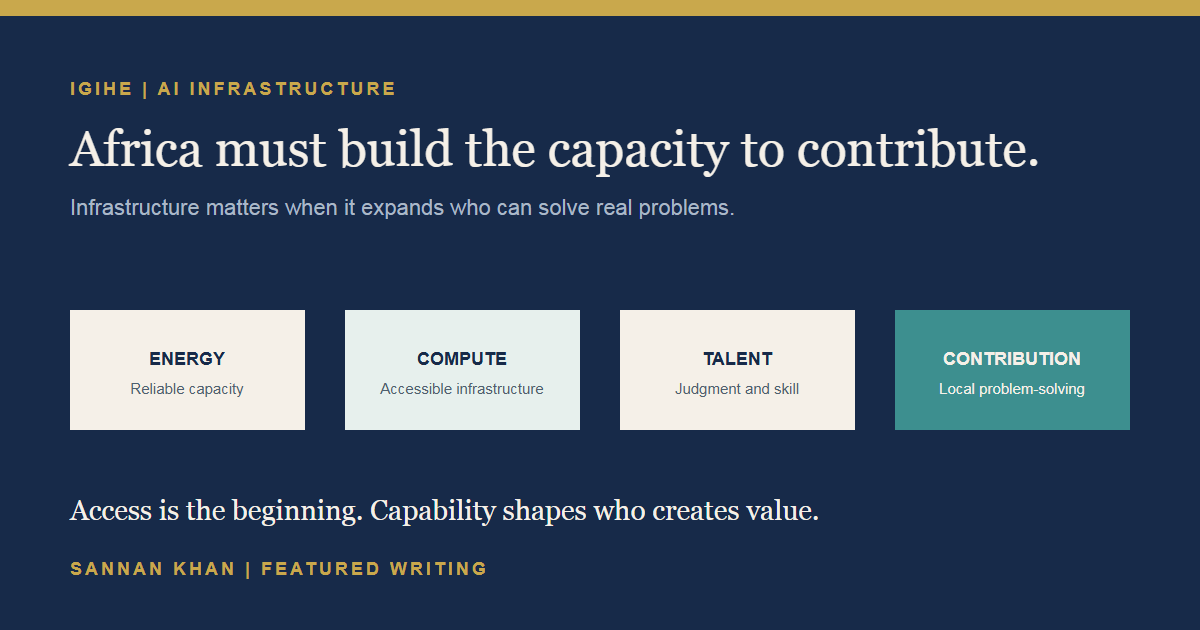
The complete opinion remains on IGIHE's website. This feature summary introduces its central question and connects it to related public-interest and organizational frameworks on SannanKhan.com.
It is a signal that future AI capability will depend on more than access to software. Countries and institutions also need reliable infrastructure, relevant talent, responsible judgment, and the ability to apply technology to problems people actually face.
Infrastructure shapes who can build
The scale of global AI investment shows that compute, energy, connectivity, data systems, and technical capability are becoming strategic assets. If African markets engage only as end users, they may consume powerful tools without developing enough influence over what is built, where value is created, or which local problems receive sustained attention.
The useful response is not to imitate every global spending decision. It is to identify the capabilities that make participation possible: dependable infrastructure, strong institutions, domain expertise, technical learning, research partnerships, and professionals who can connect AI to health, education, agriculture, finance, public services, and productive industry.
From access to contribution
Access matters, but contribution is the stronger standard. A serious AI strategy asks whether people can define problems, verify outputs, protect responsibility, improve workflows, and build solutions that fit local conditions.
That requires coordination between government, universities, employers, investors, technology communities, and young professionals. The question is not only whether Africa will use the next generation of AI infrastructure. It is whether African institutions and professionals will develop enough capability to shape what that infrastructure makes possible.