Summary
Advice can be useful.
But too much advice can become another form of confusion.
You ask one person. Then another. Then another. You listen to podcasts, read articles, watch videos, collect opinions, and keep searching for the answer that finally makes you feel certain.
But the more advice you gather, the less clear you feel.
This happens when advice becomes a substitute for judgment.
Sometimes you are not asking because you need more information.
You are asking because you are afraid to own the decision.
The problem is not that nobody has given you the right answer.
The problem may be that you are trying to borrow certainty from other people because you do not yet trust your own.
Key Takeaways
- Asking for advice is helpful when it adds perspective, but harmful when it replaces decision-making.
- Too many opinions can make a decision feel heavier, not clearer.
- People give advice from their own fears, values, experiences, and limits.
- The final decision still has to fit your life, not someone else's comfort.
- You may keep asking because you want permission, certainty, or protection from regret.
- Strong judgment is built by learning how to listen, filter, decide, and take responsibility.
Introduction
You ask everyone what they think.
A friend. A mentor. A family member. A colleague. Someone older. Someone successful. Someone who knows you. Someone who does not know you but seems confident.
At first, asking helps.
You feel less alone. You get new perspectives. You hear things you had not considered.
But then the advice starts pulling you in different directions.
One person says, "Take the risk."
Another says, "Be practical."
One person says, "You deserve better."
Another says, "Be patient."
One person says, "Leave."
Another says, "Try harder."
One person says, "Start now."
Another says, "Wait."
Now you are not clearer.
You are more divided.
You came looking for direction, but you left with more voices in your head.
This is the hidden problem with too much advice.
It can feel like wisdom, but it can become noise.
At some point, the issue is no longer that you do not have enough input.
The issue is that you do not trust your own judgment enough to decide.
Advice Is Useful Until It Becomes a Hiding Place
Advice can be valuable.
Good advice can challenge blind spots. It can show you risks you missed. It can help you slow down when emotions are too high. It can help you see options more clearly. It can bring wisdom from someone who has walked a similar path.
The problem begins when advice becomes a place to hide from responsibility.
You keep asking because you do not want to choose yet.
You keep listening because listening feels safer than deciding.
You keep gathering perspectives because every new opinion delays the moment you have to act.
This is not always obvious.
It may look like you are being thoughtful. It may sound like you are being mature.
But if the advice is not moving you toward a decision, it may be keeping you away from one.
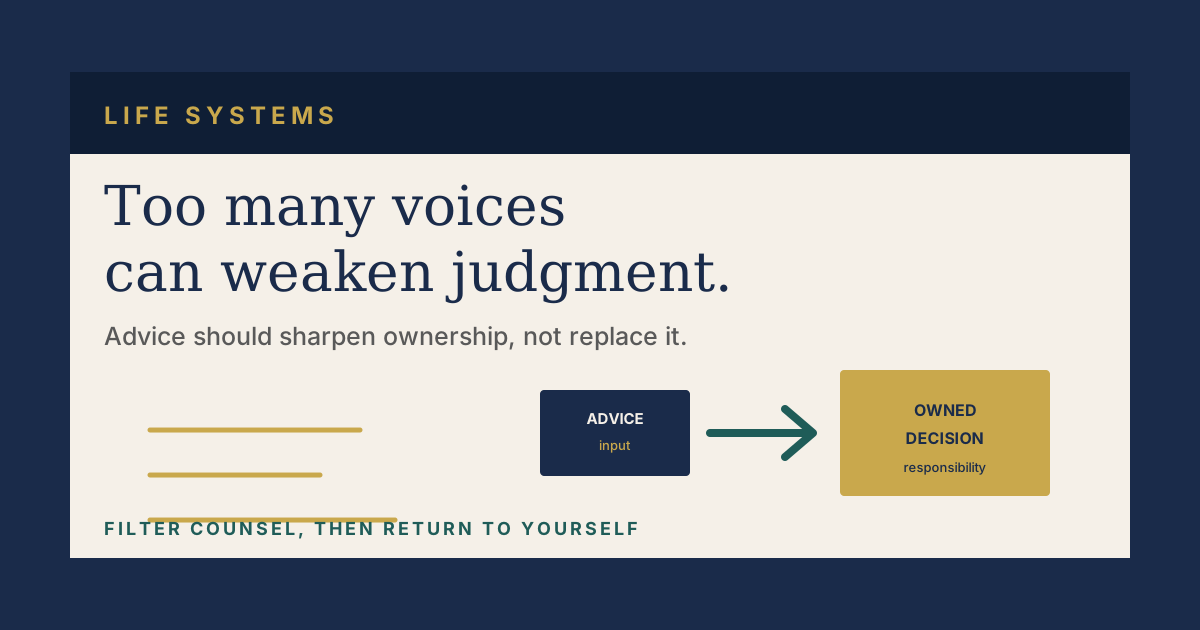
Advice should support judgment.
It should not replace it.
Too Many Opinions Can Weaken Clarity
Every opinion enters your mind with a different value system behind it.
One person values security. Another values freedom. One person fears regret. Another fears staying stuck.
One person thinks about money first. Another thinks about meaning first.
One person has been hurt before, so they advise protection. Another has taken risks before, so they advise courage.
One person sees your situation through faith. Another sees it through practicality.
One person sees your potential. Another sees only the danger.
None of them may be completely wrong.
But all of them are speaking from a particular lens.
If you collect too many lenses without knowing your own, you will become confused.
You will start asking: Who is right? Whose advice should I follow? What if I disappoint them? What if they see something I do not? What if I choose wrong?
This is why too many opinions can weaken clarity.
They multiply the voices without strengthening the decision.
People Advise From Their Own Life, Not Yours
Even loving people give advice from their own experience.
A parent may advise from fear of your struggle. A friend may advise from what they wish they had done. A mentor may advise from what worked in their season. A successful person may advise from a path that fits their personality, not yours.
A hurt person may advise you to protect yourself more. A bold person may advise you to take a risk faster. A practical person may advise stability. A restless person may advise change.
This does not make their advice useless.
It means you need to understand where it comes from.
Advice is rarely neutral.
It carries the adviser's history. Their wounds. Their success. Their fear. Their values. Their temperament. Their relationship with risk. Their understanding of what a good life means.
That is why you cannot outsource your life to someone else's opinion.
Their advice may be helpful.
But your decision must be yours.
You May Be Looking for Permission
Sometimes we say we want advice, but what we really want is permission.
Permission to leave. Permission to stay. Permission to change careers. Permission to rest. Permission to start again. Permission to say no. Permission to choose differently from what people expected. Permission to stop carrying something that has become too heavy.
This is human.
Many people struggle to trust their own desire, pain, or clarity unless someone else confirms it first.
They think: "If someone wise agrees, then I am allowed." "If someone else says it makes sense, then I am not selfish." "If enough people support the decision, then I can move."
But a life decision cannot always wait for unanimous permission.
Some decisions will disappoint people. Some decisions will be misunderstood. Some decisions will look risky from the outside. Some decisions will only make sense to people after they see the outcome.
If you need everyone's permission before you move, your life will remain controlled by other people's comfort.
You May Be Looking for Certainty
Advice often becomes addictive because it gives the feeling that certainty might be one more conversation away.
Maybe the next person will say the perfect sentence. Maybe the next article will explain it clearly. Maybe the next video will give the framework. Maybe the next mentor will know. Maybe the next opinion will finally remove the doubt.
But many decisions do not come with full certainty.
Especially decisions about marriage, career, business, family, money, faith, identity, and life direction.
You may get enough clarity to take the next responsible step.
But you may not get complete certainty before acting.
This is why endless advice can become frustrating.
You keep asking for something advice cannot fully provide.
Advice can inform you. It cannot remove all risk.
Advice can guide you. It cannot live the consequences for you.
Advice can sharpen your thinking. It cannot guarantee the outcome.
At some point, certainty has to become responsibility.
The Hidden Fear of Owning the Decision
Sometimes we keep asking because we are afraid of ownership.
If someone else tells us what to do, we feel less alone with the consequence.
If it goes wrong, we can say: "They told me to do it." "I followed their advice." "I thought they knew better." "I was only listening to people I trusted."
This protects us emotionally for a while.
But it creates a deeper problem.
You begin to trust other people's judgment more than your own. You become dependent on external confirmation. You struggle to make decisions without consulting everyone. You feel anxious when no one gives you a clear answer. You lose the ability to hear your own inner reasoning.
A mature life requires ownership.
Not perfect decisions.
Owned decisions.
You can receive advice. You can learn. You can seek counsel.
But the final decision must return to you.
The Difference Between Counsel and Noise
Not all advice is equal.
Some advice is counsel.
Some advice is noise.
Counsel helps you think more clearly. Noise makes you more anxious.
Counsel asks good questions. Noise gives quick opinions without understanding the full situation.
Counsel considers your values, responsibilities, patterns, and context. Noise projects someone else's fear onto your life.
Counsel helps you see the decision. Noise makes you doubt yourself without offering structure.
Counsel respects your ownership. Noise tries to control the outcome.
This difference matters.
You do not need more voices.
You need better voices.
Sometimes clarity comes not from asking more people, but from asking fewer, wiser, more relevant people.
How to Know Whose Advice to Take Seriously
Before taking advice seriously, ask:
- Does this person understand the situation deeply enough?
- Do they understand my values?
- Do they understand the cost of both options?
- Do they have wisdom in this area, or just an opinion?
- Are they advising from fear, ego, experience, or real insight?
- Do they respect my ability to decide?
- Do they ask questions before giving answers?
- Do they understand the difference between what worked for them and what may fit me?
A person can love you and still give unhelpful advice.
A person can be successful and still give advice that does not fit your life.
A person can be confident and still be wrong for your context.
Confidence is not the same as wisdom.
Be careful who gets access to your undecided mind.
The Advice Filter
Use this simple filter when receiving advice.
1. What Is Useful Here?
Do not accept or reject the whole opinion immediately.
Ask what part is useful.
There may be one sentence worth keeping and the rest may not fit.
2. What Is Missing?
What does this person not know?
What context are they not seeing?
What part of your life are they not carrying?
3. What Value Is Behind This Advice?
Is the advice built around safety, freedom, duty, growth, peace, money, reputation, faith, or family?
Knowing the value behind the advice helps you decide whether it fits your own values.
4. What Fear Is Behind This Advice?
Sometimes people advise from fear: fear of failure, judgment, loneliness, instability, conflict, or regret.
That fear may be worth considering, but it should not automatically lead.
5. Does This Advice Help Me Take Responsibility?
Good advice strengthens ownership.
Bad advice makes you dependent.
The best advice does not take your decision away from you.
It helps you make it more clearly.
Stop Asking People Who Benefit From Your Confusion
This is important.
Not everyone is neutral.
Some people benefit when you remain available. Some benefit when you do not set boundaries. Some benefit when you stay in the same role. Some benefit when you keep carrying the relationship. Some benefit when you do not change. Some benefit when your confidence stays low.
This does not always mean they are bad people.
But their advice may be influenced by what your decision will cost them.
If your boundary affects someone, they may advise against it.
If your growth changes the relationship, they may question it.
If your decision reduces their access to you, they may call you selfish.
If your clarity disrupts their comfort, they may call you dramatic.
Be careful about asking advice from people who are emotionally or practically invested in you staying the same.
They may not be able to see clearly.
Your Body May Know Before Your Words Do
Sometimes your mind keeps asking for advice because your body already knows something is wrong, but your words have not caught up yet.
You feel tight when you think about staying. You feel lighter when you imagine leaving. You feel dread before certain conversations. You feel calm after naming a boundary. You feel heavy when you agree to something you do not want. You feel relief when you finally tell the truth.
This does not mean every feeling is a final answer.
Feelings need interpretation.
But your body may be giving you information that your mind is trying to negotiate away.
If every piece of advice makes logical sense but your whole system still feels unsettled, pay attention.
The question is not only, "What do people think?"
The question is, "What is my own system trying to tell me?"
When Advice Becomes Avoidance
You may be using advice as avoidance if you already know the next step but keep asking anyway.
You may be using advice as avoidance if every conversation ends with more thinking and no action.
You may be using advice as avoidance if you ask different people until someone gives the answer you prefer.
You may be using advice as avoidance if you feel temporary relief after asking, but the same decision returns again.
You may be using advice as avoidance if you are more focused on getting reassurance than seeing truth.
You may be using advice as avoidance if your question has become a loop.
A question becomes a loop when it no longer produces new insight.
It only delays responsibility.
When that happens, you do not need another opinion.
You need a decision structure.
Build Judgment Instead of Collecting Opinions
Judgment is the ability to take information, understand context, weigh consequences, and choose responsibly.
It is not the same as instinct. It is not the same as impulse. It is not the same as fear.
Judgment is built through practice.
You decide. You observe the result. You learn. You adjust. You become more honest about patterns. You take responsibility. You make better decisions next time.
If you never practice deciding, your judgment stays weak.
This is why outsourcing every decision is dangerous.
It may feel safer in the short term, but it prevents you from developing the very ability you need most.
You cannot become clear by avoiding every decision.
You become clearer by learning how to decide well.
A Better Way to Ask for Advice
Instead of asking, "What should I do?" ask better questions.
Ask: "What am I not seeing?" "What risk should I consider?" "What pattern do you notice?" "What question should I ask myself?" "What would you want me to think through before deciding?" "What consequence am I underestimating?" "What part of this sounds like fear?"
These questions keep ownership with you.
They invite perspective without handing over control.
They also help the other person give better input.
When you ask, "What should I do?" people may answer too quickly.
When you ask, "What am I not seeing?" they help you think.
That is more useful.
The Decision Owner Rule
Use this rule:
The person who will carry the consequence should own the decision.
Other people can advise. They can guide. They can warn. They can support. They can challenge.
But they do not have to live inside the result the way you do.
You are the one who will wake up in that job.
You are the one who will live in that marriage.
You are the one who will carry that business.
You are the one who will manage that boundary.
You are the one who will feel the cost of staying or leaving.
So the decision must return to you.
This does not mean you ignore wise counsel.
It means you understand the difference between receiving advice and surrendering ownership.
The Three-Person Rule
If you are stuck in advice overload, limit the voices.
Choose no more than three people.
One person who knows you deeply.
One person who understands the subject.
One person who can be honest without controlling you.
That is enough.
If those three voices are chosen wisely, you will usually have enough perspective.
After that, more opinions may only create more noise.
The goal is not to build a jury for your life.
The goal is to gather enough insight to make a responsible decision.
Too many voices can make you feel less alone.
But they can also make you less clear.
The Advice Deadline
If a decision has been open for too long, give advice-gathering a deadline.
For example: "I will ask these two people by Friday, then I will decide the next step." "I will research this for one week, then I will choose a test move." "I will take counsel this month, but I will not keep reopening the question after that."
This does not force a reckless decision.
It prevents endless gathering.
Advice without a deadline can become an emotional open loop.
You keep collecting. You keep thinking. You keep delaying.
A deadline gives the process structure.
It tells your mind, "We are not avoiding this forever."
What If You Make the Wrong Decision?
You might.
That is part of being human.
But avoiding every decision does not protect you from mistakes.
It creates a different mistake.
The mistake of staying stuck. The mistake of letting time decide for you. The mistake of allowing other people's opinions to become your life. The mistake of never learning to trust yourself.
A wrong decision can teach you.
A delayed life can drain you.
This does not mean you should be careless.
It means you should be responsible without demanding perfection.
Gather the information. Seek wise counsel. Check the pattern. Consider the cost.
Then make the next honest decision.
You do not need to guarantee the whole future.
You need to take responsibility for the next step.
Trusting Yourself Does Not Mean Ignoring Everyone Else
Self-trust is not arrogance.
It does not mean you think you are always right. It does not mean you stop listening. It does not mean you reject correction.
Real self-trust means you can listen without disappearing.
You can receive advice without surrendering your judgment.
You can be challenged without collapsing.
You can admit uncertainty without handing someone else the steering wheel.
You can make a decision and stay responsible for learning from it.
That is mature self-trust.
Not stubbornness. Not isolation. Not ego.
A clear person can listen deeply and still decide honestly.
The Decision Clarity Practice
When you feel pulled in too many directions, use this practice.
Write the decision at the top of the page.
Then answer:
- What do I already know?
- What am I afraid to admit?
- What advice have I received?
- Which advice feels wise?
- Which advice feels like fear?
- What values matter most in this decision?
- What are the costs of each option?
- What is the cost of delaying?
- What is the next responsible step?
Then close the page and wait.
Not forever.
Just long enough to let the noise settle.
Often, clarity does not come while every voice is still talking.
It comes when you return to your own judgment after listening carefully.
Final Thought
You may not need more advice.
You may need more trust in your own judgment.
Advice is useful when it helps you see.
It becomes harmful when it helps you hide.
If you keep asking everyone what to do and still feel unclear, pause.
Ask whether you are gathering wisdom or avoiding ownership.
Ask whether you are looking for perspective or permission.
Ask whether you are seeking counsel or collecting noise.
Ask whether the decision is truly unclear, or whether the next step is uncomfortable.
Your life cannot be lived by committee.
Other people can guide you. They can love you. They can warn you. They can challenge you.
But they cannot become the final authority over a life they do not have to carry.
Listen well. Filter carefully. Choose your voices wisely.
Then return to yourself.
Because the goal is not to make decisions alone.
The goal is to make decisions that you can honestly own.
And sometimes clarity begins when you stop asking everyone else what your own judgment has been trying to tell you.
Need Life Direction Clarity?
If you keep asking for advice but still feel stuck, the problem may not be lack of information.
It may be decision overload, fear of ownership, or lack of trust in your own judgment.
A structured clarity session can help you separate useful counsel from noise, identify the real decision, and choose the next responsible step.
You do not need more voices in your head.
You need a clearer way to decide.
Start With the Life Direction Map
If your decision feels crowded by too many voices, use the Life Direction Map to identify what is actually pulling your attention and what the next responsible step may be.