Summary
Waiting can look wise.
You tell yourself you are being patient. Careful. Responsible. Strategic.
You say the timing is not right yet.
You need more clarity, more money, more confidence, more support, more information, more emotional stability, or one more sign that the decision is safe.
But sometimes waiting is not wisdom.
Sometimes waiting is avoidance with better language.
The right time rarely arrives as a perfect moment. Most important moves begin before you feel fully ready.
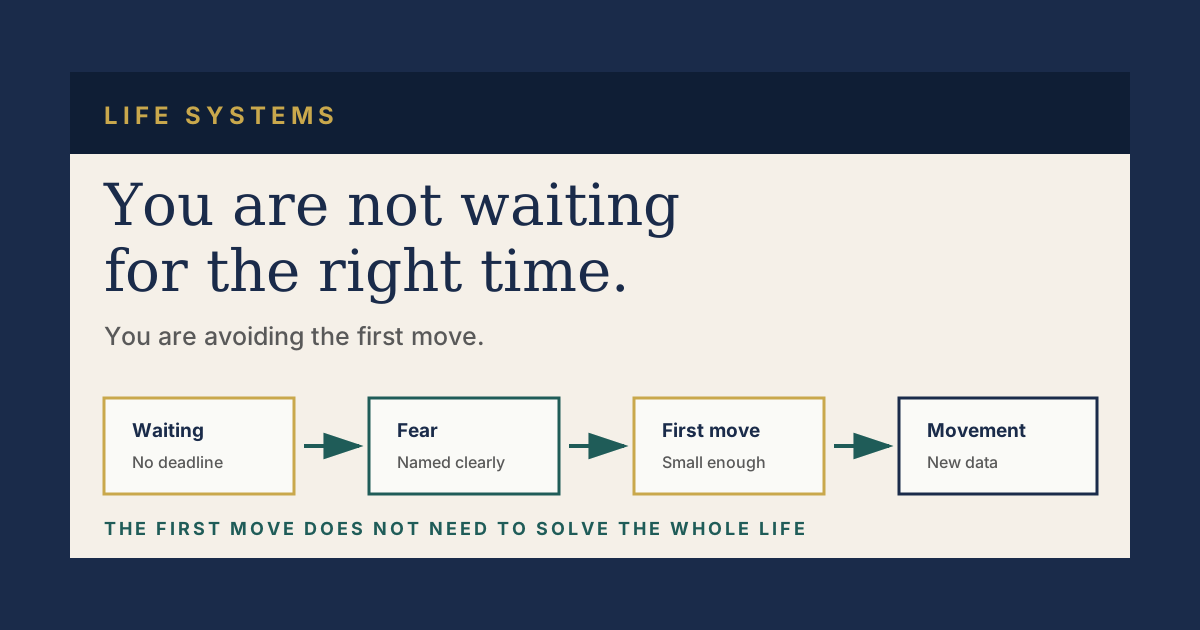
If your life has been paused for too long, the issue may not be timing.
The issue may be fear of the first move.
Key Takeaways
- Waiting for the right time can be useful, but it can also become a form of avoidance.
- The perfect time often does not arrive before action. Clarity often comes after movement.
- Many people delay because they want certainty before responsibility.
- The first move does not need to solve the whole life. It only needs to create honest movement.
- If you keep postponing the same decision, you may not need more time. You may need a smaller first step.
- Life changes when waiting turns into structure, and structure turns into action.
Introduction
You keep saying, "Not yet."
Not now.
Not this week.
Not until things settle down.
Not until you feel clearer.
Not until the pressure reduces.
Not until you have more money.
Not until the relationship becomes easier.
Not until the family situation improves.
Not until work slows down.
Not until you feel ready.
At first, this sounds reasonable.
There are real seasons where waiting is wise. Some decisions need time. Some moves need preparation. Some situations require patience.
But there is another kind of waiting.
The kind that keeps your life in the same place for months or years.
The kind where nothing is being prepared, only postponed.
The kind where you keep thinking about the same move, but never take it.
The kind where you call it timing, but deep down, you know fear is involved.
This is the quiet trap.
You think you are waiting for the right time.
But you may actually be avoiding the first move.
Waiting Can Sound Responsible
Waiting often sounds mature.
You say, "I do not want to rush."
That can be wise.
You say, "I need to think carefully."
That can be wise too.
You say, "I want to make the right decision."
That is understandable.
The problem begins when careful thinking becomes permanent delay.
You keep collecting information, but no decision gets closer.
You keep discussing the situation, but no next step is chosen.
You keep imagining change, but nothing enters reality.
You keep saying "soon," but soon keeps moving.
At some point, waiting stops being responsibility.
It becomes a hiding place.
The language still sounds mature, but the pattern is avoidance.
That is why you have to look beyond what you are saying.
You have to look at what is actually moving.
The Right Time Is Often Not a Moment
Many people imagine the right time as a clear emotional moment.
They believe one day they will wake up and feel completely ready.
The fear will be gone.
The plan will be obvious.
The risk will feel small.
The people around them will understand.
The money will be enough.
The confidence will arrive.
The next step will feel safe.
But most important life moves do not begin like that.
A career change may begin with uncertainty.
A difficult conversation may begin with a shaky voice.
A business idea may begin before the offer feels perfect.
A boundary may begin before the guilt disappears.
A healing process may begin while you still feel tired.
A new direction may begin before the full map is visible.
The right time is not always a feeling.
Sometimes the right time is the point where staying the same has become more costly than taking the first honest step.
You May Be Waiting for Certainty, Not Timing
Many people say they are waiting for the right time, but what they really want is certainty.
They want to know the decision will work.
They want to know they will not regret it.
They want to know people will not judge them.
They want to know the relationship will survive the truth.
They want to know the career move will succeed.
They want to know the business idea will make money.
They want to know the conversation will go well.
They want to know the boundary will be accepted.
But life does not usually give full certainty before movement.
Certainty often grows after action.
You take a step.
You see what happens.
You learn something.
You adjust.
You take the next step.
This is how real clarity develops.
If you wait for certainty before every move, you may spend years preparing for a life you never begin.
The Cost of Waiting Too Long
Waiting feels safe because nothing dramatic happens.
No rejection.
No conflict.
No visible failure.
No difficult conversation.
No risky decision.
No uncomfortable change.
But waiting has a cost.
It costs time.
It costs energy.
It costs self-trust.
It costs opportunity.
It costs emotional peace.
It costs respect for your own word.
Every time you tell yourself you will act and then delay again, part of you stops believing you.
You begin to feel stuck, not only because life has not changed, but because you keep watching yourself avoid the change.
That damages confidence.
You may think, "I am just waiting."
But your mind may be hearing, "I do not follow through."
That is one of the hidden costs of delay.
It changes the way you see yourself.
The Difference Between Preparation and Avoidance
Preparation moves you closer to action.
Avoidance keeps you emotionally busy without real movement.
Preparation has a deadline.
Avoidance keeps extending the deadline.
Preparation produces something useful.
Avoidance produces more thinking.
Preparation reduces uncertainty enough to act.
Avoidance uses uncertainty as a reason not to act.
Preparation asks, "What do I need before the first step?"
Avoidance asks, "What else can I think about before I have to move?"
This distinction matters.
If you are preparing, there should be evidence.
A call booked.
A document written.
A budget created.
A conversation scheduled.
A skill practiced.
A decision date chosen.
A small test started.
If there is no evidence of preparation, you may not be preparing.
You may be postponing.
Why the First Move Feels So Hard
The first move is difficult because it changes the situation from imagination to reality.
Before the first move, everything is still private.
Your plan can remain perfect in your mind.
Your dream can remain untouched by feedback.
Your decision can remain theoretical.
Your boundary can remain safe because no one has reacted yet.
Your career change can remain exciting because it has not required action.
Your business idea can remain strong because nobody has tested it.
The first move exposes the idea to reality.
That is why people avoid it.
Reality gives information, but it also brings risk.
The email may not get a reply.
The conversation may become emotional.
The application may be rejected.
The offer may not sell.
The boundary may disappoint someone.
The step may reveal that the path is harder than you expected.
But without the first move, nothing becomes real enough to improve.
The First Move Does Not Need to Be Big
Many people delay because they think the first move has to be dramatic.
Quit the job.
End the relationship.
Launch the business.
Move to another country.
Change the whole routine.
Tell everyone the decision.
Start over completely.
This makes action feel too heavy.
But the first move does not need to solve everything.
It needs to break the pause.
The first move can be small.
Send the message.
Book the consultation.
Write the first page.
Open the savings account.
Ask the honest question.
Publish the simple offer.
Create the list.
Schedule the conversation.
Apply for one role.
Take one test step.
Set one boundary.
A small first move is powerful because it gives your life new information.
It changes the relationship between you and the thing you have been avoiding.
The Problem With "I Will Start When I Feel Ready"
Readiness is often misunderstood.
People think readiness means they will feel calm, confident, and certain.
But many important things begin while you still feel nervous.
You may be ready enough before you feel ready.
Ready enough means you have enough clarity to take the next responsible step.
Not the whole journey.
The next step.
Waiting until you feel completely ready can become a way to avoid discomfort.
Because for some moves, readiness only appears after you begin.
You become ready by doing the thing carefully.
You become ready by learning through contact.
You become ready by building evidence.
You become ready by surviving the first uncomfortable step.
Action does not always follow confidence.
Sometimes confidence follows action.
Signs You Are Avoiding the First Move
You may be avoiding the first move if you keep talking about the same change but never schedule anything.
You may be avoiding the first move if you keep collecting advice but never apply it.
You may be avoiding the first move if you keep saying you need clarity but refuse small tests that would create clarity.
You may be avoiding the first move if the reason for delay keeps changing.
First it was money.
Then it was timing.
Then it was confidence.
Then it was other people.
Then it was more research.
You may be avoiding the first move if you feel temporary relief every time you postpone.
That relief is important.
It shows the delay is reducing anxiety in the short term.
But if the same issue returns later, the delay did not solve it.
It only paused the discomfort.
The Right Time Excuse Often Protects Fear
Fear is not always loud.
Sometimes fear sounds logical.
"What if this is not the right season?"
"What if I make things worse?"
"What if I fail?"
"What if people misunderstand?"
"What if I regret it?"
"What if I am not ready?"
These are not stupid questions.
Some of them deserve attention.
But fear becomes controlling when every answer leads to the same result: no movement.
At that point, the question is not whether there is risk.
Of course there is risk.
The better question is:
What is the cost of staying exactly where I am?
Because waiting is also a choice.
Delay is also a decision.
Doing nothing still builds a future.
The Life You Are Delaying Does Not Stay Still
One reason delay is dangerous is that life keeps moving even when you do not.
The opportunity changes.
The relationship pattern deepens.
The career gap grows.
The business idea gets older.
The energy reduces.
The resentment builds.
The confidence weakens.
The decision becomes heavier.
You may feel like you are pausing the situation.
But often, the situation is still developing without your leadership.
Problems do not always stay the same while you wait.
Some become more expensive.
Some become more emotional.
Some become more complicated.
Some become harder to reverse.
This does not mean you should rush.
It means you should stop pretending delay has no cost.
When Waiting Is Actually Wise
Not all waiting is avoidance.
Sometimes waiting is the right decision.
Waiting is wise when you are gathering essential information.
Waiting is wise when emotions are too heated and a pause will protect the conversation.
Waiting is wise when a decision affects many people and needs proper preparation.
Waiting is wise when your body, mind, or circumstances genuinely need recovery before action.
Waiting is wise when the next step would be reckless without basic structure.
But wise waiting has movement inside it.
You are not doing nothing.
You are preparing.
You are observing.
You are recovering.
You are getting counsel.
You are creating a plan.
You are setting a date.
You are becoming ready in practical ways.
Avoidant waiting has no structure.
It only repeats.
That is the difference.
Give Waiting a Deadline
If you truly need to wait, give the waiting a shape.
Do not leave it open forever.
Open-ended waiting becomes emotional fog.
Instead, define the waiting period.
"I will review this decision in two weeks."
"I will gather this information by Friday."
"I will have the conversation this month."
"I will test the idea for thirty days."
"I will revisit the relationship pattern after three serious conversations."
"I will apply for three roles before deciding I have no options."
A deadline does not force recklessness.
It prevents indefinite delay.
It tells your mind, "This issue has a place."
Without a deadline, the decision keeps floating.
And floating decisions become mental weight.
Build a Smaller First Move
If the full move feels too heavy, reduce the size.
Do not ask, "How do I change my whole life?"
Ask, "What is the smallest honest move I can make?"
If you are avoiding a career change, the first move may be one conversation with someone in another field.
If you are avoiding a difficult relationship conversation, the first move may be writing down what you actually need to say.
If you are avoiding a business launch, the first move may be offering the service to one person.
If you are avoiding a boundary, the first move may be saying no to one small request.
If you are avoiding a life decision, the first move may be choosing a date for the decision.
Smaller moves reduce emotional resistance.
They help you begin without pretending you have solved everything.
The First Move Creates Data
Thinking creates theories.
Action creates data.
You can think about a business idea for months and still not know whether people will buy.
You can think about a career shift for years and still not know whether the work fits you.
You can think about a relationship conversation endlessly and still not know how the other person will respond.
You can think about a routine change and still not know what your real obstacles are.
The first move gives you information.
Maybe the response is encouraging.
Maybe the response is disappointing.
Maybe the path is harder than expected.
Maybe the fear was bigger in your mind than in reality.
Maybe the idea needs adjustment.
Maybe the next step becomes clearer.
Data is more useful than fantasy.
And you only get data when something enters reality.
Stop Making the First Move Carry the Whole Future
One reason people avoid the first move is that they load it with too much meaning.
They think:
"If I send this message, everything changes."
"If I apply for this role, I am committing to a new career."
"If I test this business idea, I must become an entrepreneur."
"If I start this conversation, the relationship might collapse."
"If I set this boundary, they will think I am selfish."
Sometimes the first move matters.
But it does not always carry the whole future.
A first move is not always a final decision.
It can be an experiment.
A signal.
A test.
A conversation.
A step toward clarity.
When you make the first move too symbolic, it becomes terrifying.
Let it be smaller.
Let it be information.
Let it be movement.
The First Move Will Not Remove Fear
Do not expect fear to disappear before action.
Often, fear walks with you into the first step.
You send the message with fear.
You publish the article with fear.
You ask the question with fear.
You start the project with fear.
You apply with fear.
You say no with fear.
Courage is not the absence of fear.
It is the decision to let truth lead even while fear is present.
This matters because many people wait for fear to leave before they move.
But fear often leaves after it sees you survive movement.
The first step teaches your nervous system that action is possible.
That is how confidence begins to rebuild.
What If You Make the Wrong Move?
You might.
That is part of life.
But not every wrong move is a disaster.
Some wrong moves are information.
They show you what does not fit.
They reveal what you value.
They expose what needs adjustment.
They help you stop romanticizing an option.
They give you a clearer direction than endless thinking did.
The goal is not to avoid every wrong move.
The goal is to make moves small enough, honest enough, and responsible enough that you can learn without destroying your life.
This is why small tests matter.
They allow movement without reckless commitment.
The Waiting Audit
If you feel stuck, write down everything you are waiting on.
Then ask:
What am I waiting for?
Is that thing specific or vague?
What would prove the timing is right?
Is there a deadline?
Am I preparing or only postponing?
What fear is hidden inside the waiting?
What is the smallest first move?
What is the cost of waiting another six months?
This audit helps you separate wise patience from avoidance.
You may discover that some waiting is valid.
You may also discover that some waiting has no real structure.
That is where your attention should go.
A Simple First Move Framework
Use this framework when you feel stuck.
1. Name the Move
Be specific.
Not "fix my career."
Say, "Talk to one person in the field I am considering."
Not "improve my relationship."
Say, "Ask for one honest conversation this week."
Not "start my business."
Say, "Write the offer in one clear paragraph."
2. Reduce the Size
Make the move small enough to do within the next seven days.
If it cannot happen within seven days, it may still be too vague or too large.
3. Define the Fear
Write what you are afraid might happen.
Fear becomes easier to manage when it is named.
4. Decide the Date
Do not leave the move floating.
Choose when it will happen.
5. Review the Result
After the move, ask:
What did I learn?
What changed?
What is the next honest step?
This turns action into clarity.
Do Not Wait for Life to Feel Less Complicated
Life may not become less complicated soon.
There may always be work.
Family.
Money pressure.
Emotional seasons.
Health issues.
Responsibilities.
Uncertainty.
Other people's needs.
If your plan requires life to become completely calm before you act, you may never act.
The goal is not to wait until life is perfect.
The goal is to build movement inside real life.
This does not mean ignoring reality.
It means designing steps that can survive reality.
Small steps.
Clear steps.
Responsible steps.
But steps.
The Pattern Will Not Break Itself
If the same issue keeps returning, time alone may not fix it.
The career confusion will not automatically become clarity.
The relationship pattern will not automatically become healthy.
The business idea will not automatically become revenue.
The habit will not automatically become discipline.
The decision will not automatically become easier.
Some things soften with time.
Other things harden.
A pattern usually breaks when someone brings structure, truth, and movement into it.
If you are waiting for the pattern to change without any first move, you may be waiting for something that has no reason to happen.
Final Thought
You may not be waiting for the right time.
You may be avoiding the first move.
And that does not make you weak.
It makes you human.
The first move is uncomfortable because it brings reality closer.
It asks you to stop carrying the future only in your imagination.
It asks you to let the idea, decision, boundary, conversation, or direction meet the real world.
That can feel frightening.
But it can also be freeing.
Because the first move does not need to solve everything.
It only needs to interrupt the pause.
You do not need perfect confidence.
You need one honest step.
You do not need the whole plan.
You need the next responsible move.
You do not need certainty.
You need enough clarity to begin.
If waiting is wise, give it structure.
If waiting is avoidance, tell yourself the truth.
Then make the move smaller.
Schedule it.
Do it.
Learn from it.
Because your life will not change only because you thought about change.
It will change when thinking becomes movement.
And sometimes the right time begins the moment you stop waiting for it to arrive.
Need Life Direction Clarity?
If you keep delaying the same decision, conversation, or life move, the problem may not be timing.
It may be lack of structure around the first step.
A structured clarity session can help you identify what you are avoiding, what decision needs movement, and what first step is responsible enough to take now.
You do not need to wait forever.
You need a clearer way to begin.
Take the Life Direction Map
If you keep delaying the same decision or life move, the Life Direction Map can help you see where your energy, identity, focus, and readiness are blocked.