Summary
Some entrepreneurs are not lazy.
They are busy every day.
They post content. They reply to messages. They improve their website. They research tools. They plan new offers. They attend meetings. They take courses. They make lists. They think about strategy.
But the business still feels stuck.
This happens when business activity is not connected to business movement.
You may be doing many things, but not the few things that create sales, clarity, delivery, and growth.
A business does not move forward because you are busy.
It moves forward when your effort is attached to the right priorities.
Key Takeaways
- Being busy is not the same as building.
- Many entrepreneurs confuse activity with progress.
- A business feels stuck when too much energy goes into planning, polishing, learning, and reacting.
- Real business progress usually comes from clearer offers, better selling, consistent delivery, and focused execution.
- If your business has no main priority, every task can feel urgent.
- The solution is not to work more. The solution is to define what actually moves the business.
Introduction
You worked all day.
You opened the laptop early. You replied to messages. You posted something. You checked analytics. You adjusted the website. You researched a tool.
You watched a business video. You made a plan. You added ideas to a document. You ended the day tired.
But when you looked at the business honestly, something felt wrong.
Nothing important had really moved.
No clear offer improved. No real sales conversation happened. No decision was made. No product was launched. No client was closed. No important system was finished.
You were active.
But the business was still stuck.
This is one of the most common traps in entrepreneurship.
You are not doing nothing.
You are doing too many things that do not move the business enough.
Activity Is Not the Same as Progress
Activity feels productive because it fills time.
Progress changes the business.
Activity can look like answering emails, editing graphics, checking competitors, reorganizing files, watching tutorials, and planning future ideas.
Progress looks like making the offer clearer, speaking to a real buyer, closing a sale, delivering better results, publishing the page, finishing the product, or choosing the next priority.
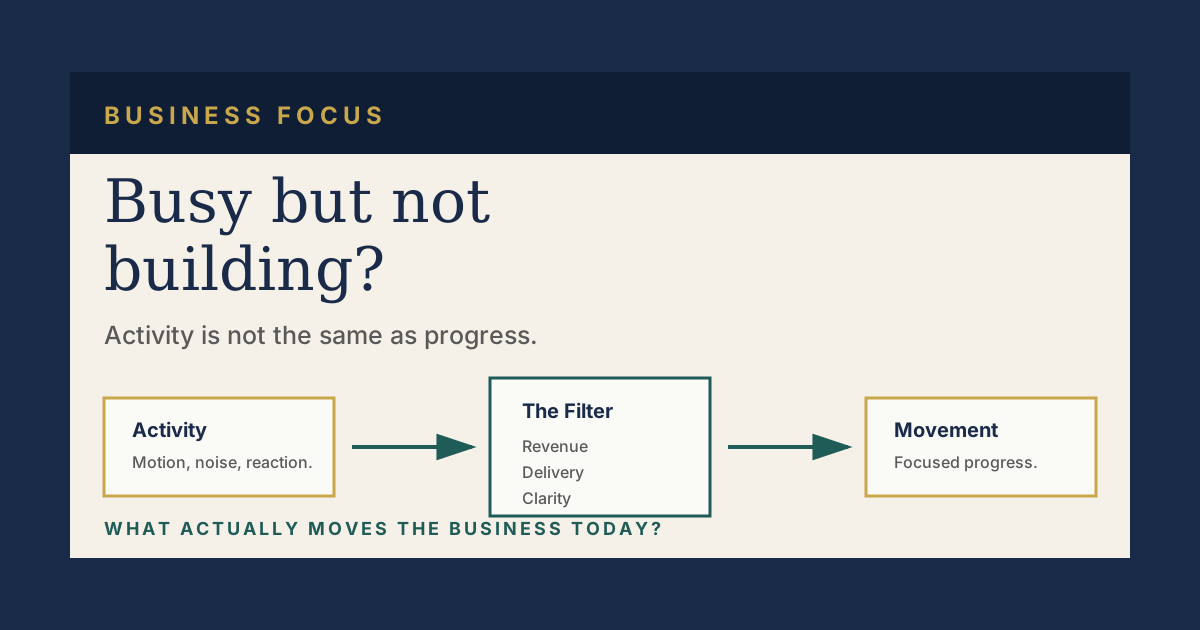
Activity creates motion.
Progress creates movement.
The difference matters because many business owners are exhausted from motion but disappointed by the lack of movement.
They are working.
But the work is scattered.
They are trying.
But the trying is not connected to a clear business outcome.
That is why the business feels busy but not built.
The Business Does Not Need More Noise
When a business feels stuck, many entrepreneurs add more.
More content. More ideas. More services. More tools. More platforms. More courses. More meetings. More planning. More branding. More offers. More research.
But more is not always growth.
Sometimes more is the reason the business feels unclear.
If the foundation is not focused, adding more activity only creates more noise.
A confused business does not become clear by becoming louder.
It becomes clear when unnecessary activity is removed and the main business priority becomes visible.
The question is not, "What else can I do?"
The question is, "What actually needs to move?"
Why Busy Work Feels Safer Than Real Work
Many entrepreneurs stay busy because busy work feels safer than real business work.
Editing a design feels safer than asking for the sale.
Planning content feels safer than publishing the offer.
Researching competitors feels safer than choosing your own direction.
Improving the website feels safer than testing whether people will buy.
Taking a course feels safer than making a decision.
Preparing feels safer than being judged.
This does not mean you are weak.
It means your brain is avoiding exposure.
Real business work exposes you to reality.
A sales call can end in rejection. An offer can fail. A launch can be ignored. A price can be questioned. A message can go unanswered.
So the mind chooses safer work.
Work that feels useful, but does not test anything.
That is how a business can stay busy for months without becoming stronger.
The Four Types of Fake Progress
Fake progress is activity that feels useful but does not meaningfully move the business.
It is not always useless.
But it becomes a problem when it replaces real movement.
1. Polishing
Polishing is when you keep improving things that are already good enough to test.
You keep editing the website. You keep changing the logo. You keep rewriting the bio. You keep adjusting the colors. You keep perfecting the presentation.
At some point, polish becomes avoidance.
The market does not need your offer to be perfect before it can respond.
It needs your offer to be clear enough to understand and real enough to test.
2. Planning
Planning is useful when it leads to execution.
But planning becomes fake progress when it keeps expanding without action.
You create roadmaps. You make content calendars. You write strategy documents. You design funnels. You list ideas. You organize tasks.
But nothing reaches the market.
A plan that does not create action is not strategy.
It is delay with structure.
3. Learning
Learning matters.
But learning can become avoidance when you keep consuming information instead of applying what you already know.
You watch another video. You buy another course. You read another thread. You save another framework.
But the business problem remains the same.
At some point, the next lesson is not the answer.
The next implementation is.
4. Reacting
Reacting is when your day is controlled by whatever appears first.
Messages. Notifications. Urgent requests. Random ideas. Client demands. Platform changes. Other people's opinions.
You stay busy, but you are not leading the business.
You are responding to it.
A reactive founder can work all day and still avoid the most important task.
The Real Question: What Moves the Business?
If you want to escape the busy-but-stuck cycle, ask one question every morning:
What would actually move the business today?
Not what would make me feel productive.
Not what would reduce anxiety.
Not what would look impressive.
Not what is easiest to start.
What would move the business?
For most businesses, movement usually comes from a few areas:
- A clearer offer.
- A better sales message.
- More direct conversations with the right people.
- A finished product or service page.
- A stronger delivery system.
- A better follow-up process.
- A decision about what to stop doing.
- A published piece of content connected to a real offer.
- A direct invitation to buy, book, or inquire.
These are not always the most comfortable tasks.
But they are often the tasks that create movement. If your issue is unclear buying action, read People Like Your Work But Don't Buy.
Your Business Needs a Main Priority
A business with no main priority turns every task into a possible priority.
That creates confusion.
Should you post more? Fix the website? Create a new offer? Start email marketing? Record videos? Run ads? Network? Build a course? Change your pricing? Start a newsletter? Rebrand? Hire someone?
All of these may be useful at some point.
But they cannot all be the priority today.
When everything matters equally, nothing gets built deeply.
A business needs a main priority for the season.
For example:
- This month, the priority is clarifying the main offer.
- This month, the priority is getting five sales conversations.
- This month, the priority is improving delivery.
- This month, the priority is launching one service page.
- This month, the priority is reducing scattered projects.
A main priority protects your attention.
It tells you what deserves energy and what can wait.
The Difference Between Maintenance and Building
Some tasks maintain the business.
Other tasks build the business.
Maintenance tasks keep things running.
They include replying to messages, checking systems, updating small details, handling admin, and managing routine operations.
Building tasks increase the strength of the business.
They include improving the offer, creating assets that sell, building systems, generating leads, closing clients, delivering better results, and making strategic decisions.
Both matter.
But many entrepreneurs spend most of their time maintaining a business that has not been properly built yet.
They are managing activity before creating momentum.
If your business is early or stuck, you need more building time than maintenance time.
Ask yourself:
How much of my week actually builds the business?
And how much only keeps me busy inside it?
The Founder's Avoidance Pattern
Every founder has an avoidance pattern.
Some avoid selling by creating content.
Some avoid content by endlessly improving the product.
Some avoid product decisions by researching strategy.
Some avoid strategy by staying busy with admin.
Some avoid pricing by adding more features.
Some avoid launching by saying the offer is not ready.
Some avoid focus by starting another idea.
Your avoidance pattern is the place where you look productive while avoiding the task that would expose the truth.
The goal is not to shame yourself.
The goal is to see the pattern.
Because once you see the pattern, you can stop calling it productivity.
You can call it what it is:
A protective loop.
Then you can choose differently.
The Business Movement Test
Use this test at the end of each day.
Ask:
- Did I make the offer clearer?
- Did I speak to a real potential buyer?
- Did I invite anyone to take action?
- Did I improve delivery for current or future clients?
- Did I finish something that can now work without me touching it again?
- Did I remove a distraction?
- Did I make a decision that reduces confusion?
- Did I move the business closer to revenue, trust, delivery, or clarity?
If the answer is no, the day may have been busy but not building.
That does not mean the day was worthless.
It means you need to adjust what you call progress.
Stop Measuring Effort Only by Hours
Many entrepreneurs measure work by how long they spent.
"I worked for eight hours."
"I spent the whole day on the business."
"I was busy all week."
But hours do not always equal progress.
You can spend eight hours avoiding one hard decision.
You can spend a week preparing something that should have been tested already.
You can spend a month creating content that never points to an offer.
You can spend a year building a business that has no clear sales system.
The better measurement is not only time.
It is movement.
What changed because of the work?
What became clearer?
What became sellable?
What became easier to deliver?
What became more focused?
What became more valuable?
What became complete?
That is a better way to measure business progress.
The One-Move Rule
When your business feels scattered, simplify the day.
Choose one move that matters.
Not ten tasks.
One move.
One sales page section. One client follow-up. One offer decision. One pricing update. One conversation with a serious lead. One published article. One removed service. One completed system. One direct invitation. One focused improvement.
The one-move rule does not mean you only do one thing all day.
It means you define the one thing that would make the day meaningful if everything else became messy.
This creates focus.
It reduces guilt.
It teaches your brain what progress actually means.
A business is not built by doing everything.
It is built by doing the right things consistently.
Why Scattered Work Creates Scattered Results
A scattered business owner creates scattered signals.
The audience does not know what you sell.
The website does not guide people clearly.
The content changes direction too often.
The offers compete with each other.
The founder keeps switching priorities.
The business has movement but no center.
Scattered work creates scattered results because the market receives unclear signals.
People may like your content but not understand your offer.
They may respect your skill but not know what to buy.
They may follow you but not see a clear next step.
Focus is not only useful for the founder.
It is useful for the buyer.
A focused business is easier to understand.
And an easier-to-understand business is easier to buy from. For a practical filter, read The 3-Project Rule.
What to Do When Everything Feels Important
When everything feels important, sort tasks into three groups.
1. Revenue
These tasks help the business make money.
Sales conversations. Follow-ups. Offer pages. Proposals. Payment links. Clear calls-to-action. Client retention.
If revenue is weak, revenue-related tasks cannot stay at the bottom of the list.
2. Delivery
These tasks help the business produce results.
Client systems. Service quality. Processes. Templates. Onboarding. Fulfillment.
A business that sells but cannot deliver will eventually create stress and damage trust.
3. Clarity
These tasks make the business easier to understand.
Positioning. Offer structure. Messaging. Website flow. Content direction. Service descriptions.
A business without clarity wastes energy explaining itself.
If a task does not support revenue, delivery, or clarity, question whether it deserves your attention right now.
The Cost of Always Preparing
Preparation feels responsible.
And sometimes it is.
But preparation becomes expensive when it never turns into exposure.
You prepare the offer but never publish it.
You prepare the content but never post it.
You prepare the pitch but never send it.
You prepare the business plan but never test the market.
You prepare the product but never ask for payment.
At some point, preparation becomes a hiding place.
The business does not grow in the private document.
It grows when something meets reality.
Reality gives feedback.
Feedback creates adjustment.
Adjustment creates progress.
Without exposure, you are not building a business.
You are building a theory.
How to Create a Building Day
A building day has a clear purpose.
It does not begin with random tasks.
It begins with the business priority.
Before opening messages, ask:
What is the main business movement needed today?
Then choose one building task.
For example:
- Clarify the offer headline.
- Write the service page.
- Message five potential clients.
- Follow up with three warm leads.
- Create a simple payment path.
- Improve the onboarding process.
- Publish one article connected to the offer.
- Remove one confusing service.
- Finish one asset that supports selling.
Do that before the day gets consumed by maintenance.
A building day does not need to be perfect.
It needs to create real movement.
What to Stop Doing This Week
Stop adding new ideas before finishing the current priority.
Stop polishing things that are already good enough to test.
Stop learning what you are not ready to apply.
Stop changing your offer every time you feel uncertain.
Stop treating admin as the center of the business.
Stop posting content that has no connection to what you sell.
Stop waiting for confidence before taking market-facing action.
Stop calling anxiety "strategy."
Stop calling delay "preparation."
Stop calling scattered effort "hard work."
Hard work matters.
But focused hard work matters more.
Final Thought
You may not be stuck because you are lazy.
You may be stuck because your effort is not organized around movement.
You are busy, but not building.
You are active, but not focused.
You are working, but not always on the work that changes the business.
This is fixable.
You do not need to do everything.
You need to identify what moves the business and give that your best energy.
A business grows when effort becomes focused.
When content points to an offer. When planning turns into execution. When learning turns into implementation. When ideas become decisions. When preparation meets the market.
When busy work stops hiding the real work.
Do not measure today only by how much you did.
Measure it by what moved.
Because a business is not built by motion.
It is built by focused progress.
Need Business Focus?
If your business feels active but not moving, the problem may not be effort.
It may be scattered focus.
A structured Business Focus session can help you identify what actually needs to move, what tasks are creating noise, and what priority deserves your attention now.
You do not need more random activity.
You need a clearer business direction.
Book a Business Focus Session.
Book a Business Focus Session
If your business is active but not moving, a Business Focus Session can help you separate noise from the work that creates revenue, delivery, and clarity.