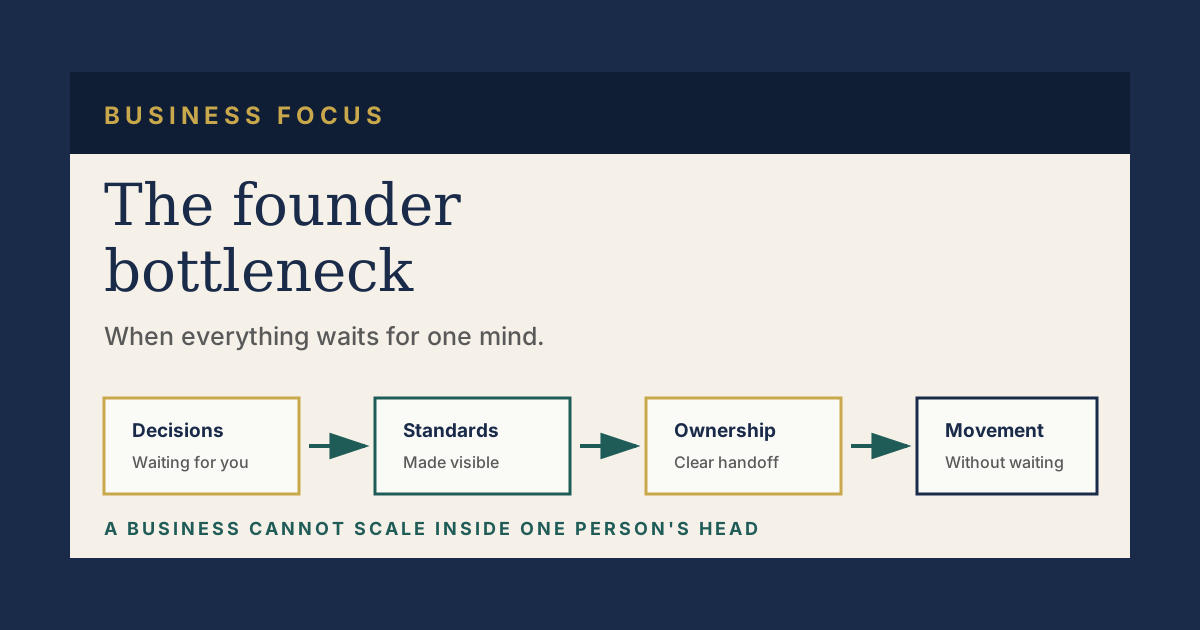
A founder bottleneck happens when the business cannot make decisions, solve routine problems, or move work forward without the founder. Growth slows because the company has no decision system, memory, or ownership outside one person.
Summary
Many businesses do not slow down because the idea is weak.
They slow down because everything depends on the founder.
Every decision waits for you.
Every approval waits for you.
Every client issue comes back to you.
Every piece of content needs your input.
Every offer change needs your thinking.
Every system lives in your head.
At first, this feels like control. Later, it becomes a bottleneck.
A founder bottleneck happens when the business cannot move unless the founder is personally involved in every important and unimportant thing.
This does not mean the founder is lazy.
Often, it means the founder has carried too much for too long.
But if the business cannot operate without you touching everything, it will eventually grow only as fast as your personal capacity allows.
Key Takeaways
- A founder bottleneck happens when too many decisions, tasks, and approvals depend on one person.
- Control can feel productive in the beginning, but later it slows the business down.
- Many founders become bottlenecks because they do not trust delegation, systems, or other people's judgment.
- The business cannot scale if every process lives inside the founder's head.
- The solution is not disappearing from the business. The solution is designing clearer decisions, ownership, systems, and standards.
- A business becomes stronger when the founder stops being the only engine.
Introduction
Your business may not be stuck because nobody is working.
It may be stuck because everything is waiting for you.
The designer is waiting for approval.
The client is waiting for a reply.
The team is waiting for direction.
The website is waiting for content.
The offer is waiting for your decision.
The invoice is waiting for review.
The process is waiting to be documented.
The next move is waiting for your mind to become clear.
From the outside, the business looks active.
From the inside, everything keeps coming back to one person.
You.
This is the founder bottleneck.
It is one of the most common reasons a small business, consulting practice, service brand, or creative business stops moving with speed.
The founder is talented.
The founder cares.
The founder has ideas.
The founder knows the quality standard.
But the business cannot move without the founder touching everything.
At first, this makes the founder feel important.
Later, it makes the business feel heavy.
What Is a Founder Bottleneck?
A founder bottleneck happens when the business depends too heavily on the founder for movement.
Not only leadership.
Movement.
The founder is needed for every decision, approval, correction, client message, content idea, delivery detail, and small operational step.
The business may have people around it.
Freelancers.
Assistants.
Team members.
Partners.
Vendors.
But the work still keeps returning to the founder.
People do not know what to decide without you.
They do not know what quality looks like without you.
They do not know what priority matters without you.
They do not know how to handle exceptions without you.
They do not know where information lives because most of it lives in your head.
That means the business is not really operating as a system.
It is operating as an extension of your personal attention.
And personal attention has limits.
Founder Bottleneck vs. Founder Effect
A founder effect is not automatically a problem. It is the useful imprint of a founder's judgment, values, and standards on an early business.
A founder bottleneck begins when that influence becomes a requirement for routine movement. The team cannot answer a normal client question, choose between approved options, or complete a repeated process without waiting for you.
The aim is not to remove the founder's judgment. It is to put enough of that judgment into principles, examples, roles, and decision rights that the business can use it without reopening every decision.
Control Feels Good Until It Starts Costing You
In the beginning, founder control makes sense.
You are building the business.
You are shaping the brand.
You are learning the customer.
You are testing the offer.
You are protecting quality.
You are making sure things do not fall apart.
At this stage, being involved in everything may be necessary.
But what starts as ownership can slowly turn into over-control.
You keep reviewing every small detail.
You keep rewriting what others write.
You keep taking back tasks.
You keep delaying decisions because you want to think more.
You keep saying, "It is faster if I do it myself."
Sometimes that is true once.
But if it is always faster to do it yourself, the business will never learn to work without you.
The cost of control is that the founder becomes the ceiling.
The business cannot grow beyond what you can personally hold.
Signs You Are the Bottleneck
You may be the bottleneck if people are often waiting for your reply before they can continue.
You may be the bottleneck if simple decisions come back to you repeatedly.
You may be the bottleneck if you are always busy but the business still feels slow.
You may be the bottleneck if tasks are completed only after you personally push them.
You may be the bottleneck if you keep correcting the same mistakes because the standard has never been documented.
You may be the bottleneck if the business has no clear process unless you explain it live.
You may be the bottleneck if you cannot take a few days away without everything becoming confused.
You may be the bottleneck if every idea, task, client, and problem feels like it needs space inside your head.
The clearest sign is this:
If you stop moving, the business stops moving.
That is not leadership.
That is dependency.
The Business Lives Too Much in Your Head
Many founders do not realize how much of the business exists only inside their own mind.
The offer structure is in their head.
The client process is in their head.
The brand tone is in their head.
The sales logic is in their head.
The pricing reasoning is in their head.
The delivery steps are in their head.
The quality standard is in their head.
The priorities are in their head.
This creates a hidden problem.
Other people cannot help properly because they cannot see the system.
They can only wait for instructions.
Then the founder becomes frustrated.
"Why can't they just understand?"
But the truth is simple.
People cannot execute a system that has never been made visible.
If the business lives in your head, the business must keep returning to your head.
That is the bottleneck.
The Difference Between High Standards and Over-Control
High standards are important.
A business needs quality.
A brand needs consistency.
Clients need trust.
But high standards and over-control are not the same thing.
High standards say, "This is the quality we are building toward."
Over-control says, "Nothing can move unless I personally approve every detail."
High standards can be documented, taught, and repeated.
Over-control depends on the founder's mood, attention, and availability.
High standards make the business stronger.
Over-control makes the business slower.
The question is not whether you should care about quality.
You should.
The question is whether quality can exist without you personally touching everything.
If the answer is no, the standard has not yet become a system.
It is still a personal preference trapped inside your head.
Why Founders Become Bottlenecks
Founders rarely become bottlenecks because they want to slow the business down.
They become bottlenecks for understandable reasons.
1. You Do Not Trust People Yet
Maybe people disappointed you before.
Maybe someone delivered poor work.
Maybe a freelancer disappeared.
Maybe a team member misunderstood the task.
So now you hold more tightly.
That makes sense emotionally, but it can create a business that cannot breathe.
Trust does not mean handing everything over blindly.
It means designing clearer ownership, expectations, and review points.
2. You Think Explaining Takes Too Long
Many founders say, "It is easier if I just do it."
Sometimes it is.
But if you say this every week, you are not saving time.
You are creating permanent dependency.
The first explanation may take longer.
But once the process is clear, the task can move without you next time.
3. You Have Not Defined What Good Looks Like
People cannot meet a standard they cannot see.
If you have not defined examples, templates, rules, tone, steps, or quality checks, people will keep guessing.
And when they guess wrong, the work returns to you.
4. You Enjoy Being Needed
This one is harder to admit.
Sometimes founders feel valuable because everyone needs them.
Every question confirms their importance.
Every problem proves they are central.
But being needed for everything is not the same as building something strong.
A strong business should need your leadership.
It should not need your constant rescue.
The Hidden Cost of Being the Bottleneck
Being the bottleneck feels normal until the cost becomes visible.
The first cost is speed.
Everything takes longer because decisions wait for you.
The second cost is mental load.
Your mind becomes crowded with too many small details.
The third cost is team weakness.
People stop thinking deeply because they expect you to decide anyway.
The fourth cost is founder exhaustion.
You become tired from carrying both leadership and operations.
The fifth cost is missed growth.
New opportunities cannot be pursued because the existing business already consumes your full capacity.
A bottleneck does not only slow tasks.
It limits the future.
The business cannot become bigger, cleaner, or more stable while every important movement depends on one overloaded person.
Delegation Is Not Dumping Tasks
Many founders avoid delegation because they think it means losing control.
But real delegation is not dumping work and hoping for the best.
Real delegation has structure.
It includes:
What needs to be done.
Why it matters.
What good looks like.
What decisions the person can make alone.
When they should ask for approval.
What deadline matters.
What examples they should follow.
How the work will be reviewed.
Without this structure, delegation becomes confusion.
The founder says, "They cannot handle it."
The team says, "We did not know what you wanted."
Both may be right.
Delegation fails when ownership is unclear.
Good delegation is not less leadership.
It is better leadership.
The Founder Bottleneck Test
Use this test to see where the business depends too much on you.
Ask:
What tasks stop when I am unavailable?
What decisions keep coming back to me?
What questions do people ask repeatedly?
What mistakes keep happening because the process is unclear?
What work do I keep taking back?
What do I approve that someone else could approve with clear standards?
What information exists only in my head?
What client process breaks if I am not personally involved?
What part of the business makes me say, "Only I can do this"?
That last question matters.
Sometimes it is true.
Some founder-level work should stay with you.
But often, "only I can do this" really means, "I have not taught, documented, or structured this yet."
Separate Founder Work From Operator Work
Not all work should be delegated.
The founder should still own the direction of the business.
Vision.
Positioning.
Core offers.
Key partnerships.
High-level strategy.
Major client relationships.
Culture.
Final quality philosophy.
But many founders confuse founder work with operator work.
They personally handle admin, repeated follow-ups, formatting, small edits, scheduling, file organization, simple client updates, and routine decisions.
This creates a problem.
The founder's best thinking gets buried under operational weight.
The business needs your highest judgment.
But if your day is filled with small decisions, your strategic clarity becomes weaker.
The goal is not to remove yourself from the business.
The goal is to protect your highest contribution.
Turn Repeated Questions Into Systems
Every repeated question is a signal.
If someone asks the same thing twice, the answer should probably become a note, checklist, template, or process.
If clients ask the same question repeatedly, create a FAQ.
If team members ask how to do the same task, create a simple SOP.
If content always needs the same edits, create a tone guide.
If proposals always require the same explanation, create a proposal template.
If onboarding always creates confusion, create an onboarding checklist.
Do not keep answering the same question manually forever.
A repeated question is not an interruption.
It is a system waiting to be built.
Start With the Bottleneck That Hurts Most
Do not try to systemize the whole business at once.
That becomes another project that never finishes.
Start with the bottleneck that creates the most friction.
Maybe it is client onboarding.
Maybe it is content approval.
Maybe it is sales follow-up.
Maybe it is project delivery.
Maybe it is admin.
Maybe it is decision-making.
Maybe it is your inbox.
Ask:
Where do things slow down most often?
Where do people keep waiting for me?
Where do mistakes keep repeating?
Where do I feel the most resentment?
That is often the best place to start.
Build one system there.
Not a perfect system.
A useful one.
The 70 Percent Rule
Many founders struggle because they want everything done exactly how they would do it.
But if you require 100 percent personal matching, you will never delegate.
Use the 70 percent rule.
If someone can do the task 70 percent as well as you, and the remaining 30 percent can be improved through feedback, templates, or review, begin transferring the task.
Not for every task.
Some tasks need a higher standard.
But many operational tasks do not need your personal perfection.
They need consistent completion.
The goal is not to accept poor quality.
The goal is to stop confusing "different from me" with "wrong."
A business cannot grow if every task must carry the founder's exact fingerprint.
Make Decisions Easier for Other People
If every decision comes back to you, the business may not have decision rules.
People need to know:
What matters most?
Speed or perfection?
Client satisfaction or internal efficiency?
Brand consistency or experimentation?
Cost saving or quality?
When can someone decide alone?
When must they ask?
What is the acceptable range?
What is not acceptable?
Decision rules reduce dependency.
They help people act without fear.
Without decision rules, every small choice feels risky.
So people wait.
And the founder becomes the bottleneck again.
Document the Standard, Not Just the Task
A task list tells people what to do.
A standard tells people what good looks like.
Both are needed.
For example, do not only say, "Write the client update."
Show what a good client update includes.
Clear status.
Next step.
Timeline.
Friendly tone.
No unnecessary detail.
No vague promises.
One action item.
That is a standard.
Do not only say, "Create the social post."
Show examples of strong posts, weak posts, tone, formatting, message length, and common mistakes.
When standards are visible, quality becomes teachable.
When standards are invisible, quality stays dependent on the founder.
Stop Approving Things That Do Not Need Approval
Approval can become addictive.
It makes the founder feel safe.
But too much approval slows everything down.
Some decisions need approval.
Many do not.
Create approval levels.
Level 1: Decide without asking.
Level 2: Decide, then inform me.
Level 3: Recommend a decision and ask for confirmation.
Level 4: Bring it to me before action.
This simple structure reduces confusion.
It also trains people to think.
If everything is Level 4, the business will always be slow.
A healthy business teaches people which decisions they can own.
Your Business Needs Memory Outside Your Mind
A business needs memory.
Not only human memory.
System memory.
Documents.
Checklists.
Templates.
Processes.
Examples.
Meeting notes.
Client histories.
Decision logs.
Content calendars.
Offer details.
Brand standards.
If the only memory is the founder's memory, the business is fragile.
People will repeat mistakes.
Clients will receive inconsistent experiences.
The founder will keep answering old questions.
Growth requires shared memory.
A business becomes stronger when knowledge can be accessed without interrupting the founder.
What to Delegate First
Do not begin by delegating the most strategic thing.
Begin with repeatable tasks.
Tasks with clear steps.
Tasks that happen often.
Tasks that drain your attention.
Tasks where the standard can be documented.
Tasks where mistakes are recoverable.
For example:
Scheduling.
Basic admin.
File organization.
Client reminders.
Invoice follow-ups.
Content formatting.
Research.
First drafts.
Simple reporting.
Routine updates.
Do not delegate chaos.
Clarify the task first.
Then delegate.
A messy task handed to someone else often returns as a bigger mess.
What the Founder Should Keep
You should not remove yourself from everything.
Some work should stay close to the founder.
Business direction.
Core positioning.
Offer strategy.
Important relationship building.
Major hiring decisions.
Final brand philosophy.
High-impact sales conversations.
Quality principles.
Long-term vision.
The founder should not be absent.
The founder should be focused.
The goal is not to make the business founderless.
The goal is to make it less founder-dependent in the wrong places.
That distinction matters.
The Emotional Side of Letting Go
Letting go is not only operational.
It is emotional.
You may fear the quality will drop.
You may fear people will make mistakes.
You may fear clients will notice.
You may fear losing control.
You may fear becoming less important.
You may fear the business will not reflect you anymore.
These fears are normal.
But the answer is not to keep holding everything.
The answer is to build stronger systems, better training, clearer standards, and healthier review points.
Letting go without structure is risky.
Holding everything forever is also risky.
The mature path is structured release.
The Founder's New Role
As the business grows, the founder's role must change.
You move from doing everything to designing how things get done.
You move from answering every question to building systems that answer repeated questions.
You move from approving every detail to defining standards.
You move from carrying all decisions to creating decision rules.
You move from rescuing the business daily to strengthening the structure.
This transition is uncomfortable.
But it is necessary.
A business cannot become stronger if the founder keeps acting as the only working system.
Final Thought
If your business feels slow, do not only ask whether your team is working.
Ask whether everything is waiting for you.
A founder bottleneck is not always obvious at first.
It can look like high standards.
It can look like responsibility.
It can look like care.
It can look like leadership.
But if the business cannot move without your constant involvement, the system is too dependent on you.
That dependency will eventually cost you speed, clarity, energy, and growth.
The solution is not to care less.
The solution is to design better.
Make the invisible visible.
Turn repeated questions into systems.
Document standards.
Create decision rules.
Delegate with structure.
Protect your highest contribution.
Your business does not need you to touch everything.
It needs you to build something that can move with you, and eventually, without waiting for you at every step.
That is when the founder stops being the bottleneck.
And the business starts becoming a system.
Need Business Focus?
If your business feels active but slow, and everything keeps coming back to you, the problem may not be effort.
It may be structure.
A structured Business Focus session can help you identify where you are the bottleneck, what needs to be systemized, and what decisions or tasks should stop living only in your head.
You do not need to carry the whole business alone.
You need a clearer system for movement.
Founder decision bottleneck: when every choice waits for you
A founder decision bottleneck appears when team members must wait for your approval on decisions they should be able to make. The delay is not only operational. It teaches the business that judgment lives with the founder instead of in clear principles, roles, and decision rights.
Owner bottleneck: when the business lives in your head
An owner bottleneck forms when customer history, quality standards, priorities, and next steps exist mainly in your memory. People then ask the same questions, work around uncertainty, and avoid responsibility because the standard was never made visible.
Why a business cannot grow without the founder
A business cannot grow past the founder when every important action requires founder attention. Growth needs a small set of documented standards, named owners, and decisions that can be made without reopening the same discussion.
What is a founder decision bottleneck?
A founder decision bottleneck is a pattern where routine approvals, exceptions, and next steps wait for the founder because decision rights, standards, or ownership are unclear.
How do I know if I am the bottleneck in my business?
You may be the bottleneck if work pauses when you are unavailable, your team repeatedly asks the same questions, or you approve routine decisions that others could make with a clear standard.
What should a founder delegate first?
Start with repeated, low-risk decisions and tasks that have a clear standard. Document the outcome, give one owner decision rights, and review the result instead of approving every step.
What is the difference between a founder bottleneck and a founder effect?
A founder effect is the useful influence of the founder's values, judgment, and direction. A founder bottleneck is the harmful dependency that forms when routine work cannot move without the founder's constant involvement.
Book a Business Opportunity Focus Session
If your business feels active but slow, a Business Opportunity Focus session can help you identify the bottleneck, clarify what needs to be systemized, and protect your highest contribution.