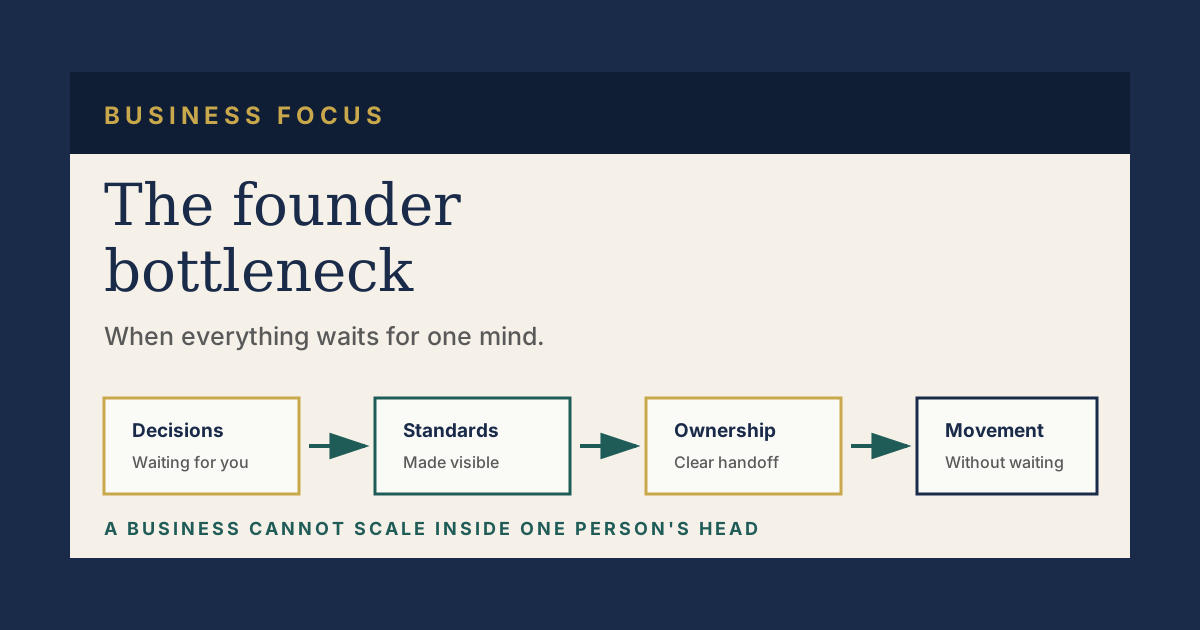
To stop being the bottleneck in your business, do not try to delegate everything at once. Start by transferring one repeated decision: define the outcome, name the owner, set the boundary of their authority, and replace constant approval with a predictable review point.
Why Good Founders Become the Bottleneck
Most founders do not set out to slow their business down. They become the person who knows the customer, protects the quality, remembers the history, and sees the risk before anyone else does.
That judgment is valuable. The problem starts when ordinary work cannot move until the founder gives an answer.
Clients wait for replies. Team members wait for approval. Small exceptions become meetings. Work returns for edits because nobody can see the standard. The founder stays busy, but the business becomes slower than its opportunity.
For the underlying pattern, start with Founder Decision Bottleneck: Why Your Business Stops at You. This article focuses on the practical system that begins to remove it.
Do Not Start With Delegation. Start With a Decision Map.
“Delegate more” is too vague to change anything. A decision map shows which decisions should stay with you, which can be made by someone else, and which simply need a clear rule.
For one working week, write down every question, approval, or task that reaches you. Next to each one, mark:
- Keep: this changes direction, risk, positioning, pricing, or a key relationship.
- Transfer: this repeats and another person can own it with a clear standard.
- Standardize: this should not need a new decision at all because a checklist, template, or rule can answer it.
The aim is not to prove that you are doing too much. It is to find the first place where work is repeatedly waiting for you.
The Founder Decision System
A useful decision system has five parts. It is simple enough for a small business, consulting practice, or growing team to use immediately.
1. Name One Owner
Every repeated area needs one clear owner. “The team” is not an owner. A named person should know they are responsible for moving the decision, collecting the necessary information, and communicating the result.
Ownership does not mean they must do every task. It means the work has somewhere to go besides back to you.
2. Define the Outcome, Not Only the Task
“Handle client onboarding” is a task label. It does not tell someone what success looks like.
A useful outcome is specific: “Every new client receives a welcome email, a confirmed start date, the payment step, and the preparation checklist within one business day.”
When the outcome is visible, people can make sensible choices instead of waiting for detailed instructions.
3. Set Decision Rights
People become dependent on founders when they do not know what they can decide. Use four simple levels:
- Act: decide and complete it without asking.
- Act and inform: decide, then send a short update.
- Recommend: bring a proposed decision with the relevant facts.
- Escalate: pause and ask before acting because the risk is high.
Do not put every decision in the last category. If every decision requires approval, you have not created ownership. You have created a queue.
4. Give One Standard and One Example
Delegation fails when the founder gives a task but keeps the quality standard private. Share a short checklist, a good past example, a template, or a list of non-negotiables.
For example, a client update might need a clear status, one next action, a realistic date, and no vague promises. That is enough to guide many decisions without a new approval loop.
5. Replace Interruptions With Review Points
Instead of receiving messages throughout the day, agree when and how the owner will update you. It may be a 15-minute weekly review, a shared tracker, or an exception list for decisions above a stated threshold.
Review points protect quality while allowing work to move. They also show where the system still needs a better rule.
Start With the Smallest Useful Transfer
Choose one repeated, low-risk process first. Good examples include scheduling, invoice follow-up, client onboarding, content formatting, routine customer replies, or preparing a proposal from an approved template.
Do not start with your most complex strategic decision. Early transfers are for learning what the team needs from you in order to make good decisions.
If your business has too many priorities competing for attention, use The 3-Project Rule before building another large operating project.
What Founders Should Keep
Removing a bottleneck does not mean making the founder irrelevant. Some decisions still need founder judgment, particularly when they affect:
- Business direction, positioning, or a major offer change
- Large financial commitments or material legal and reputational risk
- Key partnerships and high-stakes client relationships
- The principles that define quality, culture, and what the business will not do
The test is not “Can someone else do this exactly as I would?” It is “Does this decision truly require founder-level judgment, or does it need a visible standard?”
What to Do When the Team Still Sends Everything Back
Do not assume people lack initiative. First check the system.
They may not know the real outcome. They may not know the acceptable range of choices. They may have been corrected for acting before, or they may not have access to the information required to decide.
Ask three questions:
- What made this decision unclear?
- What information or standard was missing?
- What rule would let you handle this next time?
Use the answer to improve the system instead of simply taking the work back.
A 30-Day Founder Bottleneck Reset
Week 1: Track the approvals and questions that interrupt you. Pick one recurring delay.
Week 2: Name an owner, define the outcome, and set their decision rights.
Week 3: Create one short standard, template, or checklist. Hold the first review rather than approving every step.
Week 4: Review what still returned to you. Refine the standard and transfer the next repeated decision.
Small systems compound. Each one removes a little waiting, protects a little more founder attention, and gives the business more memory outside your mind.
Do Not Confuse Activity With Movement
A founder can answer messages all day and still leave the most important work untouched. When every small decision becomes urgent, the business starts responding to noise instead of building capacity.
Read Busy But Not Building if the business feels active but progress is still hard to see. For a scattered pipeline of opportunities, read Too Many Business Ideas?.
Final Thought
You do not stop being the bottleneck by caring less. You stop by making your judgment usable without your constant presence.
Name the owner. Clarify the outcome. Set decision rights. Show the standard. Review the result.
That is how a founder moves from being the business's permanent answer desk to building a business that can think and move with more consistency.
How do I stop being the bottleneck in my business?
Start with one repeated delay. Name one owner, set their decision rights, document what a good outcome looks like, and agree on when they should update you instead of asking for approval at every step.
What decisions should a founder keep?
Founders should usually keep direction, positioning, major investments, key partnerships, and decisions that materially change risk or reputation. Repeated operational decisions should be transferred with clear standards.
Why does delegation fail in small businesses?
Delegation often fails when the task is handed over without decision rights, examples, a quality standard, or a review point. People then either guess or send every choice back to the founder.
Need Business Focus?
If your business keeps waiting for your attention, a Business Opportunity Focus session can help you identify the real constraint, choose a practical priority, and design a clearer next step.