Summary
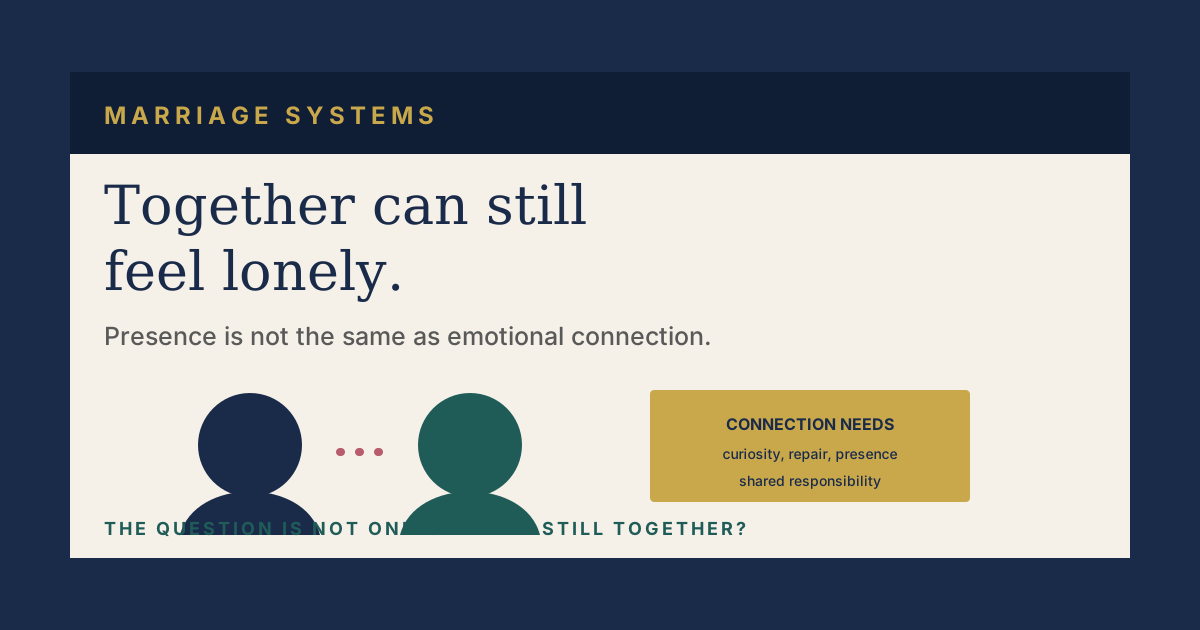
One of the most painful forms of loneliness is feeling alone beside someone who is still there.
The relationship exists.
The person is present.
The routine continues.
The home, messages, plans, responsibilities, and public image may still look normal.
But emotionally, something feels missing.
You may still talk, but not deeply.
You may still live together, but not feel close.
You may still function as a couple, but feel like you are carrying your inner life alone.
This kind of loneliness is confusing because nothing obvious may have ended.
But something important may have stopped being shared.
The question is not only, "Are we still together?"
The deeper question is, "Are we still emotionally connected?"
Key Takeaways
- Feeling alone in a relationship is not always about physical absence.
- A partner can be present in the routine but absent emotionally.
- Loneliness often appears when emotional presence, repair, curiosity, and shared responsibility weaken.
- The relationship may still function externally while becoming disconnected internally.
- You should not ignore loneliness simply because the relationship still looks normal.
- The goal is not to panic. The goal is to understand whether this is a temporary season, a communication gap, or a deeper pattern.
If you are trying to understand patterns before a deeper commitment, the relationship readiness map can help you reflect before making the next conversation heavier.
Introduction
You are not single.
But you feel alone.
That is what makes it confusing.
There is someone in your life.
Someone you speak to.
Someone you may live with.
Someone you may share responsibilities with.
Someone others may still see as your partner.
From the outside, the relationship exists.
But inside, you feel a kind of distance that is difficult to explain.
You may sit beside them and still feel unseen.
You may talk about daily things and still feel emotionally untouched.
You may share a home and still feel like your inner world has nowhere to go.
You may be in the same room and still feel like you are carrying life by yourself.
This kind of loneliness is not always loud.
It is quiet.
It appears in small moments.
When something happens and they are not the first person you want to tell anymore.
When you stop explaining your feelings because you already know the response.
When you have a difficult day and realize you would rather process it alone than risk being dismissed.
When you miss the person even while they are physically present.
That is a different kind of pain.
Being Together Is Not the Same as Being Connected
A relationship can continue without real connection.
Two people can share routines, meals, bills, children, messages, family events, plans, and responsibilities.
They can function together and still feel emotionally far apart.
This is why relationship loneliness is so difficult to name.
Nothing may look dramatic enough to justify your sadness.
There may be no obvious betrayal. No explosive conflict. No official separation. No clear ending.
But connection can disappear slowly without a formal announcement.
You stop asking certain questions.
They stop noticing certain parts of you.
The conversations become practical.
The affection becomes automatic.
The repair becomes weaker.
The emotional curiosity fades.
And one day, you realize the relationship is still standing, but you no longer feel held inside it.
That realization matters.
Because a relationship is not only a structure.
It is supposed to be a place of emotional presence.
What Relationship Loneliness Feels Like
Relationship loneliness often feels like having no safe place to take your inner life.
You may have thoughts you do not share. Feelings you minimize. Fears you keep private. Disappointments you swallow. Dreams you no longer mention. Questions you avoid.
You may find yourself becoming quieter.
Not because you have nothing to say.
Because speaking no longer feels useful.
You may feel lonely when your partner only responds to facts but not feelings.
You say, "I had a hard day."
They say, "What happened?"
But they do not really stay with the emotion.
You may feel lonely when your concerns are treated like complaints.
You may feel lonely when you are physically close but emotionally far.
You may feel lonely when you are always the one trying to create depth.
You may feel lonely when your partner is present for the routine but absent from the relationship's emotional life.
That is the difference.
The body may be present.
But the connection may not be.
Emotional Absence Is Not Always Obvious
Emotional absence does not always look like cruelty.
Sometimes it looks like distraction, busyness, fatigue, silence, avoidance, indifference, practical conversation, phone use, short replies, lack of curiosity, no follow-up, no repair after conflict, and no real interest in your inner world.
This is why emotional absence can be confusing.
The person may not be doing anything obviously wrong.
They may go to work, provide financially, help with tasks, attend family events, answer messages, and sit beside you.
But emotional presence is more than physical participation.
It is the willingness to notice, engage, ask, listen, repair, and remain connected.
When that presence disappears, loneliness enters.
Even if the relationship continues.
The Difference Between a Quiet Season and Emotional Disconnection
Every relationship has quiet seasons.
There are times when life becomes demanding. Work pressure increases. Children need more attention. Health issues appear. Family responsibilities grow. Financial stress creates tension. One or both people may have less emotional capacity.
A quiet season does not automatically mean the relationship is broken.
The important question is whether both people still care about reconnecting.
In a quiet season, there may be distance, but there is still concern.
There may be tiredness, but there is still tenderness.
There may be less conversation, but there is still willingness.
There may be stress, but there is still recognition that the relationship needs care.
Emotional disconnection is different.
In disconnection, the distance becomes normal.
The lack of depth is not questioned.
The loneliness is dismissed.
One person stops trying.
Or both people begin living beside each other instead of with each other.
A quiet season needs support.
A disconnection pattern needs repair.
Why You Start Feeling Alone
You may start feeling alone when your partner stops being emotionally curious.
They no longer ask how you really are. They do not notice your mood. They do not follow up on things you shared. They do not ask what is weighing on you.
You may feel alone when repair disappears.
After a conflict, things return to normal without real understanding.
The issue is not resolved.
It is simply buried.
You may feel alone when your partner hears your words but not your experience.
They respond to the details, but not the emotional meaning.
You may feel alone when you become the only one protecting the connection.
You initiate the conversations. You check in. You try to soften the distance. You suggest solutions. You carry the hope.
At some point, loneliness appears because the relationship no longer feels shared.
It feels managed by one person.
The Pain of Being Unseen
Feeling unseen is different from being ignored completely.
Sometimes your partner sees the surface of your life.
They know your schedule. They know what you do. They know what needs to be handled. They know the external facts.
But they do not seem to see what those facts are doing to you.
They do not see the tiredness behind your silence.
The fear behind your questions.
The sadness behind your distance.
The effort behind your patience.
The loneliness behind your calm.
This kind of unseen feeling can be painful because you begin to wonder whether your inner life matters in the relationship.
You may start thinking: Do they notice me at all? Do they care how I am changing? Do they know what I am carrying? Would they realize if I stopped trying?
That last question is especially painful.
Because when you feel alone, you often wonder whether the relationship only continues because you keep holding it together.
When Communication Becomes Only Practical
A relationship can become lonely when communication becomes purely functional.
Who is picking up the children? What time is dinner? Did you pay the bill? Who is going to the event? What needs to be done tomorrow? Did you call them? Did you send the message?
Practical communication matters.
Life requires coordination.
But if practical communication becomes the only communication, the relationship begins to feel like an arrangement.
Not a connection.
You may be coordinating life together while emotionally living separately.
There is no deeper check-in. No real curiosity. No shared reflection. No emotional presence. No sense of being known.
This does not always happen suddenly.
It happens when the relationship becomes more about managing responsibilities than maintaining intimacy.
At some point, the couple still functions.
But the emotional relationship is starving.
The Loneliness of Not Being Able to Share Good News
People often think relationship loneliness is only about pain.
But loneliness also appears when you cannot share joy.
You receive good news and hesitate.
You accomplish something and do not expect real excitement.
You feel proud but keep it small.
You have an idea but do not share it because you expect disinterest.
You experience a moment of beauty and realize they would not understand why it mattered.
A partner does not need to be excited about everything you love.
But they should care that something matters to you.
When your joy has nowhere to go, the relationship becomes lonely in a different way.
You are not only alone in pain.
You are alone in aliveness.
That is a serious signal.
When You Stop Reaching
At first, you may try to reconnect.
You ask questions. You bring up the distance. You suggest spending time. You explain that you feel alone. You try to create a better conversation. You wait for a different response.
But if nothing changes, you may stop reaching.
Not because you stopped caring.
Because reaching started to hurt.
It hurts to keep offering your inner life and receive little back.
It hurts to keep asking for closeness and feel like a burden.
It hurts to keep naming the distance and be told you are imagining it.
Eventually, you protect yourself by becoming quieter.
This can look like peace from the outside.
But inside, it may be withdrawal.
Not the cold kind.
The tired kind.
The kind that happens when hope has been disappointed too many times.
Do Not Dismiss Your Loneliness Too Quickly
Many people dismiss their loneliness because they feel guilty for having it.
They tell themselves: "At least they are still here." "At least they provide." "At least we do not fight all the time." "At least the relationship looks stable." "At least other people have worse problems."
Gratitude matters.
But gratitude should not be used to silence truth.
You can appreciate what exists and still admit what is missing.
You can recognize your partner's good qualities and still feel emotionally alone.
You can be grateful for stability and still need connection.
Minimizing loneliness does not make it disappear.
It usually pushes it deeper.
And loneliness that stays unspoken often turns into resentment, numbness, or quiet distance.
The Relationship Loneliness Test
Use these questions to understand what kind of loneliness you are experiencing.
1. Do I Feel Known?
Does my partner understand my inner world?
Not perfectly.
But enough that I feel emotionally recognized.
Do they know what I fear, hope for, struggle with, and carry?
2. Do I Feel Safe Sharing?
Can I share pain, confusion, or disappointment without being dismissed, mocked, blamed, or punished?
Or have I learned to keep certain things to myself?
3. Do I Feel Met With Curiosity?
Does my partner ask questions?
Do they want to understand?
Do they follow up?
Do they notice changes in me?
4. Do I Feel Repair After Conflict?
When something goes wrong, do we repair?
Or do we simply return to normal without understanding?
5. Do I Feel Like We Are Both Protecting the Connection?
Is connection a shared responsibility?
Or am I the main person noticing, initiating, and carrying it?
These questions help separate temporary loneliness from a deeper pattern.
What Not to Do When You Feel Alone
Do not immediately blame yourself for needing more.
Wanting emotional connection does not make you demanding.
Do not pretend everything is fine because the relationship looks normal externally.
The outside image cannot replace the inside reality.
Do not turn your loneliness into silent punishment.
Withdrawing without clarity may deepen the distance.
Do not chase endlessly.
If you are always reaching and the other person never responds with responsibility, the pattern needs to be named.
Do not compare your relationship to others from the outside.
Many lonely relationships look stable in public.
The real question is not how the relationship appears.
The real question is how it functions emotionally.
How to Name the Loneliness Clearly
If you decide to speak about it, avoid beginning with accusation if possible.
Not because your pain is invalid.
But because the goal is to create a conversation that has a chance of being heard.
You might say:
"I feel like we are functioning, but not really connecting."
Or:
"I do not feel emotionally close to you lately, and I do not want us to ignore that."
Or:
"I feel alone inside the relationship, even though we are still together."
Or:
"I need us to talk about how we can rebuild connection, not just manage responsibilities."
These sentences name the pattern without turning the conversation immediately into blame.
But after you name it, watch what happens.
The response matters.
Does your partner become curious? Defensive? Dismissive? Concerned? Avoidant? Willing?
Their response gives information about whether the loneliness can be repaired together.
When Your Partner Says, "But I Am Here"
This response can be painful.
You say you feel alone.
They say, "But I am here."
They may think physical presence should be enough.
They may point to what they provide, what they do, or how much time they spend at home.
Those things may matter.
But emotional loneliness is not only about whether someone is physically present.
It is about whether they are emotionally available.
A person can be in the house and still unreachable.
They can sit beside you and still not engage.
They can provide practically and still avoid emotional connection.
So if your partner says, "But I am here," the deeper reply is:
"I know you are physically here. I am talking about emotional closeness."
That distinction is important.
Without it, the conversation will keep missing the real issue.
What Reconnection Requires
Reconnection does not happen only because two people spend more time together.
Time helps, but time without presence can still feel lonely.
Reconnection requires attention, curiosity, honesty, repair, follow-through, and shared effort.
It may require asking better questions.
Listening without immediately defending.
Bringing back small moments of warmth.
Naming the distance without turning it into war.
Creating time where the relationship is not only about tasks.
Rebuilding trust after repeated disappointment.
Most importantly, reconnection requires both people to care that disconnection is happening.
One person cannot fully reconnect a relationship alone.
They can invite. They can name. They can create space. They can change their part.
But connection must be met.
When Loneliness Becomes Information
Loneliness is not always an instruction to leave.
But it is information.
It tells you something is missing.
Something is not being shared.
Something is not being heard.
Something is not being repaired.
Something is not being held.
The mistake is either to panic immediately or ignore it completely.
Do not panic.
But do not dismiss it.
Study it.
Ask: How long have I felt this way? Have I named it clearly? Has my partner responded with responsibility? Is this connected to a temporary season or a repeated pattern? Do I feel alone because of one issue or because emotional presence has disappeared? What would need to change for me to feel connected again?
These questions turn loneliness into clarity.
When the Relationship Needs Help
Some loneliness cannot be fixed by one emotional conversation.
Especially if the pattern has been present for a long time.
You may need outside help if:
- You have explained the loneliness many times and nothing changes.
- Your partner dismisses your emotional needs.
- Every conversation about connection becomes a fight.
- The relationship functions practically but feels empty emotionally.
- You are no longer sure whether you are patient or abandoning yourself.
- You feel more peaceful alone than when trying to connect.
- You are beginning to emotionally detach.
Getting help does not mean the relationship has failed.
It means the current system may not know how to repair itself.
A structured conversation can help both people see what has been avoided, what has been lost, and what needs to be rebuilt.
Final Thought
Feeling alone in a relationship that still exists is painful because it is difficult to explain.
The person is there.
The relationship is there.
The routine is there.
But the emotional connection feels absent.
This kind of loneliness should not be ignored simply because nothing dramatic has happened.
Sometimes the quiet absence of connection is the problem.
A relationship is not only meant to continue.
It is meant to hold emotional life.
To create a place where both people feel seen, heard, known, and met.
If you feel alone, do not rush to blame yourself.
And do not rush to make a final decision from pain.
First, diagnose the pattern.
Is this a hard season? A communication gap? A one-sided effort problem? An emotional absence pattern? A relationship that functions externally but has stopped connecting internally?
The answer matters.
Because loneliness is not just a feeling to survive.
It is a signal to understand.
You do not need to pretend the relationship is healthy just because it still exists.
You need to know whether connection can be rebuilt, shared, and protected by both people.
That is where clarity begins.
Need Marriage Clarity?
If you feel alone inside a relationship that still exists, you do not need more silent overthinking.
You need to understand what the loneliness is pointing to.
A structured Marriage Clarity session can help you see whether this is a temporary season, emotional disconnection, one-sided effort, or a deeper relationship pattern that needs repair or decision.
You do not need to carry the loneliness alone.
You need clarity about what is really happening between you.
Book a Marriage Clarity Session
If the relationship still exists but emotional connection feels absent, a Marriage Clarity session can help you map whether this is a hard season, a repair issue, or a deeper pattern that needs a decision.