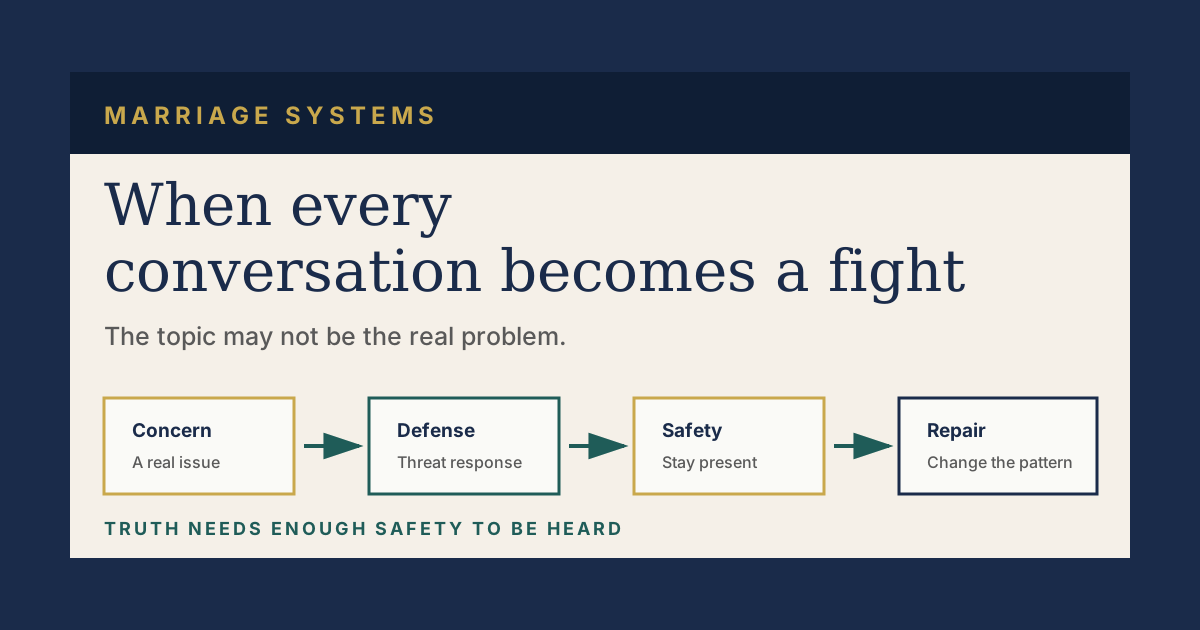
When every conversation turns into a fight, the issue is usually not one topic or one bad mood. It is a repeating pattern of blame, defensiveness, emotional unsafety, and failed repair that both people need to see clearly.
Summary
Some relationships do not break because there is no communication.
They break because communication no longer feels safe.
You try to talk, but the conversation turns into a fight. You bring up a concern, and it becomes an argument. You ask for clarity, and it becomes defensiveness. You express hurt, and suddenly you are defending your tone, your timing, your memory, or your right to feel what you feel.
Over time, you stop bringing things up.
Not because the problems are gone.
Because the cost of conversation has become too high.
When every conversation becomes a fight, the issue is rarely just communication style. It is usually a deeper relationship system problem.
The relationship has lost the ability to hold truth without turning it into threat.
Key Takeaways
- Constant fighting is not always caused by the topic being discussed.
- Many couples fight because the relationship no longer feels emotionally safe.
- Defensiveness, blame-shifting, interruption, shutdown, and scorekeeping can turn normal conversations into conflict.
- When one person feels punished for bringing up issues, communication slowly stops.
- The goal is not to avoid all conflict. The goal is to make truth safe enough to discuss.
- A relationship improves when both people learn how to hear discomfort without turning it into attack.
Introduction
You only wanted to talk.
That is how it starts.
You wanted to explain something that hurt you.
You wanted to ask why the same pattern keeps happening.
You wanted to say you felt alone, ignored, dismissed, or tired.
You wanted to understand.
But within minutes, the conversation changed.
Now you are not talking about the issue anymore.
You are defending how you said it.
You are being told your timing is wrong.
You are being told you are too sensitive.
You are being reminded of something you did three months ago.
You are trying to prove you are not attacking.
You are trying to calm the other person down while still holding your own pain.
By the end, nothing is solved.
Both people are tired.
The issue is still there.
And next time, you hesitate before speaking.
This is how communication breaks down.
Not all at once.
Slowly.
One unsafe conversation at a time.
The Problem Is Not Always the Topic
Many couples think they are fighting about money, children, family, time, intimacy, chores, tone, phones, work, or respect.
Sometimes they are.
But often, the topic is only the surface.
The deeper problem is how the relationship handles discomfort.
A healthy relationship can discuss a hard topic without destroying emotional safety.
An unhealthy pattern turns every hard topic into a threat.
One person says, "I felt hurt."
The other hears, "You are saying I am a bad person."
One person says, "I need more support."
The other hears, "You are never satisfied."
One person says, "This pattern is affecting me."
The other hears, "You are attacking me."
This is where the conversation breaks.
The words may be about one issue.
But the fight is really about safety, defensiveness, blame, and fear.
Emotional Safety Is the Real Foundation
Emotional safety means both people can bring truth into the relationship without being punished for it.
It does not mean every conversation is easy.
It does not mean nobody feels uncomfortable.
It does not mean there is no disagreement.
It means discomfort can be discussed without one person being dismissed, attacked, mocked, punished, ignored, or emotionally abandoned.
In an emotionally safe relationship, you can say:
"This hurt me."
"I need to understand what happened."
"I feel distant from you."
"I do not feel supported."
"I need us to change this pattern."
And the other person may not enjoy hearing it, but they do not immediately turn it into war.
They listen.
They ask.
They take a breath.
They try to understand before defending.
That is emotional safety.
But safety should not make important issues disappear forever. Read when emotional safety becomes avoidance for the difference between a protective pause, a boundary, and a pattern that blocks repair.
Without it, even small conversations become dangerous.
When Communication Becomes a Threat
A relationship becomes fragile when one or both people experience honest communication as danger.
They do not hear the concern.
They hear criticism.
They do not hear the need.
They hear pressure.
They do not hear the pain.
They hear accusation.
So they defend, attack, withdraw, explain, minimize, or counter-blame.
This creates a cycle.
One person brings up an issue.
The other feels attacked.
They respond defensively.
The first person feels unheard.
They push harder.
The other person becomes more defensive.
The conversation escalates.
Now both people feel unsafe.
The original issue disappears under the fight.
This cycle can repeat for years.
Eventually, the relationship does not only have unresolved issues.
It has fear around discussing unresolved issues.
That is much deeper.
Signs Every Conversation Has Become Unsafe
One sign is that you rehearse before speaking.
You think carefully about every word because you know one sentence can be used against you.
Another sign is that the conversation quickly moves away from the actual issue.
You try to talk about one problem, but soon you are discussing your tone, your timing, your past mistakes, your emotional style, or why you should not have brought it up.
Another sign is that you feel anxious before bringing up normal concerns.
You are not afraid because the topic is extreme.
You are afraid because the reaction is unpredictable.
Another sign is that you leave conversations more confused than before.
You started with a clear concern, but after the argument, you are not even sure whether you were allowed to feel hurt.
Another sign is that the relationship depends on silence to stay peaceful.
Things only feel calm when difficult topics are avoided.
That is not peace.
That is emotional avoidance.
Why Small Issues Become Big Fights
Small issues often become big fights because they are not really small anymore.
They are connected to repeated patterns.
A late reply is not only a late reply if it connects to years of feeling ignored.
A forgotten promise is not only one forgotten promise if it connects to repeated unreliability.
A dismissive comment is not only one comment if it connects to a pattern of disrespect.
A small disagreement about chores is not only about chores if one person has been carrying the emotional and practical load for a long time.
When the pattern is unresolved, small moments carry old weight.
That is why the reaction may seem bigger than the event.
The event is current.
The pain is accumulated.
If the relationship never repairs patterns properly, every new issue arrives with history attached.
The Defensiveness Loop
Defensiveness is one of the main reasons conversations become fights.
Defensiveness says:
"I need to protect myself from blame."
But in a relationship, defensiveness often prevents understanding.
A defensive person may interrupt.
Explain quickly.
Deny intention.
Bring up the other person's faults.
Focus on technical details.
Say, "That is not what happened."
Say, "You always make me the problem."
Say, "I can never do anything right."
The issue is that defensiveness shifts the conversation away from impact.
The hurt person is trying to say, "This affected me."
The defensive person replies as if they are on trial.
Now the conversation becomes about innocence instead of repair.
But relationships do not heal through proving innocence.
They heal through understanding impact and taking responsibility.
The Blame-Shifting Loop
Blame-shifting happens when the person receiving feedback turns the focus back onto the person who raised the issue.
You say, "I felt hurt when you ignored me."
They say, "You ignore me too."
You say, "I need more consistency."
They say, "You are never satisfied."
You say, "I want us to talk about this pattern."
They say, "You always start fights."
Now the original concern has been moved aside.
Instead of discussing what happened, you are defending your right to bring it up.
Blame-shifting is powerful because it confuses the conversation.
It makes the hurt person feel guilty for naming the hurt.
This is one reason people stop communicating.
Not because they have nothing to say.
Because every attempt to speak becomes a courtroom.
The Scorekeeping Loop
Scorekeeping turns the relationship into a competition of wounds.
One person brings up an issue.
The other responds with a list of their own injuries.
The conversation becomes:
"You did this."
"Well, you did that."
"You hurt me."
"You hurt me too."
"I apologized."
"You never apologized for this."
Sometimes both people have real pain.
That should not be ignored.
But scorekeeping prevents repair because it refuses to stay with one issue long enough to resolve it.
Every concern becomes evidence in a larger case.
The goal shifts from understanding to winning.
And when both people are trying to win, the relationship loses.
A healthy conversation may eventually discuss both people's pain.
But it cannot repair anything if every issue becomes a competition.
The Shutdown Loop
Some conversations become fights loudly.
Others become fights quietly.
One person brings up an issue.
The other shuts down.
They stop speaking.
They become cold.
They leave the room.
They say, "I do not want to talk about this."
They withdraw affection.
They disappear emotionally.
This may not look like fighting, but it can still damage the relationship.
Shutdown teaches the other person that honesty leads to distance.
So they start choosing silence.
They stop bringing things up.
They swallow the pain.
They wait for the right time that never comes.
A relationship cannot heal if one person is not allowed to speak and the other is not willing to stay present.
Silence may prevent an argument in the moment.
But it often stores the conflict for later.
The Tone Trap
Tone matters.
How something is said can affect how it is received.
But tone can also become a trap.
Sometimes a person avoids the actual issue by focusing only on how it was said.
You say, "This hurt me."
They say, "I do not like your tone."
You soften your tone.
They say, "Now is not the right time."
You choose another time.
They say, "Why are you bringing this up again?"
At some point, you realize the standard keeps moving.
The problem is no longer your tone.
The problem is that the conversation itself is unwanted.
This does not mean tone should be ignored.
A harsh tone can damage trust.
But a concern does not become invalid simply because it was expressed imperfectly.
Healthy repair can hold both truths:
"Yes, the tone could have been better."
And:
"Yes, the issue still matters."
When You Start Editing Yourself Too Much
In an unsafe communication pattern, you begin to edit yourself constantly.
You make your needs smaller.
You wait longer before speaking.
You choose words carefully.
You avoid direct sentences.
You apologize before saying anything difficult.
You say, "Maybe I am wrong, but..."
You say, "I do not want to fight, but..."
You say, "Please do not get upset, but..."
This may look like maturity, but sometimes it is fear.
You are not communicating with freedom.
You are communicating with caution.
You are trying to make your truth small enough to be accepted.
Over time, this changes you.
You become less honest.
Not because you are dishonest.
Because honesty has become expensive.
The Difference Between Conflict and Fighting
Conflict is not automatically bad.
A relationship with no conflict is not necessarily healthy.
It may simply be silent.
Healthy conflict allows two people to bring different experiences into the room and work toward understanding.
Fighting is different.
Fighting is when the conversation becomes about protection, attack, winning, escaping, or punishing.
Conflict can create clarity.
Fighting creates damage.
Conflict says, "We see this differently. Let us understand."
Fighting says, "I must defend myself from you."
Conflict stays connected to the issue.
Fighting becomes personal.
Conflict can end with repair.
Fighting often ends with exhaustion, silence, or emotional distance.
The goal is not to eliminate all conflict.
The goal is to stop every conflict from becoming a fight.
The Conversation Safety Test
Use this test to understand what happens in your relationship when a hard topic appears.
1. Can the Issue Stay the Issue?
When one person brings up a concern, can the conversation stay focused long enough to understand it?
Or does it quickly become about tone, blame, history, or counter-attacks?
2. Can Both People Stay Present?
Can both people remain emotionally available?
Or does one person attack, shut down, leave, mock, dismiss, or become cold?
3. Can Impact Be Heard Without Immediate Defense?
Can one person say, "This hurt me," and receive some level of care before explanations begin?
Or does every hurt become a debate?
4. Can Responsibility Be Shared?
Do both people look at their part?
Or does one person always become the problem?
5. Does the Conversation Lead to Change?
After the conversation, does anything improve?
Or do you repeat the same fight again later?
These questions reveal whether communication is functioning as repair or repeating as conflict.
What Not to Do When Every Conversation Becomes a Fight
Do not keep trying to explain the same issue in ten different ways if the other person refuses to engage.
At some point, the issue may not be your explanation.
It may be their willingness to hear.
Do not turn every conversation into a full relationship trial.
If everything is discussed at once, nothing gets repaired clearly.
Do not bring up serious issues only when emotions are already high.
That may be understandable, but it often makes the conversation harder.
Do not ignore the pattern just because there are good days.
Good days matter, but they do not erase repeated communication breakdown.
Do not accept a relationship where peace only exists when you stay silent.
Silence can reduce conflict temporarily.
But it does not create closeness.
What a Safer Conversation Looks Like
A safer conversation does not mean nobody feels uncomfortable.
It means discomfort is handled with more care.
A safer conversation may sound like:
"I want to understand before I respond."
"I feel defensive, but I am trying to listen."
"I did not mean to hurt you, but I can see that I did."
"Can we stay with this one issue first?"
"I need a short pause, but I will come back to the conversation."
"Let us talk about what needs to change."
This kind of conversation does not require perfection.
It requires willingness.
Both people may still feel emotional.
Both may still disagree.
But the relationship does not turn truth into danger.
That is the goal.
Repair Matters More Than Winning
Many couples know how to argue.
Fewer know how to repair.
Repair means returning to the wound with responsibility.
It means saying:
"What happened between us?"
"What did I do that affected you?"
"What did I not understand in the moment?"
"What do we need to do differently next time?"
Repair does not mean one person takes all the blame.
It means both people care more about the relationship than winning the argument.
A relationship can survive conflict when repair is strong.
But when conflict happens often and repair is weak, the relationship slowly becomes unsafe.
The issue is not that you fight.
The issue is whether the fight ever teaches the relationship how to become better.
When One Person Wants Repair and the Other Wants Escape
This is a painful pattern.
One person wants to talk because they want repair.
The other person wants to stop talking because they want relief.
One person says, "We need to deal with this."
The other says, "Why can't we just move on?"
One person is looking for understanding.
The other is looking for the conversation to end.
This creates a mismatch.
Repair requires both people to stay long enough to understand.
Relief only requires the tension to stop.
If one person consistently chooses relief over repair, the relationship may become quiet, but not healthy.
The issue may disappear from the conversation.
But it remains inside the connection.
How to Restart the Pattern Differently
If every conversation becomes a fight, do not begin with the hardest issue.
Begin with the pattern itself.
Instead of saying, "You always do this," try:
"I notice that when I bring up something difficult, we often end up fighting about how I brought it up instead of dealing with the issue. I do not want us to keep repeating that."
This shifts the focus from one complaint to the communication system.
Then create structure.
Choose one issue.
Choose a calm time.
Agree not to interrupt.
Agree not to bring unrelated history into the first part of the conversation.
Agree that each person will summarize what they heard before responding.
Agree to take a pause if emotions rise, but also agree to return.
This may sound simple.
But structure is often what unsafe conversations lack.
When You Need Outside Help
If the same communication pattern keeps repeating, outside structure may be necessary.
Not because the relationship is hopeless.
Because some patterns cannot be fixed from inside the same emotional loop that created them.
You may need help if every serious conversation turns into defensiveness.
You may need help if one person shuts down whenever concerns are raised.
You may need help if you are afraid to speak honestly.
You may need help if one person always becomes the problem.
You may need help if repair never lasts.
You may need help if the relationship is full of unresolved issues that cannot be safely discussed.
A structured conversation can help slow the pattern down.
It can help both people see what happens between the concern and the fight.
Often, the issue is not only what you are discussing.
It is how the relationship reacts when truth enters the room.
Final Thought
When every conversation becomes a fight, the relationship is telling you something.
It may not be saying that the relationship is over.
But it is saying the current communication system is not safe enough.
A relationship cannot grow if truth is punished.
It cannot heal if pain becomes a debate.
It cannot become close if one person must stay silent to keep peace.
The problem is not always that you talk too much.
It may be that the relationship has not learned how to hold difficult truth without turning it into attack, defense, silence, or blame.
So do not only ask:
"How do we stop fighting?"
Ask:
"Why does honesty feel unsafe here?"
"Why does every concern become a threat?"
"Why can we not stay with one issue long enough to repair it?"
"Are we trying to understand each other, or only protect ourselves?"
These questions matter.
Because a relationship does not become healthy by avoiding every hard conversation.
It becomes healthy when hard conversations can happen with enough safety, responsibility, and repair.
You do not need a relationship with no conflict.
You need a relationship where conflict does not destroy connection every time it appears.
That is the difference.
Need Marriage Clarity?
If every serious conversation turns into a fight, and you are no longer sure whether the issue is communication, emotional safety, or a deeper relationship pattern, you do not need more guessing.
A structured Marriage Clarity session can help you understand what is really happening, why the same conversations keep collapsing, and what kind of repair or boundary may be needed next.
You do not need another fight about the same issue.
You need clarity about the system creating the fight.
Why does every conversation become a fight?
Conversations become fights when a concern is heard as criticism, one person becomes defensive, and neither person feels safe enough to stay with the actual issue. The pattern matters more than the topic.
Why does every conversation become blame?
Blame often appears when people feel unheard, ashamed, or powerless. It shifts attention from the problem to who is at fault, which makes repair harder.
How do I talk without starting an argument?
Choose one issue, describe what happened without attacking character, say what you need, and pause when either person is too activated to listen. Return at a specific time instead of abandoning the conversation.
Book a Marriage Clarity Session
If every serious conversation turns into conflict, a Marriage Clarity Session can help you map whether the issue is communication, emotional safety, or a deeper relationship pattern.