Summary
Many people keep blaming themselves for not being disciplined.
They make plans, routines, goals, schedules, and promises. For a few days, everything feels possible. Then real life appears.
They get tired.
Work runs late.
Emotions become heavy.
Someone needs them.
Sleep gets disturbed.
The plan breaks.
Then they blame themselves.
But sometimes the problem is not lack of discipline.
Sometimes the problem is that the plan was designed for an imaginary version of you.
A version with perfect energy, perfect focus, perfect emotional control, perfect time, and no interruptions.
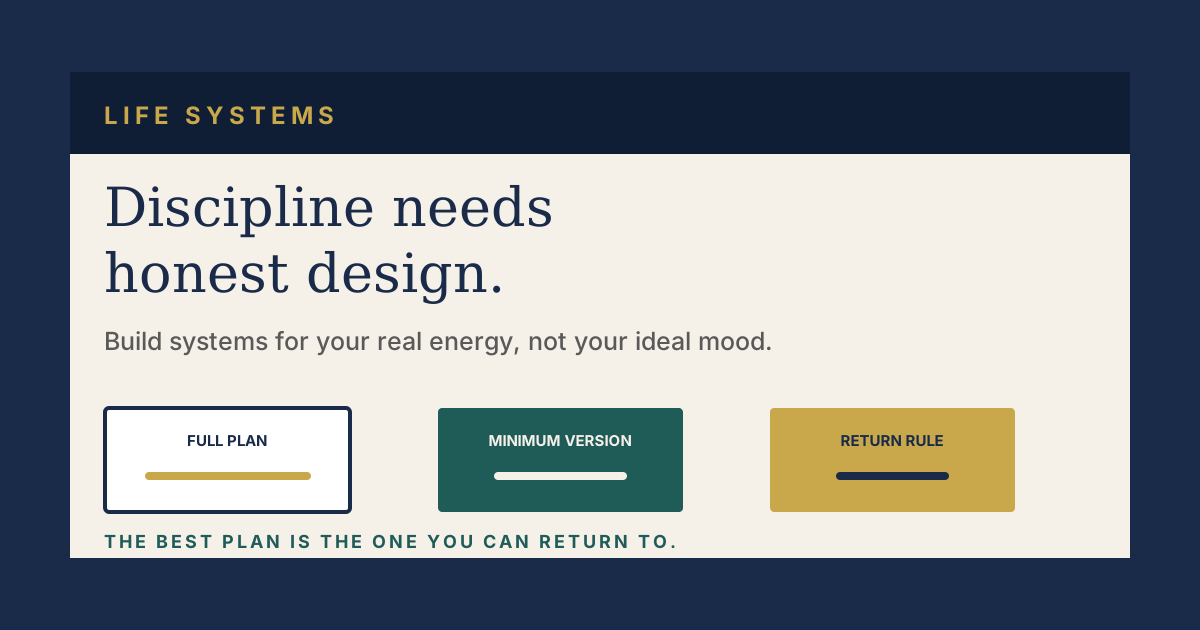
Real change begins when you stop planning for the ideal version of yourself and start building systems for the real one.
Key Takeaways
- Failing a plan does not always mean you lack discipline.
- Many plans fail because they are built for perfect conditions.
- A good system should work with your real energy, responsibilities, emotions, and environment.
- The best plan is not the most ambitious one. It is the one you can return to.
- You need minimum standards, recovery rules, and flexible structure.
- Self-trust grows when your plans are honest enough to keep.
Introduction
You make the plan.
This time, it looks serious.
You will wake up early.
You will stop scrolling at night.
You will exercise.
You will focus deeply.
You will eat better.
You will pray more consistently.
You will stop delaying decisions.
You will finish the work.
You will become disciplined.
For a few days, the plan works.
You feel proud.
You feel like the new version of your life has finally started.
Then one day goes wrong.
You sleep late.
You wake up tired.
A task takes longer than expected.
Someone interrupts you.
Your mood drops.
Work becomes heavy.
The routine breaks.
Then the old feeling returns.
"I have no discipline."
"I always fail."
"I cannot stay consistent."
"I start strong and then fall apart."
But before you blame yourself again, ask a better question.
Was the plan actually designed for your real life?
Or was it designed for a version of you that only exists in your imagination?
The Imaginary Version of You
Most people do not realize they are planning for an imaginary person.
This person always wakes up with energy.
This person never gets emotionally tired.
This person has full control over the day.
This person is never interrupted.
This person always makes rational decisions.
This person does not get overwhelmed.
This person does not have family pressure, work pressure, fatigue, loneliness, anxiety, responsibilities, or low-energy days.
This person can follow a perfect routine simply because it looks good on paper.
But that person is not you.
That person is an idealized version of you.
And when you design your life around that version, the real you keeps failing the plan.
Not because the real you is weak.
Because the plan was never built for reality.
Discipline Is Not the Same as Fantasy
Discipline is useful.
But discipline is not pretending you have unlimited energy.
Discipline is not creating a schedule that ignores your actual responsibilities.
Discipline is not forcing yourself into a routine that only works on perfect days.
Discipline is not punishing yourself for being human.
Real discipline is honest design.
It asks:
What can I repeat?
What usually breaks my plan?
What do I do when I miss a day?
What is the minimum version?
What structure supports me when motivation drops?
What environment makes this easier?
What decision can I remove?
Discipline is not only about pushing harder.
Sometimes discipline means building a system that does not depend on your strongest emotional state.
Why Your Plans Keep Failing
Your plans may keep failing because they are too big too early.
You try to change your sleep, work, health, phone use, money, relationships, career, and spiritual rhythm all at once.
That feels inspiring.
But it also creates pressure.
Your plans may fail because they have no recovery rule.
You miss one day, then the whole plan feels ruined.
Your plans may fail because they ignore your weak points.
You know you scroll at night, but you keep charging your phone beside the bed.
You know mornings are hard after late work, but you design a 5am routine anyway.
You know you get tired after meetings, but you schedule deep work right after them.
Your plans may fail because they are built around mood.
When you feel good, the plan looks possible.
When the mood changes, the plan collapses.
This is not always a discipline issue.
It is often a design issue.
A Plan That Only Works on Perfect Days Is Not a Plan
If your routine only works when you sleep well, feel motivated, have no interruptions, and experience no emotional pressure, it is not a strong plan.
It is a fragile plan.
A strong plan expects disruption.
It knows some days will be messy.
It knows you will sometimes wake up late.
It knows emotions will not always cooperate.
It knows work will sometimes expand.
It knows people will need you.
It knows life will not always follow your calendar.
The question is not, "Can this plan work on my best day?"
The better question is:
"Can this plan survive an ordinary difficult day?"
If the answer is no, the plan needs to become more honest.
The Problem With All-or-Nothing Planning
All-or-nothing planning sounds powerful at first.
From now on, no more excuses.
Every day, I will do everything properly.
No missed days.
No delays.
No weakness.
No failure.
This kind of thinking creates short-term energy.
But it also creates long-term collapse.
Because the moment you miss one part of the plan, the whole system feels broken.
You miss the workout, so the day feels wasted.
You wake up late, so the routine feels ruined.
You eat badly once, so the health plan feels over.
You scroll at night, so you tell yourself you have failed again.
All-or-nothing thinking turns small disruptions into full identity failures.
A mature system does not do that.
It allows recovery.
It says:
"This part broke. What is the next smallest return?"
That is how consistency is built.
Not through perfection.
Through return.
You Need a Minimum Version
Every plan needs a minimum version.
The minimum version is the smallest form of the habit that keeps the identity alive.
If your full workout is forty minutes, the minimum version may be ten minutes.
If your full writing session is two hours, the minimum version may be one paragraph.
If your full morning routine has five steps, the minimum version may be washing your face, praying, and naming the main task.
If your full planning session is thirty minutes, the minimum version may be writing three priorities.
If your full clean-up is the whole room, the minimum version may be clearing the desk.
The minimum version is not the dream.
It is the floor.
It prevents one bad day from becoming a lost week.
It teaches your mind:
"I may not always do the full version, but I do not disappear completely."
That builds self-trust.
The Real You Needs Recovery Rules
A recovery rule tells you what to do when the plan breaks.
Most people do not have recovery rules.
They only have success rules.
Wake up early.
Exercise daily.
Eat clean.
Focus for three hours.
No scrolling.
Finish the work.
But what happens when you fail?
What happens when you miss a day?
What happens when you sleep late?
What happens when you lose momentum?
Without a recovery rule, failure becomes emotional.
You start judging yourself.
You delay restarting.
You wait for Monday.
You need another reset.
A recovery rule makes return simple.
For example:
If I miss one day, I return the next day with the minimum version.
If I sleep late, I do not abandon the day. I start with one focused task.
If I scroll at night, I do not call the week ruined. I move the phone away tomorrow.
If I fail the full routine, I keep the smallest rhythm alive.
Recovery rules are not soft.
They are intelligent.
They prevent collapse.
Your Energy Has Patterns
You cannot build a good life system if you ignore your energy patterns.
Some people think best in the morning.
Others become clearer later in the day.
Some people have strong energy after movement.
Others need quiet before focus.
Some people can work deeply after meetings.
Others are drained by interaction.
Some people need structure.
Others need flexible blocks.
If you design your plan against your energy, you will keep fighting yourself.
This does not mean you should obey every mood.
It means you should study your patterns.
Ask:
When do I naturally think best?
When do I usually lose focus?
What type of task drains me fastest?
What kind of environment helps me start?
What time of day is most vulnerable to scrolling, overeating, avoidance, or delay?
What responsibilities consistently interrupt my plans?
A good plan does not ignore these answers.
It uses them.
Stop Copying Systems Built for Other People's Lives
Many people fail because they copy routines from people with completely different lives.
Someone online wakes up at 5am, works out, reads, journals, meditates, records content, and starts work before most people are awake.
That may work for them.
But do they have your responsibilities?
Your family structure?
Your work hours?
Your emotional load?
Your health?
Your commute?
Your season of life?
Your pressure?
A routine can look impressive and still be wrong for you.
The question is not, "Does this system look successful?"
The question is, "Can this system live inside my actual life?"
Borrow ideas.
Do not borrow identities.
A system must fit the life it is meant to support.
The Plan Should Reduce Decisions, Not Create More
A good plan reduces mental load.
A bad plan creates more decisions.
If your plan requires you to constantly decide what to do, when to do it, how long to do it, and whether you feel ready, it will become exhausting.
Decision-heavy systems break quickly.
A better system decides in advance.
For example:
After dinner, I prepare tomorrow's top three tasks.
Before opening messages, I finish one focused task.
After prayer, I review the day.
At 10pm, the phone leaves the bed.
On Friday, I close open loops.
When the trigger happens, the response is already chosen.
This is how systems protect you.
They remove repeated negotiation.
You do not need to remake the same decision every day.
You need a rhythm that carries the decision for you.
Your Environment Is Part of Your Discipline
Discipline is not only internal.
Your environment shapes your behaviour.
If your phone is beside your bed, late-night scrolling becomes easier.
If your workspace is messy, starting becomes harder.
If your calendar is full of other people's priorities, deep work becomes unlikely.
If unhealthy food is always available, better eating becomes harder.
If your notifications are always on, focus becomes weaker.
If your tasks are hidden in your head, overwhelm increases.
Many people try to solve environmental problems with willpower.
That is expensive.
A better question is:
How can I make the right behaviour easier and the wrong behaviour harder?
This is not weakness.
This is design.
A disciplined person does not rely only on inner strength.
They arrange life so fewer battles are necessary.
The Real Plan Must Include Low-Energy Days
Low-energy days are not exceptions.
They are part of life.
A realistic plan must include them.
What will you do when you are tired?
What will you do when your mood is low?
What will you do when work runs late?
What will you do when you miss the full routine?
What will you do when you feel resistance?
If your plan has no answer for low-energy days, then low-energy days will keep breaking it.
Create a low-energy protocol.
For example:
Do the minimum version.
Avoid making major decisions.
Complete one stabilizing task.
Take a short walk.
Clear one small area.
Sleep earlier.
Return tomorrow.
The goal is not to perform at your best every day.
The goal is to avoid abandoning yourself on the days you are not at your best.
The Plan Must Respect Your Emotional Life
Many people design routines as if emotions do not exist.
But emotions affect consistency.
Sadness affects energy.
Anxiety affects focus.
Conflict affects sleep.
Loneliness affects scrolling.
Guilt affects decision-making.
Resentment affects motivation.
If you ignore your emotional life, your plan will keep being interrupted by feelings you refuse to address.
This does not mean you should wait until you feel perfect.
It means your system should include emotional maintenance.
A weekly check-in.
A journal page.
A difficult conversation.
A boundary.
A walk without your phone.
A quiet evening.
A closure practice.
A plan that only manages tasks but ignores emotional weight will eventually collapse under hidden pressure.
You are not a machine.
Your life system should know that.
Stop Making Promises From Guilt
Many plans are created from guilt.
You feel ashamed of how things are going, so you make a dramatic promise.
I will change everything.
I will never do this again.
I will wake up early every day.
I will stop wasting time completely.
I will become a different person.
Guilt creates extreme promises because it wants relief.
But extreme promises are often hard to keep.
Then you break them.
Then guilt becomes stronger.
Then you make another extreme promise.
This cycle damages self-trust.
A better approach is honesty.
Instead of asking, "What promise would make me feel better right now?"
Ask:
"What promise can I actually keep this week?"
Small kept promises build more change than dramatic broken promises.
The Self-Trust Problem
Every plan you break affects self-trust.
Not because missing one day is a disaster.
But because repeated broken promises teach your mind not to believe you.
You say, "Tomorrow I will start."
Your mind remembers the last ten tomorrows.
You say, "This time is different."
Your mind waits for evidence.
You say, "I will be disciplined."
Your mind does not trust the sentence yet.
Self-trust is rebuilt through evidence.
Not emotional declarations.
Evidence.
You keep the minimum version.
You return after failure.
You design smaller promises.
You follow through.
You stop making impossible commitments.
You tell yourself the truth.
Slowly, your mind begins to believe you again.
That is discipline at a deeper level.
Build the System Around Return
The most important part of any system is not how it starts.
It is how it returns.
Anyone can start when motivation is high.
The real question is:
What happens after interruption?
A good system has a return point.
The weekly review.
The minimum habit.
The reset day.
The closure hour.
The next morning rule.
The return message.
The small task that gets you back inside the rhythm.
Without return points, every disruption becomes a full stop.
With return points, disruption becomes part of the system.
This is the difference between fragile consistency and mature consistency.
Fragile consistency says, "I must never fall off."
Mature consistency says, "When I fall off, I know how to return."
The Plan Should Be Boring Enough to Repeat
Some plans fail because they are too dramatic.
They create excitement but not stability.
You redesign your whole life.
You create a beautiful schedule.
You add ten habits.
You imagine the transformation.
But the plan is too intense to repeat.
A good plan may look boring.
That is not a problem.
Boring is often repeatable.
Repeatable is powerful.
Ten minutes daily.
One weekly review.
Three priorities.
A regular sleep boundary.
One focused work block.
One closure hour.
One small financial habit.
One honest conversation.
These do not look dramatic.
But repeated over time, they change the structure of life.
Do not underestimate boring systems.
They are often the ones that actually work.
The Honest Plan Test
Before you trust a plan, test it with these questions.
Can I do this on an ordinary day?
Can I do a smaller version on a hard day?
What usually breaks this plan?
What will I do when it breaks?
Does this plan fit my actual responsibilities?
Does this plan reduce decisions or create more?
Does my environment support it?
Am I making this promise from clarity or guilt?
Can I repeat this for four weeks?
Does this plan help me return, or does it punish me for failing?
If a plan cannot pass these questions, it may still be inspiring.
But it may not be sustainable.
What to Change First
Do not rebuild your whole life at once.
Choose the one plan that keeps breaking most often.
Maybe it is your sleep.
Maybe it is your morning.
Maybe it is work focus.
Maybe it is your phone use.
Maybe it is exercise.
Maybe it is decision-making.
Maybe it is weekly planning.
Then simplify it.
Create a minimum version.
Create a recovery rule.
Change the environment.
Attach it to an existing rhythm.
Review it weekly.
Do not add five more habits yet.
Build one honest system first.
A stable life is not built by stacking promises.
It is built by strengthening the rhythm underneath them.
The Real Discipline Question
The real question is not, "Why am I not disciplined?"
The better question is:
"What kind of structure would help the real version of me act more consistently?"
That question is more useful.
It does not shame you.
It studies you.
It looks at your energy, environment, emotions, responsibilities, patterns, and weak points.
It helps you build a system that works with reality.
Discipline is not only force.
Discipline is design.
And design begins with truth.
Final Thought
You may not lack discipline.
You may be trying to follow a plan built for someone you are not.
A version of you with perfect energy.
Perfect time.
Perfect focus.
Perfect emotions.
Perfect control.
Perfect conditions.
But real life is not perfect.
And the real you needs a plan that understands that.
A strong life system is not the one that looks most impressive.
It is the one you can return to.
It has a minimum version.
It has recovery rules.
It respects your energy.
It reduces unnecessary decisions.
It adjusts the environment.
It makes space for emotion.
It does not collapse after one missed day.
So stop asking only, "How do I become more disciplined?"
Ask:
"What keeps breaking?"
"What version of me did this plan assume?"
"What would help the real me return?"
That is where change begins.
Not with another dramatic promise.
With an honest system.
Because the goal is not to become an imaginary person.
The goal is to build a real life that the real you can actually live.
Need Life Direction Clarity?
If you keep making plans, breaking them, and blaming yourself, the problem may not be laziness.
It may be that your life system is not designed around your real energy, responsibilities, and patterns.
A structured clarity session can help you identify what keeps breaking, what rhythm needs support, and what practical system would actually fit your life.
You do not need another impossible promise.
You need a plan built for the real you.
Book a Life Direction Session
If your plans keep breaking, a clarity session can help you identify the rhythm, recovery rule, and practical system that would actually fit your real energy, responsibilities, and patterns.