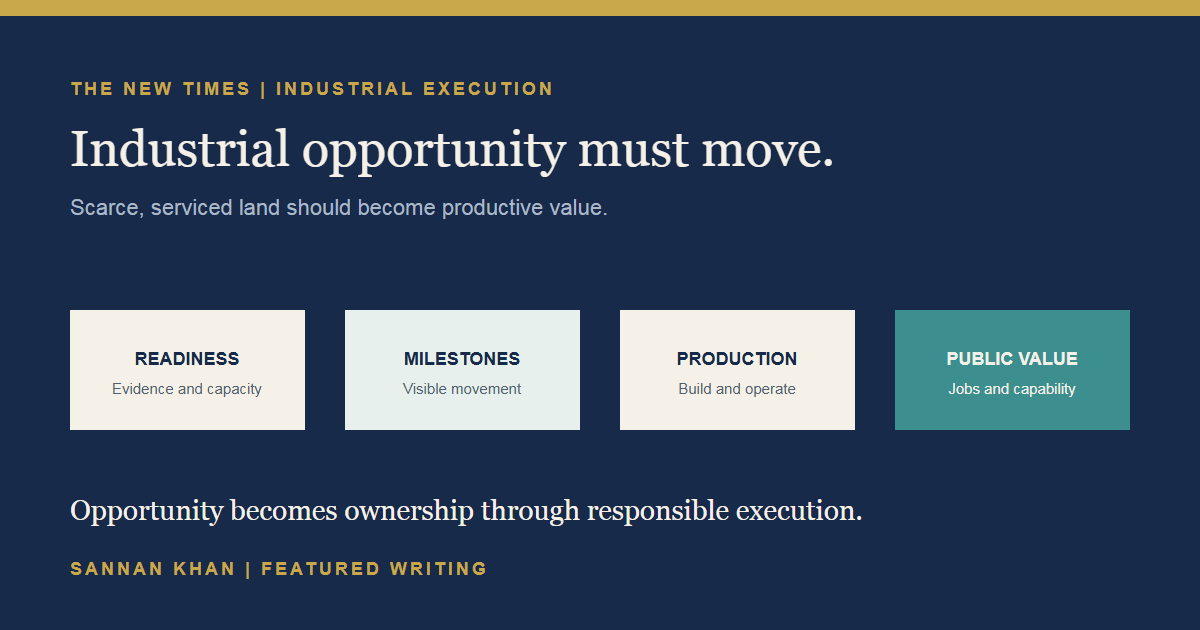
The complete opinion remains on The New Times website. This feature summary introduces its central argument and connects it to related execution and organizational frameworks on SannanKhan.com.
Industrial land carries public infrastructure, planning effort, and opportunity cost. Allocation should therefore test investor readiness and be followed by measurable implementation milestones, support for credible obstacles, and consequences where scarce land remains idle without defensible progress.
Industrial opportunity carries a public purpose
Serviced industrial land is not ordinary passive property. Roads, electricity, water, fibre, planning, and institutional coordination are organized around the expectation that projects will produce jobs, goods, exports, supplier opportunities, new capabilities, or useful import substitution.
That makes readiness important before allocation. An attractive concept should be supported by financing evidence, implementation capacity, relevant experience, a realistic market case, and a credible timeline. Facilitation should help serious investors execute, not turn scarce productive space into inventory that can be held indefinitely.
Milestones distinguish obstacles from inaction
Projects can stall for legitimate reasons. Financing conditions change, construction costs rise, markets shift, and infrastructure can be delayed. A disciplined system should recognize those realities through investor aftercare and problem-solving.
At the same time, milestones make movement visible: financing closed, design completed, permits secured, construction started, equipment ordered, production launched. Where there is no credible progress and no defensible obstacle, reallocation protects fairness for other investors ready to build.
The broader principle is simple: opportunity becomes economically valuable through execution. The strongest investor is not only the one who secures access first, but the one who turns access into productive value.