Summary
Not every peaceful relationship is healthy.
Sometimes the relationship feels calm because the problem has been solved.
Other times, it feels calm because one person has stopped bringing the problem up.
You stopped asking for emotional presence.
You stopped asking for better communication.
You stopped asking for repair.
You stopped asking for consistency.
You stopped asking for effort.
You stopped asking for change.
Now there are fewer arguments.
The house feels quieter.
The tension is lower.
But inside, something in you is also quieter.
Not because you are at peace.
Because you have stopped expecting to be met.
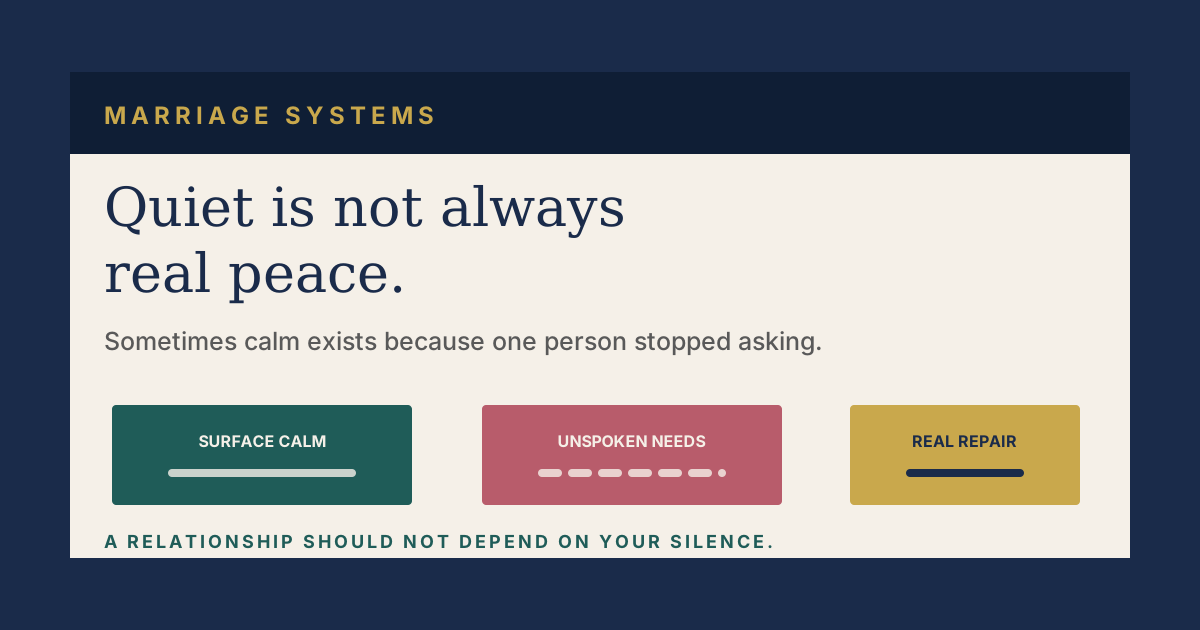
This is not real peace.
This is silence created by unmet needs.
A relationship is not healthy just because nobody is fighting.
Sometimes the absence of conflict only means one person has stopped believing the conversation will help.
Key Takeaways
- Peace is not always a sign that the relationship is healthy.
- Sometimes conflict stops because the issue is resolved.
- Sometimes conflict stops because one person has given up asking.
- If your silence is creating peace, the relationship may be avoiding truth.
- Unspoken needs do not disappear. They often become resentment, numbness, or emotional distance.
- Real peace includes honesty, repair, emotional safety, and shared responsibility.
Introduction
The relationship seems calmer now.
There are fewer arguments.
Fewer difficult conversations.
Fewer emotional moments.
Fewer requests.
Fewer questions.
Fewer complaints.
From the outside, this may look like improvement.
Maybe even maturity.
Maybe you tell yourself, "Things are better now."
But deep down, you know something else changed.
You did not become peaceful.
You became quiet.
You stopped asking for the same things.
You stopped asking why they withdraw.
You stopped asking for more effort.
You stopped asking for emotional presence.
You stopped asking for consistency.
You stopped asking for repair after conflict.
You stopped asking for the relationship to feel shared.
Now the relationship feels easier.
But not because the connection became stronger.
Because your needs became smaller.
This is one of the most confusing relationship patterns.
A relationship can become calmer when one person stops telling the truth.
That calm may feel like peace.
But it may actually be emotional resignation.
Not All Peace Is Real Peace
Real peace is different from silence.
Real peace comes after truth has been spoken, heard, and handled with care.
False peace comes when truth is avoided.
Real peace creates closeness.
False peace creates distance.
Real peace allows both people to breathe.
False peace requires one person to disappear emotionally.
Real peace is built on understanding.
False peace is built on not bringing things up.
This distinction matters because many people mistake the absence of arguments for progress.
They think:
"We are not fighting anymore, so maybe things are better."
Sometimes that is true.
But sometimes the fighting stopped because you stopped trying to repair what kept hurting you.
A relationship should not depend on your silence to stay calm.
If peace only exists when you ask for nothing, it is not peace.
It is a system that rewards your self-abandonment.
When Asking Became Too Expensive
You probably did not stop asking all at once.
At first, you tried.
You explained how you felt.
You asked for better communication.
You asked them to listen.
You asked for more consistency.
You asked for help.
You asked for closeness.
You asked for something to change.
Maybe they got defensive.
Maybe they dismissed you.
Maybe they said you were too sensitive.
Maybe they promised change but did not follow through.
Maybe every conversation turned into a fight.
Maybe they withdrew.
Maybe they made you feel guilty for needing anything.
After enough attempts, asking began to feel expensive.
It cost too much energy.
Too much vulnerability.
Too much disappointment.
Too much conflict.
So you stopped.
Not because the need disappeared.
Because the cost of expressing it became too high.
That is not healing.
That is emotional adaptation.
The Relationship Became Easier Because You Became Smaller
Sometimes the relationship feels easier because you have reduced yourself to fit inside it.
You no longer ask certain questions.
You no longer expect certain conversations.
You no longer hope for certain changes.
You no longer share certain feelings.
You no longer let yourself need certain things.
This may reduce conflict.
But it also reduces intimacy.
A relationship cannot truly know you if you keep editing yourself to keep it stable.
It may feel calmer when you are smaller.
But it will also feel lonelier.
Because peace that requires self-erasure is not connection.
It is survival.
The relationship may be more manageable now, but at what cost?
If the price of calm is your emotional honesty, something important is wrong with the system.
The Difference Between Acceptance and Giving Up
Acceptance can be healthy.
Giving up can look similar from the outside.
Acceptance says, "I understand what this person can and cannot give, and I will make a clear decision from that truth."
Giving up says, "I do not think my needs will matter here, so I will stop mentioning them."
Acceptance is conscious.
Giving up is exhausted.
Acceptance creates clarity.
Giving up creates numbness.
Acceptance may lead to boundaries, repair, or a wise decision.
Giving up often leads to quiet resentment.
This distinction matters.
You may tell yourself you have accepted the relationship as it is.
But ask honestly:
Have I accepted it with clarity?
Or have I given up because asking hurts too much?
Those are not the same thing.
Signs You Have Stopped Asking for What You Need
One sign is that you no longer bring up issues that still hurt you.
You have not healed from them.
You have simply stopped mentioning them.
Another sign is that you feel relief when you avoid a conversation.
The relief is real, but it may not be peace.
It may be relief from the fear of conflict.
Another sign is that you say, "It is fine," when it is not fine.
Not because you are trying to be kind.
Because explaining feels pointless.
Another sign is that you have stopped imagining change.
You no longer think, "Maybe we can fix this."
You think, "This is just how it is."
Another sign is that the relationship feels calm but emotionally distant.
There may be fewer fights, but also less closeness.
Less honesty.
Less tenderness.
Less hope.
Less of you.
That is important information.
Why Silence Can Feel Like Maturity
Many people confuse silence with maturity.
They think being mature means not making a big deal.
Not needing too much.
Not bringing up old issues.
Not asking difficult questions.
Not disturbing the peace.
There is wisdom in choosing the right moment.
There is maturity in not reacting to every feeling.
There is strength in learning what deserves attention and what does not.
But maturity is not the same as emotional disappearance.
Maturity does not mean you pretend repeated pain is no longer there.
Maturity does not mean you accept a pattern that keeps hurting you.
Maturity does not mean you become easy to be with because you no longer ask for anything.
Sometimes silence is wisdom.
Sometimes silence is fear.
Sometimes silence is exhaustion.
You need to know which one is operating in you.
The Hidden Cost of Not Asking
Unasked needs do not vanish.
They usually move somewhere else.
They become resentment.
You begin feeling irritated by small things because the bigger things were never addressed.
They become numbness.
You stop feeling as much because feeling has become too painful.
They become distance.
You slowly stop reaching emotionally.
They become criticism.
The needs you never named begin leaking out as sharpness.
They become hopelessness.
You stop believing the relationship can become different.
They become fantasy.
You imagine being understood somewhere else, not always because you want to leave, but because you miss being met.
This is why silence is not neutral.
It may reduce conflict in the short term.
But if truth is being buried, the relationship pays later.
When the Other Person Thinks Everything Is Fine
One painful part of this pattern is that your partner may think things are better.
They may notice fewer arguments.
They may feel less pressure.
They may believe you have finally "moved on."
They may think the issue is resolved because you stopped mentioning it.
But inside, you may be more distant than ever.
This creates a dangerous mismatch.
One person feels relieved.
The other feels resigned.
One person thinks peace has returned.
The other has quietly stopped expecting repair.
This is why silence can mislead a relationship.
The absence of conversation does not always mean the absence of pain.
Sometimes it only means the pain has gone underground.
The Relationship May Be Avoiding the Truth
Some relationships become very good at avoiding truth.
They create routines.
They stay busy.
They talk about practical things.
They keep the household moving.
They attend events.
They manage responsibilities.
They avoid the deeper conversation.
Everything looks functional.
But the emotional truth is untouched.
This is not always intentional.
Sometimes both people are tired.
Sometimes one person is afraid.
Sometimes both know that one honest conversation could expose too much.
So the relationship keeps moving.
But movement is not the same as repair.
A relationship can function and still be emotionally unresolved.
It can look stable and still be quietly disconnected.
That is why the deeper question is not, "Are we still operating?"
The question is, "Are we still honest?"
The Problem With Being the "Easy" Partner
When you stop asking for what you need, you may become easier to be with.
Less demanding.
Less emotional.
Less confrontational.
Less complicated.
Less "difficult."
But sometimes being easy means becoming invisible.
You may become easy because you no longer ask for emotional presence.
Easy because you tolerate inconsistency.
Easy because you do not bring up repeated hurt.
Easy because you accept less than what you actually need.
Easy because you keep the peace by carrying the pain privately.
A relationship should not require you to become low-maintenance in order to be loved.
You can be considerate without disappearing.
You can be patient without abandoning your needs.
You can be peaceful without becoming silent about what matters.
The Difference Between Need and Demand
Some people stop asking because they have been made to feel needy.
They begin to question basic emotional needs.
Communication.
Consistency.
Repair.
Respect.
Honesty.
Affection.
Presence.
Shared responsibility.
These are not excessive demands.
They are part of a healthy relationship system.
Of course, how you ask matters.
Timing matters.
Tone matters.
Emotional regulation matters.
But the existence of a need does not make you unreasonable.
A need becomes a demand when it refuses to consider the other person's humanity.
But a healthy need asks to be seen, understood, and responded to.
Do not let someone's discomfort with your needs convince you that having needs is the problem.
Sometimes the problem is not that you asked for too much.
It is that the relationship has become organized around you asking for too little.
When You Stop Asking, You Also Stop Being Known
To be known in a relationship, you have to be able to bring your inner life into it.
Your needs.
Your fears.
Your hopes.
Your disappointments.
Your limits.
Your desires.
Your hurt.
Your questions.
When you stop bringing these things, the relationship may still continue, but your partner is no longer relating to your full self.
They are relating to the edited version.
The safer version.
The quieter version.
The version that does not disturb the system.
Over time, this creates loneliness.
You may feel like your partner loves you, but does not really know what is happening inside you.
That is because you have stopped showing it.
Not because you are false.
Because the relationship has not felt safe enough for your full truth.
That is a serious signal.
How to Tell If the Peace Is Real
Ask these questions.
1. Did the Issue Actually Change?
If the pattern changed, the peace may be real.
If the pattern stayed the same but you stopped talking about it, the peace may be false.
2. Do I Feel Closer or Just Quieter?
Real peace usually creates more closeness.
False peace often creates emotional distance.
3. Can I Still Bring Up Hard Things?
If you can speak honestly without fear of punishment, the system may be healthier.
If you avoid hard topics to protect the calm, the peace is fragile.
4. Do I Feel Respected in My Needs?
Real peace makes room for both people.
False peace usually depends on one person needing less.
5. Is There Repair or Just Reset?
Repair means the pattern was understood and addressed.
Reset means the tension reduced, but nothing deeper changed.
These questions help you see whether the relationship is peaceful or merely quiet.
What Not to Do
Do not explode after months of silence and expect one conversation to fix everything.
Your pain may be valid, but stored pain often comes out with force.
Try to name the pattern before resentment takes over.
Do not keep pretending you are fine when you are not.
That only deepens the internal split.
Do not punish your partner with silence if what you really need is an honest conversation.
Silence may feel protective, but it can also make the pattern harder to repair.
Do not assume your partner knows what you have stopped asking for.
They may know.
They may not.
The first step is to make the hidden pattern visible.
Do not confuse being calm with being healed.
Calm can be real.
But it can also be emotional shutdown.
How to Name What Has Happened
If you decide to speak, you may need to name the pattern carefully.
You can say:
"I realize things have been calmer, but I do not think it is because everything is resolved. I think I have stopped bringing up what hurts me."
Or:
"I do not want us to confuse fewer arguments with real repair. I feel like I have become quieter, not more connected."
Or:
"I have stopped asking for certain things because I did not believe the conversation would lead anywhere. That is not healthy for me or for us."
Or:
"I want to talk about what has changed between us, because I do not want peace that depends on me hiding what I need."
These sentences are direct without being reckless.
They name the system.
They invite a real conversation.
Then watch the response.
A willing partner may feel uncomfortable, but they will try to understand.
An avoidant partner may turn the conversation into blame, denial, or dismissal.
The response gives you information.
What Repair Would Look Like
Repair does not mean your partner immediately gives you everything you need.
Repair begins with recognition.
They recognize that the calm may not be real peace.
They recognize that you have been carrying unspoken needs.
They recognize that the relationship may have rewarded your silence.
Then repair moves toward responsibility.
What did each person avoid?
What needs were dismissed?
What conversations became unsafe?
What patterns need to change?
What requests are realistic?
What support is needed?
What agreements must be made?
Repair requires more than emotional reassurance.
It requires changed behaviour.
If the pattern is communication, communication must change.
If the pattern is emotional absence, presence must change.
If the pattern is defensiveness, listening must change.
If the pattern is one-sided effort, responsibility must change.
Real repair touches the system.
When the Relationship Cannot Hold Your Needs
Sometimes you name the pattern, and the relationship still cannot hold it.
You speak honestly.
They dismiss it.
You ask for repair.
They accuse you of creating problems.
You explain your loneliness.
They say you are never satisfied.
You ask for change.
They make promises but repeat the same behaviour.
This is painful.
But it is also clarifying.
If a relationship cannot hold your needs, you have to stop pretending the problem is only your communication.
At some point, you must ask:
Is this a relationship where my emotional life can exist?
Can I be honest here?
Can repair happen here?
Can my needs matter without being treated as a threat?
If the answer keeps being no, the issue is deeper than one conversation.
You may need stronger boundaries, outside support, or a larger decision.
Do Not Return to Silence Too Quickly
After one hard conversation, you may feel tempted to return to silence.
Especially if the conversation is uncomfortable.
But if the pattern is serious, one conversation is not enough.
You may need follow-up.
You may need structure.
You may need to check whether behaviour changes.
You may need to observe whether the relationship can hold repeated truth, not only one emotional moment.
Do not measure repair by how someone responds when they are afraid of losing you.
Measure it by what happens after the conversation is over.
Does the pattern change?
Does the responsibility become shared?
Does the effort continue?
Does your voice remain welcome?
Repair is proven over time.
The Goal Is Not to Ask Forever
This is important.
The goal is not to spend your life asking for the same basic needs repeatedly.
The goal is to see whether the relationship can respond.
If you have to ask endlessly for basic respect, presence, honesty, or repair, something is wrong.
A healthy relationship may need reminders.
It should not require constant pleading.
When a need is named clearly and repeatedly, the next issue is not whether you explained it well enough.
The issue is whether the other person is willing to take it seriously.
You are not meant to become the full-time manager of your own unmet needs.
The relationship should be able to carry them with you.
Final Thought
A relationship is not healthy just because it is quiet.
Sometimes quiet means peace.
Sometimes quiet means one person has stopped asking.
You need to know the difference.
If the relationship feels calmer because the issue has been repaired, that is good.
But if it feels calmer because you have stopped naming what hurts, then the calm is fragile.
Your needs did not disappear.
Your voice just got tired.
You do not need to create unnecessary conflict.
But you also do not need to keep protecting a false peace that costs you emotional honesty.
A relationship should be able to hold truth.
It should be able to hear needs.
It should be able to repair patterns.
It should not require one person to become smaller so the system can stay comfortable.
So ask yourself honestly:
Is this peace real?
Or did I simply stop asking for what I need?
The answer may be uncomfortable.
But it is also the beginning of clarity.
Frequently Asked Questions
Why can a relationship feel peaceful after you stop asking for what you need?
Because fewer requests can reduce conflict on the surface, even when the underlying need has not been repaired. That calm may be resignation rather than real peace.
How do I know whether the peace is real?
Real peace usually includes honesty, repair, emotional safety, and shared responsibility. False peace often depends on one person staying quiet or needing less.
What should I do if I have stopped asking for what I need?
Name the pattern carefully, watch whether repair becomes shared, and consider structured support if the relationship cannot hold honest needs.
When Silence Replaces the Truth
Stopping the request is often only the visible part of the pattern. Over time, people may also stop naming disappointment, fear, anger, or the smaller truths that would make the relationship more honest. The relationship looks calmer because less of the real experience is allowed into it.
That is why a quiet relationship can still feel lonely. Silence may reduce immediate conflict, but it does not repair the underlying issue or show whether both people can hold an honest conversation.
Need Marriage Clarity?
If your relationship feels calmer but you know it is because you stopped asking for what you need, you do not need more silent overthinking.
You need clarity.
A structured Marriage Clarity session can help you understand whether this is real peace, emotional resignation, one-sided effort, or a deeper relationship pattern that needs repair or decision.
You do not need to keep shrinking to keep the relationship calm.
You need to know whether the relationship can hold your truth.
Book a Marriage Clarity Session
If the relationship feels calmer because you stopped asking for what you need, a Marriage Clarity session can help you understand whether this is real peace, emotional resignation, one-sided effort, or a deeper repair pattern.