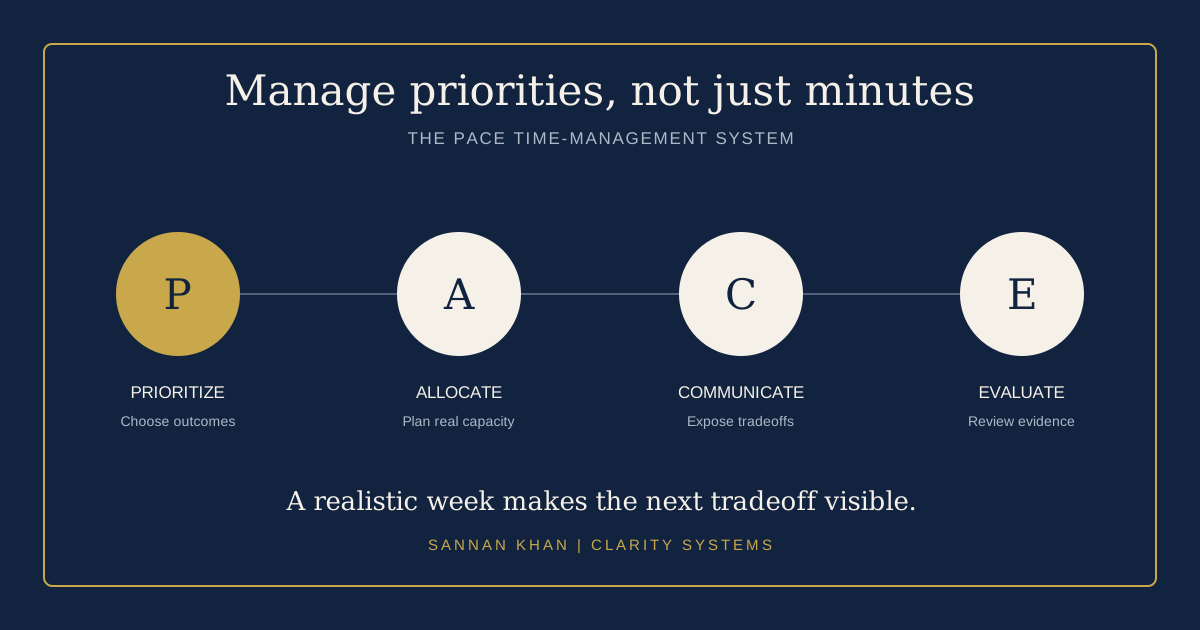
Better time management at work begins with four moves: prioritize a few outcomes, allocate your real capacity, communicate the tradeoffs created by new requests, and evaluate the week using evidence. The PACE system helps busy UAE professionals manage attention and commitments instead of trying to fit unlimited work into a limited calendar.
You can answer every message, attend every meeting, and still finish the week without moving the work that matters. That is because time management is not simply a speed problem. It is a decision system.
For professionals in Dubai, Abu Dhabi, Sharjah, and across the UAE, a normal week may include clients in several timezones, fast-moving projects, long commutes, multilingual teams, messaging apps, family responsibilities, and requests from more than one stakeholder. A longer task list cannot solve competing ownership and limited capacity. The system has to decide what receives time and what does not.
What Is Time Management at Work?
Time management at work is the process of choosing priorities, matching commitments to available capacity, protecting attention, coordinating deadlines, and reviewing whether effort produced the intended result.
It is not the ability to remain busy for every available minute. It is also not a promise that one person can absorb any workload through better discipline. A useful system distinguishes four different problems:
- Priority problem: too many tasks are being treated as equally important.
- Capacity problem: the required work exceeds the time and resources available.
- Clarity problem: the output, owner, deadline, or quality standard is unclear.
- Attention problem: interruptions and task switching prevent concentrated progress.
The solution depends on the diagnosis. A new productivity app cannot fix an impossible workload. A boundary cannot help if nobody has decided what the priority is. A perfect plan cannot survive when every new request enters the calendar without replacing anything.
Why Traditional To-Do Lists Often Fail
A to-do list records demand. It does not automatically make a decision about value, sequence, effort, or capacity. Twenty tasks can fit on one page even when they require forty hours more than the week contains.
Lists also hide the difference between an activity and an outcome. "Work on presentation" is an activity. "Agree the client's preferred option and secure written approval by Thursday" is an outcome. The outcome clarifies why the work matters and what completion means.
The most dangerous list is the one that keeps expanding while the calendar remains unchanged. It creates the feeling that everything is possible if you become more efficient. In reality, every accepted commitment consumes time that can no longer be given to another one.
The PACE Time-Management System
PACE stands for Prioritize, Allocate, Communicate, and Evaluate. Use it at the beginning of the week, whenever a major request changes the plan, and during a short weekly review.
P: Prioritize Outcomes
Start by naming the two or three outcomes that would make the week meaningfully successful. An outcome should describe a result, not an intention to stay busy.
Ask:
- Which result has the greatest consequence if it moves or fails?
- Which work unlocks other people, decisions, or revenue?
- Which deadline is real, and which one has simply never been questioned?
- What requires my judgment, and what can be delegated, simplified, or removed?
You will still have routine work. The purpose is to stop routine demand from silently displacing the few outcomes that require deliberate progress.
Use three levels: must move, should move, and maintain. If everything remains in the first level, prioritization has not happened.
A: Allocate Real Capacity
Do not plan from total working hours. Plan from usable capacity after fixed meetings, operational responsibilities, breaks, travel, administration, and realistic recovery are accounted for.
A person may have a forty-hour workweek but only twelve hours available for concentrated project work. Scheduling thirty hours of deep work into that space creates predictable failure, not ambition.
For each priority outcome, estimate:
- The next visible deliverable.
- The amount of focused effort it needs.
- The people, information, or approvals it depends on.
- The earliest useful block in which progress can begin.
Place the highest-value work into the calendar before the week fills with lower-value activity. Keep some capacity unallocated for genuine operational surprises. A calendar planned to one hundred percent has no room for reality.
C: Communicate Tradeoffs
Time management becomes a team skill when new work arrives. Saying yes without naming what it displaces hides the tradeoff until something misses its deadline.
Use clear language: "I can complete the revised cost analysis by Wednesday. If the client summary must also be finished tomorrow, which item should move first, and what can be delayed?" This does not reject responsibility. It gives the decision-maker accurate information about capacity.
When requests come from different managers or stakeholders, create one visible comparison:
- Requested outcome
- Owner or decision-maker
- Deadline and reason
- Estimated effort
- Consequence of delay
- Existing work it would replace
Then ask the relevant authority to resolve the conflict. Quietly carrying contradictory priorities is not good time management. It is hidden risk.
The CLEAR workplace communication framework provides a fuller method for stating context, expectations, alignment, and written follow-through.
E: Evaluate the Week
A system improves only when it learns. At the end of the week, compare the plan with what actually happened.
Review five questions:
- Which priority outcomes moved?
- Which work consumed more capacity than expected?
- Which interruptions were necessary, and which were preventable?
- Where did unclear ownership or waiting time create delay?
- What should be stopped, delegated, clarified, or scheduled differently next week?
Do not judge the week only by the number of completed tasks. A small number of consequential results may be more valuable than clearing a long list of low-impact activity.
You do not manage time by promising more. You manage it by making priorities, capacity, and tradeoffs visible before the deadline exposes them.
How to Protect Focus in a High-Interruption Workday
Focused work does not require an entire silent day. It requires a protected block with one defined output and fewer opportunities to switch attention.
Before the block begins:
- Write the specific deliverable you want to produce.
- Gather the files, data, and decisions you already need.
- Close unrelated tabs and mute nonessential notifications where policy permits.
- Tell relevant colleagues when you will next check messages.
- Capture new thoughts on a short parking list instead of following them immediately.
Choose a block length that fits the role. A customer-facing professional may protect thirty minutes. A strategist or analyst may need ninety. The standard is not duration; it is whether the block is long enough to create a meaningful unit of progress.
Meetings, Email, and Messaging Apps
Communication channels can coordinate work or fragment it. The difference is whether each channel has a clear purpose.
Before accepting or scheduling a meeting, ask what decision or output requires synchronous discussion. If the purpose is only to share information, a concise written update may be enough. If a meeting is necessary, end it with decisions, owners, deadlines, and unresolved items.
Use messaging for short coordination, not as the only record of important scope or ownership changes. Batch nonurgent email and messages into planned checks where your role permits. Constant availability can feel responsive while preventing the concentrated work that clients and managers are waiting to receive.
Follow organizational rules for confidentiality, data, client communication, and response expectations. Personal productivity preferences should not override policy or a genuine operational need.
When the Problem Is Workload, Not Time Management
A workload is structurally excessive when the required outcomes consistently exceed available capacity even after priorities, processes, interruptions, and role clarity have been examined. Signs include:
- High-priority work regularly conflicts with other high-priority work.
- Deadlines depend on routine overtime rather than an exceptional period.
- New commitments are added without adjusting scope, staffing, timing, or quality.
- Several people believe their request is first, with no shared decision-maker.
- Essential recovery, safety, or health is being treated as wasted time.
In that situation, improve the evidence before blaming yourself. Track demand, estimated effort, actual effort, delays, and unresolved priority conflicts. Use the evidence to request a decision about scope, resources, sequence, or deadlines.
Time-management guidance is not employment or legal advice. Working hours, overtime, leave, and employment rights depend on current rules and individual circumstances. Use official guidance such as the UAE Ministry of Human Resources and Emiratisation's worker rights portal and obtain qualified support where necessary.
Time Management or Procrastination?
A task can remain unfinished even when time exists. The delay may come from an unclear first step, fear of being judged, low value, missing information, too many options, or a task that feels larger than it has been defined.
Do not respond to every delay by adding pressure. Diagnose it:
- If the next action is unclear, define the first visible step.
- If the task is too large, reduce it to a short deliverable.
- If a decision is missing, identify who must make it.
- If distraction is immediate, change the environment for one start block.
- If the task has no credible value, question whether it belongs in the plan.
Read Procrastination or Lack of Clarity? for the full diagnostic. Persistent difficulty starting, concentrating, or functioning can have causes that a productivity framework cannot assess; seek appropriately qualified support when needed.
A Seven-Day Time-Management Reset
- Day 1: Audit demand. Put current projects, routine responsibilities, meetings, and open requests into one view.
- Day 2: Choose outcomes. Identify the two or three results that must move this week.
- Day 3: Measure capacity. Calculate the focused time left after fixed commitments and realistic operating work.
- Day 4: Protect attention. Schedule one uninterrupted block for the highest-value deliverable.
- Day 5: Resolve a conflict. Make one competing-priority tradeoff visible to the relevant decision-maker.
- Day 6: Reduce channel noise. Remove one unnecessary meeting, notification, or repeated update.
- Day 7: Review evidence. Record what moved, what expanded, what waited, and what should change next week.
The reset is not meant to create a perfect schedule. It establishes a repeatable connection between what matters and what your working week can responsibly hold.
What Effective Time Management Looks Like
Effective time management does not make every day predictable. It makes change easier to handle because priorities and capacity are already visible.
You know the system is improving when:
- Important outcomes receive time before the calendar fills.
- New requests trigger a tradeoff instead of an automatic promise.
- Meetings produce decisions and ownership.
- Delays are raised before they become surprises.
- The weekly review changes the next plan.
The UAE's National Program for Advanced Skills emphasizes capabilities including adaptability, communication, collaboration, and lifelong learning. A reliable time-management system supports those capabilities by turning professional intention into repeatable action.
How can I improve time management at work?
Choose a small number of weekly outcomes, estimate your usable capacity after fixed commitments, protect focused work for the highest-value task, communicate tradeoffs when new work arrives, and review what moved at the end of the week.
What is the best time-management method for busy professionals?
There is no single best method for every role. A useful system must connect priorities to real capacity, reserve time for focused work, make new tradeoffs visible, and include a regular review so the plan can adapt.
How do I manage competing priorities from different managers?
Make the conflict visible. List the requested outcomes, deadlines, effort, and consequences, then ask the relevant decision-maker which item should move first and what should be delayed, reduced, delegated, or removed.
Is poor time management actually too much workload?
It can be. If the required work consistently exceeds available capacity even after priorities, interruptions, and working methods are clarified, the problem may be workload, staffing, role design, or expectations rather than personal discipline.
How can I avoid procrastination at work?
Identify why the task is being delayed, define the first visible action, reduce unnecessary choices, reserve a short start block, and remove the immediate distraction. Persistent difficulty may also require support beyond a productivity method.
Map the professional priority beneath the pressure
The free Career Direction Map helps you reflect on focus, role fit, pressure, confidence, and the next professional move. For a private clarity session, choose a UAE-friendly time online.
Disclaimer: This article provides educational time-management and career-reflection frameworks. It is not employment, legal, medical, mental-health, financial, immigration, or human-resources advice. Follow current workplace policies and consult official sources or appropriately qualified professionals where needed.