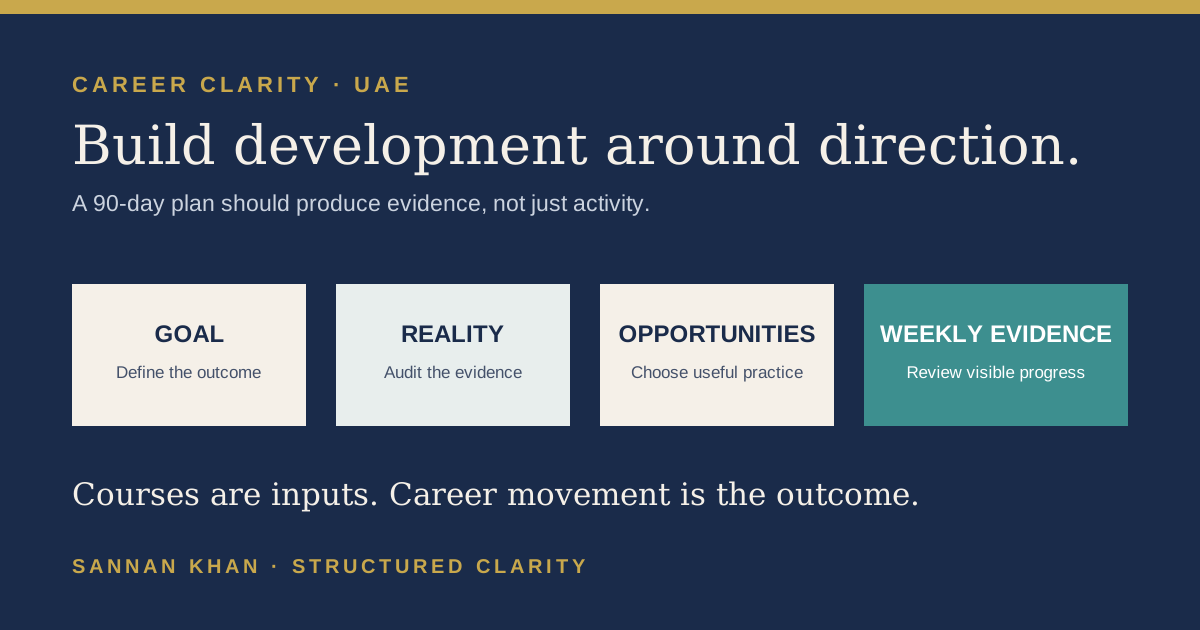
A useful professional development plan defines one career outcome, identifies the capability and evidence gaps blocking it, creates opportunities to practise in real work, and reviews visible progress every week. For UAE professionals, a 90-day plan is long enough to build evidence but short enough to remain connected to changing roles, projects, and priorities.
Many development plans begin with a list: complete a certificate, improve communication, learn artificial intelligence, attend a workshop, update a CV. These may be useful activities, but a list of activities is not yet a direction.
The sharper question is: What should become possible because you developed? Perhaps you need to lead a larger project, move into a new function, become credible for promotion, contribute at a more strategic level, or decide whether your current path still fits. Once that outcome is clear, learning can be selected for a reason.
This distinction matters in Dubai, Abu Dhabi, Sharjah, and across the UAE, where professionals may work in fast-moving, multinational environments while comparing internal growth, a new employer, a career change, or a move into leadership. A broad plan can create motion without movement. A focused plan connects each development action to evidence the workplace can actually see.
What Is a Professional Development Plan?
A professional development plan is a structured agreement with yourself, and sometimes with a manager or mentor, about the career outcome you want to move toward, the gap that currently matters, the practice required, the evidence you will produce, and the dates on which progress will be reviewed.
It should answer six practical questions:
- What professional outcome am I trying to create?
- What evidence shows where I am now?
- Which capability gap most limits the next move?
- Where will I practise that capability?
- What visible evidence will show improvement?
- When will I review and adjust the plan?
A good plan can fit on one page. Its value comes from the quality of its decisions, not its length.
Why Generic Development Plans Fail
Generic plans usually fail for one of four reasons.
- No destination: development is disconnected from a role, responsibility, contribution, or decision.
- Too many gaps: the person tries to improve everything at once and builds depth in nothing.
- Learning without practice: courses are completed, but the capability is never tested in real work.
- No evidence: improvement remains a private feeling rather than a result, work sample, decision, or stronger responsibility.
Another failure is copying somebody else's plan. A leadership course may be useful for a colleague preparing to manage a team but irrelevant to someone who needs technical depth, stronger stakeholder communication, or clarity about whether they want management at all.
Development should solve the next real constraint. Otherwise, it becomes respectable procrastination.
The GROW Professional Development Framework
Use GROW to build the plan: Goal, Reality, Opportunities, and Weekly evidence. The framework moves from direction to proof.
G: Define One Career Goal
Choose an outcome that is specific enough to guide the next 90 days. "Grow professionally" is too broad. Better outcomes include:
- Become ready to lead a client project with less supervision.
- Build enough evidence to apply for a data-analysis role.
- Improve executive communication before taking on regional stakeholders.
- Test whether people management fits before pursuing a formal leadership role.
- Prepare a credible internal case for expanded responsibility.
The goal does not need to guarantee a promotion or job offer. Those decisions involve other people. It should define the readiness, contribution, or evidence you can responsibly build.
If you cannot name the goal because several directions still compete, work on career clarity before selecting development activities. The existing guide on career planning with direction helps define a realistic path without pretending you can predict your entire future.
R: Audit Your Current Reality
Replace vague self-judgment with evidence. Review recent projects, feedback, responsibilities, work samples, outcomes, and recurring difficulties.
Ask:
- What am I already trusted to do?
- Where do I still need close support?
- What feedback has repeated across managers, clients, or projects?
- Which results can I demonstrate rather than merely claim?
- What responsibility would the next role require that I have not yet practised?
Separate four types of gap:
- Capability gap: you cannot yet perform an important task reliably.
- Evidence gap: you may have the skill, but little visible proof.
- Exposure gap: you have not had access to the projects, people, or context required to demonstrate it.
- Direction gap: you are developing, but not toward an outcome you actually want.
These gaps require different responses. Another course may help a capability gap. It cannot automatically solve limited exposure, weak visibility, or an unclear direction.
O: Design Opportunities to Practise
Choose one primary capability for the 90-day cycle, then create a place to use it. Practice may include leading a meeting, improving a recurring report, owning a small project, presenting a recommendation, shadowing a colleague, producing a portfolio example, or solving a real operating problem.
Courses and certifications belong here only when they support the practice. Before enrolling, ask:
- Which verified gap does this learning close?
- Where will I apply it within the next month?
- What evidence will exist after I apply it?
- Does the target role or employer value this credential?
If those answers are unclear, delay the purchase. The certificate may be interesting without being strategically useful.
The UAE government's UAE Skills platform connects skills development with career opportunities and next steps. The broader principle is useful even outside that platform: development becomes meaningful when learning connects to work and progression.
W: Produce Weekly Evidence
Evidence turns private improvement into professional credibility. Depending on the goal, evidence may be:
- A completed analysis or work sample.
- A project delivered with clearer ownership.
- Feedback showing stronger communication or judgment.
- A measurable improvement in time, quality, revenue, risk, or client response.
- A documented recommendation that influenced a decision.
- A reflection showing what changed after practice.
At the end of each week, record what you attempted, what happened, what you learned, and what the next repetition should change. This prevents the plan from disappearing beneath daily work.
Courses are inputs. Practice creates capability. Evidence makes the capability visible.
A Practical 90-Day Professional Development Plan
Divide the cycle into three stages. Each stage has a different purpose.
Days 1-30: Direction and Baseline
- Define the professional outcome.
- Collect feedback and current evidence.
- Identify one primary capability or evidence gap.
- Agree on a practice opportunity where appropriate.
- Record the current baseline.
The output is a one-page plan, not a large learning schedule.
Days 31-60: Practice and Feedback
- Apply the capability in real work at least once each week.
- Request specific feedback about the chosen capability.
- Capture work samples, outcomes, and lessons.
- Adjust the practice when evidence shows a problem.
Ask for feedback that can guide behaviour. "How did I do?" is difficult to answer. "Was the recommendation clear, and what information would have made the decision easier?" is more useful.
Days 61-90: Demonstrate and Decide
- Complete one visible piece of evidence or larger responsibility.
- Compare the result with the original baseline.
- Summarize the value created and the capability demonstrated.
- Decide whether to deepen, broaden, or change direction.
The final decision may be to pursue a larger responsibility, continue another 90-day cycle, apply externally, or admit that development inside the current path will not resolve the deeper mismatch.
Professional Development Plan Template
Use this structure:
- 90-day outcome: What should become possible?
- Current evidence: What proves the starting point?
- Primary gap: Capability, evidence, exposure, or direction?
- Practice: Where will the capability be used?
- Support: Who or what will provide guidance or access?
- Weekly evidence: What will show movement?
- Review dates: Day 30, day 60, and day 90.
- Decision rule: What evidence will justify continuing, changing, or stopping?
Keep the plan visible and review it during the week. A development plan stored in a folder and opened after three months is only a record of intention.
How to Discuss the Plan With Your Manager
Where the workplace permits, frame the conversation around contribution rather than entitlement. Explain the outcome you want to prepare for, the capability you are developing, the practice opportunity you need, and how the work could support team priorities.
A clear request might be: "I want to become more reliable in client-facing analysis. Over the next 90 days, I would like to own the first draft of the monthly recommendation, review it with you, and track which changes improve clarity and decision speed. Would that be useful, and what standard should I meet?"
This creates something a manager can evaluate. It is stronger than asking vaguely for more development.
For federal-government contexts, the UAE's training and development system explicitly connects learning goals, job performance, and organizational priorities. Private organizations use different processes, but aligning personal growth with useful contribution remains a sound planning principle.
When Development Is Not the Real Problem
A professional development plan is useful when you want the direction but lack capability, evidence, or exposure. It is less useful when the real problem is chronic overload, a harmful environment, values conflict, an unsuitable role, or a future you no longer want.
Watch for these signs:
- You keep adding qualifications because you are afraid to make a career decision.
- Your development goals change every time a new trend appears.
- You are improving at work you do not want to continue doing.
- No amount of learning changes the structural conditions causing burnout.
- You can describe many courses but not the contribution you want to make.
If that is the pattern, compare whether you need to change jobs or change careers in the UAE. Development should strengthen a direction, not help you remain indefinitely inside an unexamined one.
What Progress Should Look Like After 90 Days
A useful cycle should leave you with more than completed learning. You should have clearer evidence about at least one of these:
- You can perform an important task more reliably.
- You can explain your value with stronger examples.
- You have tested a responsibility before making a larger move.
- You understand which gap should receive the next cycle.
- You have learned that the current direction does not fit.
That final outcome is not failure. A development plan should improve decision quality as well as capability. Sometimes the most valuable evidence is proof that another path deserves serious consideration.
What is a professional development plan?
A professional development plan connects a defined career outcome to the capability gaps, practice, evidence, support, and review required to move toward it.
How do I create a professional development plan?
Define one career outcome, audit your current evidence, choose one important capability gap, design work-based practice, set weekly evidence, and review the plan after 30, 60, and 90 days.
How long should a professional development plan be?
The written plan can fit on one page. It should be detailed enough to define the outcome, capability, practice, evidence, support, and review dates without becoming another project to manage.
Should a professional development plan include courses and certifications?
Only when they close a verified capability or credibility gap. A course is an input; the plan should also show where the learning will be practised and what evidence will demonstrate improvement.
Can professional development fix career dissatisfaction?
Not always. Development helps when the direction fits but capability, evidence, or exposure is missing. If the role, environment, values, or desired future is misaligned, the deeper question may be career direction.
Build development around the right direction
Use the free Career Direction Map to identify the clarity, confidence, focus, pressure, and role-fit patterns shaping your next move. For a private online session, choose a UAE-friendly time.
Disclaimer: This article provides educational career-reflection and professional-development frameworks. It is not employment, legal, immigration, financial, medical, mental-health, or human-resources advice. Follow current workplace policies and consult official sources or appropriately qualified professionals where needed.